
1. References 2. Articles 3. BLOG
AVRAM Aerospace

1. References
Operational Reliability Regulations
CFR 14, 21.3, Reporting Failures, Malfunctions, and Defects
CFR 14, 21.4, ETOPS Reporting Requirements
EASA Reliability Program Guidance, Appendix I to AMC M.A.302 and AMC M.B.301 (b)
EASA Opinion N 03/2023 (VTOL / UAS) – Part 2.3.1. Initial airworthiness, 2. 3. 1. 9. Airworthiness Directives (ADs)
FAA, AC25.1309 SYSTEM DESIGN AND ANALYSIS
FAA, AC120-1, Standard Operation Specifications- Aircraft Maintenance Handbook
FAA, AC120-16, Air Carrier Maintenance Programs
FAA AC 120-17, Reliability Program Methods—Standards for Determining Time Limitations
FAA AC 120-42, Extended Operations (ETOPS and Polar Operations)
FAR , Part 21, CERTIFICATION PROCEDURES FOR PRODUCTS AND ARTICLES
Order 8110.54 Instructions for Continued Airworthiness Responsibilities, Requirements, and Contents
Order 8300.10, Vol 2, Ch 66, Approve a Reliability Program
Order 8900.1, Vol 3, Ch 40, Approve a Maintenance Reliability Program for Part 121 and Part 135
DRS FAA: Order 8900.1,Vol.6,Ch2,Sec31 Safety Assurance System: Inspect Approved Reliability Program
TCCA AC 605-002, Reliability Methods for Maintenance Schedule Amendment
TCCA Airworthiness Manual Advisory (AMA) 571.101/1
TCCA AC SUR-002 Root Cause Analysis and Corrective Action for TCCA Findings
TCCA Service Difficulty Reports
Other
CAP 718 Human Factors in Aircraft Maintenance and Inspection
CFR 14, Appendix K to Part 25 – Extended Operations (ETOPS)
IATA, Handbook Of Production Planning & Control, Maintenance Philosophies & Concepts
TCCA AC 700-042 Crew Resource Management (CRM)
FAA AC 23.1523 MINIMUM FLIGHT CREW
N. Wirth, Algorithms and Data Structures
D. Maier: The Theory of Relational Databases
AI: Aurélien Géron, Hands-On Machine Learning with Scikit-Learn, Keras, and TensorFlow: Concepts, Tools, and Techniques to Build Intelligent, O’REILLY, 2019
AI: Max Bramer, Principles of Data Mining, Springer, 2016
AI: Scott E. Page, The Model Thinker: What You Need to Know to Make Data Work for You, HB Group, 2018

2. Articles
1. Aircraft Operational Reliability – Definition
2. Aircraft Operational Reliability – Why Do We Need RP?
3. The Snowstorm, the Aircraft, and the Mechanic
4. Maintainability or Engines In the Tail
5. Friday Thoughts: Engine Failure Combinatorics – Taxi or Not – Taxi
6. Aircraft Operational Reliability – Formula-Contributors Table and Severity Index
7. Aircraft Operational Reliability – AMP Interval Calculation Example (Z-score, T-score)
8. Aircraft Operational Reliability – Planning Task Comparison: Exponential vs Erlang
9. Aircraft Operational Reliability – Mean, Variance, Standard Deviation, and Empirical Rule
10. MTBUR, MTBF, etc.
11. Lagrange or Not Lagrange
12. Aircraft Operational Reliability – Conditional Probability, Operation Risk Management
13. AI In Aircraft Maintenance Planning
14. Philosophy: Aircraft as a Product of Creativity
15. Leadership – Hire or not to hire
16. Buying Aircraft? Ask About Aircraft Reliability Characteristics!
17. Aircraft Reliability Improvement Elements And Phases
18. Aircraft Operational Reliability Road Map Structure
19. Aircraft Operational Reliability Road Map Structure. 01 ME Organization
20. Aircraft Operational Reliability Road Map Structure. 02 Reliability Review Board
21. Aircraft Operational Reliability Road Map Structure. 03 Data Collection
22. Aircraft Operational Reliability Road Map Structure. 04 Performance Standards
23. Aircraft Operational Reliability Road Map Structure. 05 Mtx Data Display And Reporting
24. Aircraft Operational Reliability Road Map Structure. 06 Mtx Data Analysis
25. Aircraft Operational Reliability Road Map Structure. 07 Corrective Actions
26. Aircraft Operational Reliability Road Map Structure. 08 Follow-Up
27. Aircraft Operational Reliability Road Map Structure. 09 RP Revision Control
28. Aircraft Operational Reliability Road Map Structure. 10 RP Administration
29. Aircraft Operational Reliability Road Map Structure. 11 Reliability Program Audit

29. Aircraft Operational Reliability Road Map Structure. 11 Reliability Program Audit
My Dear Friends,
Now let’s quickly describe Reliability Program Audit elements.
In general, AAA-Airlines QC/QA Department conducts Reliability Program/System Audit, and it includes the following elements:
– Data Security
– Data Quality
– Data Collection
– Data Processing
– Data Reporting
– Data Display
– Data Performance
– RRB Meeting
– RP Administration
– RP Rev Control
– RP Distribution
– RP Notification System
– Special Attention List Process
– Corrective Action Program
– Follow-Up
– Etc.
This is a short list of the Reliability Program Audit elements.
The Reliability Program Audit must be developed for each phase that is described in the previous article (from aircraft on paper to EIS) to support aircraft reliability improvement process and safety.
PS If you are an aviation start-up, please contact me and I will build for you the world’s best aircraft reliability road map. Only a proper and a comprehensive reliability system can tell you what is happening with your aircraft!
Sincerely,
Ramaz
26-Sep-2024
28. Aircraft Operational Reliability Road Map Structure. 10 RP Administration
My Dear Friends,
Now let’s quickly describe Reliability Program Administration elements.
In general, Reliability Program Administration is based on an Airline MCM, MPM, MOE, and RP Procedure Manual, and it includes the following elements:
– Reliability Program
– R&R
– Data Collection
– Data Processing
– Performance Standards
– Data Analysis
– Data Display and Reporting
– Corrective Actions
– Follow-Up
– RP Revision Control
– RP Audit
– Etc.
This is a short list of the Reliability Program Administration elements.
The Reliability Program Administration must be developed for each phase that is described in the previous article (from aircraft on paper to EIS) to support aircraft reliability improvement process and safety.
PS If you are an aviation start-up, please contact me and I will build for you the world’s best aircraft reliability road map. Only a proper and a comprehensive reliability system can tell you what is happening with your aircraft!
Sincerely,
Ramaz
19-Sep-2024
27. Aircraft Operational Reliability Road Map Structure. 09 RP Revision Control
My Dear Friends,
Now let’s quickly describe Reliability Program Revision Control elements.
Reliability Program revision approval is required from RRB and Aviation Authorities, for the following changes:
– Definitions
– Aircraft Type
– Data Collection Process
– Performance Standards
– Alert Level Notification & Process
– Data Analysis
– Corrective Action P&P
– Mtx Organization Structure
– Alert Level Math Calculations
– Reliability System QC/QA
– Etc.
This is a short list of the Reliability Program Revision Control elements.
The Reliability Program Revision Control must be developed for each phase that is described in the previous article (from aircraft on paper to EIS) to support aircraft reliability improvement process and safety.
PS If you are an aviation start-up, please contact me and I will build for you the world’s best aircraft reliability road map. Only a proper and a comprehensive reliability system can tell you what is happening with your aircraft!
Sincerely,
Ramaz
12-Sep-2024
26. Aircraft Operational Reliability Road Map Structure. 08 Follow-Up
My Dear Friends,
Now let’s quickly describe Reliability Program Follow-Up elements.
After Airline RRB approved Corrective Action (CA), and appropriate department developed CA implementation plan, and CA was implemented, etc. The Reliability Department keeps the updated RRB Alert Level Notification Form (ALNF).
ALNF includes the following elements :
– Alert Notification Number
– Alert Notification Title
– Date
– Aircraft Model
– PIREP
– MAREP
– Delay
– Cancellation
– ATA Chapter
– ATA Description
– Reference N
– Reporting Date
– Rate
– Historical Rate
– Alert Level
– Status (Open, Closed)
– PR Description
– Impact on Operation
– LRU Removal
– CA Date Presented to RRB
– CA Description
– CA Program
– CA Accepted/Rejected by RRB
– CA Assigned to Department
– CA Assigned to Person
– CA Implementation Date
– CA Actual Implementation Date
– Comment
– Etc.
This is a short list of the RRB Follow-Up elements.
The RRB Follow-Up elements/requirements must be developed for each phase that is described in the previous article (from aircraft on paper to EIS) to support aircraft reliability improvement process and safety.
PS If you are an aviation start-up, please contact me and I will build for you the world’s best aircraft reliability road map. Only a proper and a comprehensive reliability system can tell you what is happening with your aircraft!
Sincerely,
Ramaz
05-Sep-2024
25. Aircraft Operational Reliability Road Map Structure. 07 Corrective Actions
My Dear Friends,
Now let’s quickly describe Corrective Actions (CA) elements.
In general, the goal of the Corrective Actions are to isolate the main contributors responsible for safety, exceeding alert levels (AL), and holding aircraft reliability and economics performances under target levels.
Almost all CA are initiated by RRB through Alert Level System (Notification).
CA are based on analysis and may include but not limited to the following actions/elements/updates:
– AMP Optimization
– Add task to AMP
– Reduce AMP task interval
– Operational Procedures
– Maintenance Process and Procedures
– Spare/Parts Provisioning
– Shipping and Storage Procedures
– Documentation
– Technical Procedure Documents and Manuals
– LRU Modification
– Best Mtx Practices
– Training
– Update Troubleshooting Procedures
– Etc.
This is a short list of the Corrective Action elements.
The Corrective Action elements/requirements must be developed for each phase that is described in the previous article (from aircraft on paper to EIS) to support aircraft reliability improvement process and safety.
PS If you are an aviation start-up, please contact me and I will build for you the world’s best aircraft reliability road map. Only a proper and a comprehensive reliability system can tell you what is happening with your aircraft!
Sincerely,
Ramaz
28-Aug-2024
24. Aircraft Operational Reliability Road Map Structure. 06 Mtx Data Analysis
My Dear Friends,
Now let’s quickly describe Airline Reliability Program Data Analysis elements.
In general, the goal of the Airline Reliability Program (Maintenance) Data Analysis is to identify if potential findings have impact on aircraft safety, reliability, and economics.
The Maintenance Data Analysis includes the following activities and elements (analysis):
– Data Sorting
– Safety
– AD/SB
– Reliability
– Airworthiness
– Alert Levels
– Targets
– AMP Optimization
– Chronic System Faults
– Engine IFSD
– SDR
– ECM
– OCM
– Engine Shop Visit
– Rogue Components
– Fleet Performance
– ATA (System) Performance
– LRU Performance
– Etc.
This is a short list of the Airline Reliability Program Maintenance Data Analysis elements.
The Maintenance Data Analysis elements/requirements must be developed for each phase that is described in the previous article (from aircraft on paper to EIS) to support aircraft reliability improvement process and safety.
PS If you are an aviation start-up, please contact me and I will build for you the world’s best aircraft reliability road map. Only a proper and a comprehensive reliability system can tell you what is happening with your aircraft!
Sincerely,
Ramaz
21-Aug-24
23. Aircraft Operational Reliability Road Map Structure. 05 Mtx Data Display And Reporting
My Dear Friends,
Now let’s quickly describe Maintenance Data Display and Reporting elements.
In general, the goal of the Airline Reliability Program Maintenance Data Display and Reporting is to visualize maintenance data and present information in easy-to-read and understand format.
The Maintenance Data Display and Reporting includes the following elements/information:
– Aircraft Section
– Aircraft Status
– Fleet Reliability Summary
– Aircraft Utilization
– PIREP and MAREP
– Delay and Cancellation
– Incident/Accident
– Engine/APU
– LRU Performance/Information
– Special Attention List
– Autoland Reliability
– Fleet Performance
– Alert (Notification) Report
– Etc.
This is a short list of the Maintenance Data Display and Reporting elements.
The Maintenance Data Display and Reporting elements/requirements must be developed for each phase that is described in the previous article (from aircraft on paper to EIS) to support aircraft reliability improvement process and safety.
PS If you are an aviation start-up, please contact me and I will build for you the world’s best aircraft reliability road map. Only a proper and a comprehensive reliability system can tell you what is happening with your aircraft!
Sincerely,
Ramaz
14-Aug-2024
22. Aircraft Operational Reliability Road Map Structure. 04 Performance Standards
My Dear Friends,
Now let’s quickly describe Airline Operational Operational Reliability Performance Standards.
In general Airline Reliability Performance Standards depend on the Reliability Program Type.
However, almost all Reliability Program Types include the following Performance Standards elements:
– Aircraft in Fleet
– Aircraft in Service
– Operating Days
– Engine IFSD
– PIREP & MAREP
– Delays and Cancellations
– Incident and Accident
– Parts Removals
– Autoland Reliability
– Alert Levels
– Targets and Goals
– Rates
– Etc.
This is a short list of the Reliability System Performance Standards elements.
The Performance Standards must be developed for each phase that is described in the previous article (from aircraft on paper to EIS) to support aircraft reliability improvement process and safety.
PS If you are an aviation start-up, please contact me and I will build for you the world’s best aircraft reliability road map. Only a proper and a comprehensive reliability system can tell you what is happening with your aircraft!
Sincerely,
Ramaz
31-Jul-2024
21. Aircraft Operational Reliability Road Map Structure. 03 Data Collection
My Dear Friends,
Now let’s quickly describe Airline Operational Data Collection elements:
– Airplane and Engine make, model, and serial number
– Aircraft FH and FC (Total & Monthly)
– PIREP & MAREP
– Delays and Cancellations
– GGI, GTB, RTO, ATB, DIV, AAP, GAI
– Parts Installation/Removal Information
– Shop Reports
– OOS
– Engine position
– Engine FH and FC (Total or Monthly)
– Engine (MSN) with highest FH and FC
– Engine IFSD (both ground and in-flight)
– Engine control problem
– Engine flameouts
– Engine configuration, and major alteration history
– Circumstances leading up to the engine shutdown or occurrence
– Phase of flight or ground operation
– Weather and other environmental conditions
– Cause of engine shutdown or occurrence
– Engine Unscheduled removals
– Engine Unscheduled shop visits
– Delay and Cancellation due to Engine PR (including HF, etc)
– GGI, GTB, RTO, ATB, DIV, AAP, GAI due to Engine PR (including HF, etc)
– Etc.
This is a short list of the Reliability System Data Collection elements.
The Data Collection structure must be developed for each phase that is described in the previous article (from aircraft on paper to EIS) to support aircraft reliability improvement process and safety.
PS If you are an aviation start-up, please contact me and I will build for you the world’s best aircraft reliability road map. Only a proper and a comprehensive reliability system can tell you what is happening with your aircraft!
Sincerely,
Ramaz
24-Jul-2024
20. Aircraft Operational Reliability Road Map Structure. 02 Reliability Review Board
My Dear Friends,
Suppose our airline road map document is approved by an aviation authorities, and next step, based on the reliability document (road map), the VP of ME needs to form a Reliability Review Board (RRB). The Board will govern an airline reliability system. In this article we shortly describe – (1) RRB Responsibility, (2) RRB Permanent Members, (3) RRB Meeting subjects.
1. The RRB Responsibility:
– Develop, approve, and manage the reliability program
– Seek Aviation Authority (Program) approval
– Conduct RRB monthly meetings
– Review previous month reliability report
– Review the list of the Alert Items
– Review and approve Alert Notifications
– Issue Alert Notification
– Assign Alert Notification item to the appropriate department
– Monitor status of the assigned alert items
– Review and approve corrective actions
– Review and approve corrective action program
– Review follow-up
– Identify candidates for the Special Attention List (SAL)
– Review SAL items (add, remove from the list)
– Review SAL for corrective action items
– Review Alert Notification report
– Reliability program Distribution List
– Program administration
– Program revision, etc.
RRB Chair is QA/QC Manager, Reliability Engineer is the administrator.
2. The RRB Permanent Members:
1. QA/QC
2. Reliability
3. Engineering
4. Tech Support
5. MOCC
6. AA, etc.
3. The RRB Meeting Subjects:
– Reliability Report
– Fleet Performance
– Data Analysis
– Performance Standards
– Alert Notifications
– Corrective Actions
– Corrective action program
– Special Attention List
– Follow-up
– Spare Provisioning
– Aircraft Economics
– Closing Actions (for all Open Alert Notifications)
– Data Quality and Safety
– Reliability Program Administration and Revision, etc.
RRB memebers are representing their departments. Each memeber of the RRB has their responsibilities.
This is a short list of the RRB Responsibility, RRB Memebers, and RRB Meeting subjects.
The RRB (sometimes companies title it in different names but meaning is the same) structure must be developed for each phase that is described in the previous article (from an aircraft paper to EIS) to support an aircraft reliability improvement process and safety.
PS If you are an aviation start-up, please contact me and I will build for you the world’s best aircraft reliability road map. Only a proper and a comprehensive reliability system can tell you what is happening with your aircraft!
Sincerely,
Ramaz
17-Jul-2024
19. Aircraft Operational Reliability Road Map Structure. 01 ME Organization
My Dear Friends,
In the last article we described quickly the major elements and phases of the airline reliability road map document.
In this article we will identify an airline maintenance and engineering organization structure and elements that are responsible for the In-Service Reliability System (ISRS).
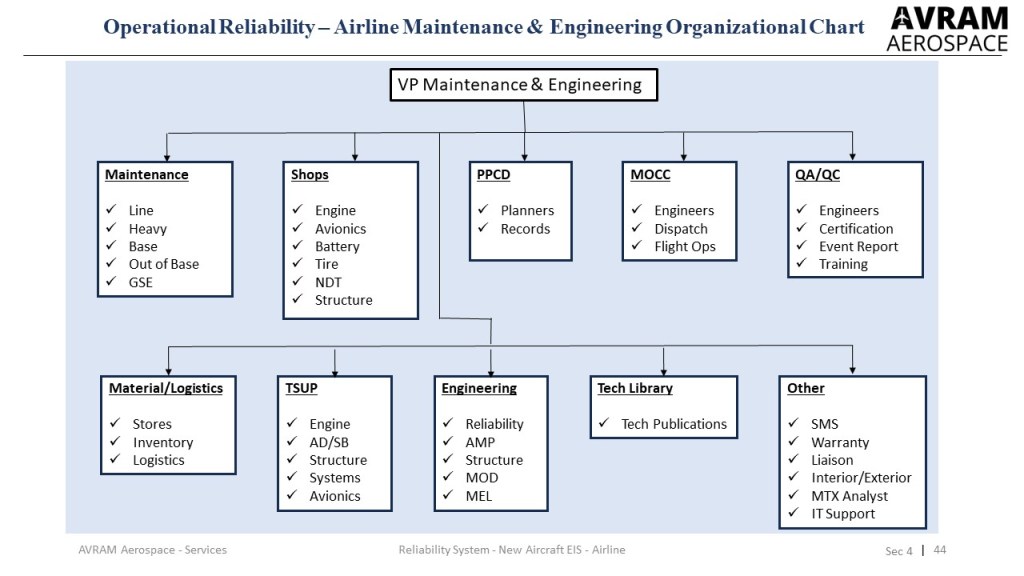
Let’s shortly describe major elements of the ME Organization. Below you can see a general ME Organization Chart.
1. Vice President of Maintenance & Engineering
Vice President of Maintenance & Engineering controls In-Service Reliability System.
2. Maintenance
Oversees the Line Maintenance, Hangar Maintenance, etc.
3. Shops
Responsible for the removed aircraft parts overhaul.
4. PPCD
Production Planning and Control Department is responsible for the aircraft maintenance forecasting, planning, and control.
5. MOCC
Maintenance Operation Control Center coordinates the aircraft line maintenance activity.
6. QA/QC
QA/QC – (a) conducts an audit of the Maintenance and Engineering Organization, and (b) controls how maintenance works, and other maintenance and engineering activities are conducted.
7. Material and Logistics
Material and Logistics is responsible for all aircraft parts movement (inventory control, stocking, etc.).
8. TSUP
Technical Support provides technical and inspection/instruction supports (Issues EO, Instructions, etc.).
9. Engineering
Engineering is responsible for Maintenance Program, Reliability Program, etc.
10. Tech Library
Provides ME with all technical documents that are necessary to keep aircraft an airworthy.
11. Other
Other includes – SMS, IT, Interior, etc.
This is the short list of the Maintenance and Engineering organization structure elements that support the aircraft In-Service Reliability.
The same type of organization structure must be developed for each phase that is described in the previous article (from paper to EIS) to support an aircraft reliability improvement process and safety.
PS If you are an aviation start-up, please contact me and I will build for you the world’s best aircraft reliability road map. Only a proper and a comprehensive reliability system can tell you what is happening with your aircraft!
Sincerely,
Ramaz
10-Jul-2024
18. Aircraft Operational Reliability Road Map Structure
My Dear Friends,
In the last article we described quickly the major elements and phases of the aircraft reliability improvement program.
As we mentioned, each phase has its own reliability improvement process or reliability road map.
In this article I am going to address the operational reliability phase (EIS) and show you the Reliability Development Document Technical Procedure or shortly the “Operational Reliability Road Map” document.
The document contains almost 100+ pages, and for this reason I am going to describe the major subjects, not going into too much details. However, if you are an aerospace/airline start-up it will give you an idea how to structure your reliability system.
1. Revision Summary
This section describes the document’s revision control.
2. General
This section describes the document’s purpose, definitions, document administration, etc.
3. Reliability Program Description
This section describes an airline ME’s roles and responsibilities, reliability system, process, etc.
4. Data Collection
This section is about the data collection system, types, etc.
5. Performance Standard
This section describes the performance standards.
6. Data Display and Reporting
This section describes the data display and reporting subjects, means and procedures.
7. Data Analysis
This section describes the data analysis processes, etc.
8. Corrective Actions
This section describes the corrective action subjects, etc.
9. Follow-Up
This section describes the follow-up process, etc.
10. Reliability Program Revision Control
This section describes the reliability program revision control, administration, audit, etc.
11. Engineering Judgment and Training
This section describes the methods how to make decisions to do the aircraft reliability assessment.
12. Reliability Program Template
This section describes the reliability program templates.
13. Etc.
This is the short version of the Operational Reliability Development Technical Procedure / Document or the reliability road map, and this document is part of the aircraft reliability improvement system.
The same types of documents must be developed for each phase that is described in the previous article (from paper to EIS).
PS If you are an aviation start-up, please contact me and I will build for you the world’s best aircraft reliability road map. Only a proper and a comprehensive reliability system can tell you what is happening with your aircraft!
Sincerely,
Ramaz
03-Jul-2024
17. Aircraft Reliability Improvement Elements And Phases
My Dear Friends,
In the last article we mentioned that the reliability improvement is a non-stop process and starts from the Aeronautical Equipment TRD. In this article, I would like to describe, quickly, the major elements and phases of the aircraft reliability improvement program.
1. Purpose:
The purpose of the reliability improvement program is to continuously monitor the product reliability.
Why? The answer is simple:
– First, definitely, it is – SAFETY! and
– Second, the poor reliability means – there is a high demand of the Components/Parts/LRU.
2. Aircraft Reliability Improvement Program Elements:
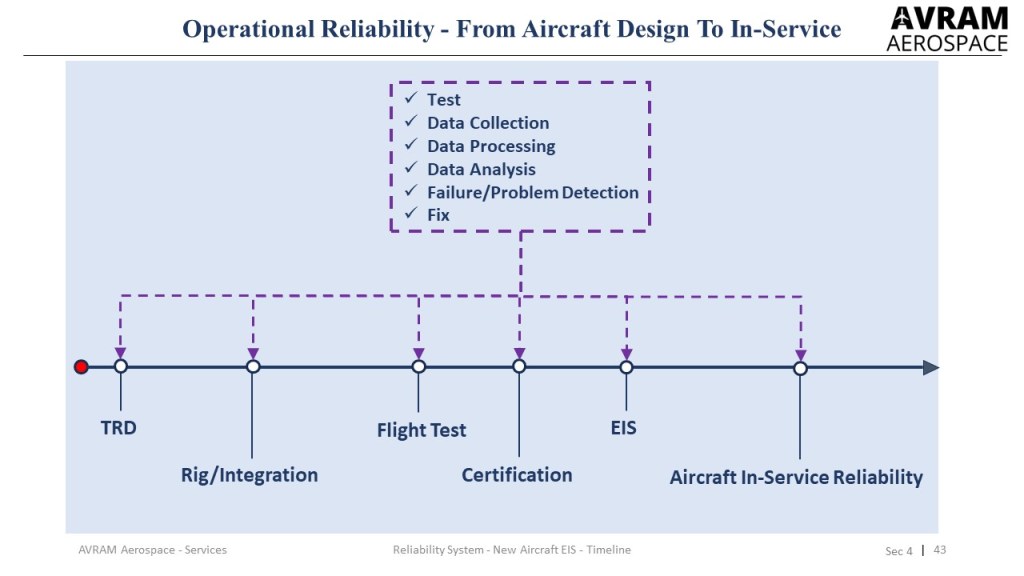
The aeronautical equipment reliability improvement has six major elements:
– Test
– Data Collection
– Data Processing
– Data Analysis
– Failure/Problem Detection
– Fix.
3. Aircraft Reliability Phases:
– Aeronautical Equipment Design
– Parts /LRU/System Assemble and Test
– System Integration and Test
– Aircraft Assemble/Manufacturing and Test
– Aircraft Certification
– Aircraft EIS
– Aircraft Operation.
These are the seven major phases or check points where we need to asses our aircraft reliability.
On each phase we need to build the reliability assessment document, where we clarify the goal of the program and product reliability improvement processes described in 2.
Only comprehensive reliability program can tell us how our aeronautical equipment behaves on each phase, and whether or not we are aligned with the TRD requirements.
Figure below illustrates the timeline – Operational Reliability – From Aircraft Design To In-Service
Sincerely,
Ramaz
PS If you are an aviation start-up, contact me and I will build for you the world’s best aircraft reliability road map. Only a proper and a comprehensive reliability system can tell you what is happening with your aircraft!
27-Jun-2024
16. Buying Aircraft? Ask About Aircraft Reliability Characteristics!
My Dear Friends,
If you decide to buy an aircraft or invest in aviation business, you need to read this article, as I am going to give you a short list of the aircraft reliability characteristics that need to be clarified and will help you make a proper decision.
I have been 25 Years in the aviation business, and I heard many stories from the aircraft buyers, from “…an aircraft caught fire, just before signing sell-buying documents… ” to “I have to invest in this aircraft more than paid to buy it ”…
Long story short…
1. Availability Rate
We are buying an aircraft to fly and not for AOG (Aircraft On The Ground).
This Rate measures your aircraft availability. If your aircraft is not available (due to technical reason, part failed, etc.) you cannot fly. There are no unique standards how to calculate the Rate, but
Poor Availability is 0%, and Excellent – 100%.
2. Dispatch Reliability (DR)
This DR Rate describes how reliable is scheduled dispatch. In general, it includes delays (> 15 minutes) and cancellations, due to technical reasons.
Poor DR is 0%, and Excellent – 100%.
3. Engine IFSD Rate
Engine is an important part of the aircraft, no engine – no fly. The Rate describes engine “behavior” during flight. The metric usually is calculated – Engine IFSD Number/Rate per Departures/EFC/EFH (100, 1000). It is clear that the 0 (Zero) Engine IFSD Rate is an Excellent characteristic.
4. Incidents (GTB, RTO, ATB, DIV, AAP, etc.) Rates
Ground Turback, Rejected Take-Off, Air TurnBack, Diversion, Aborted Approach, etc. due to Technical reasons. This data helps us measure aircraft incident rates. These are similar as 3 (Engine IFSD).
5. Severity Index
The Severity Index includes 2,3,4 and more (described in my book – “Aircraft Operational Reliability In Formulas Quick Reference Handbook”).
6. PIREP/MAREP Rates
Pilot Report (PIREP) and Maintenance Report (MAREP).
These two items serve as primary sources of the aircraft performance. In general, a standardization unit of these rates depend on the PIREP/MAREP Numbers, Flight Hours or Flight Cycles. The measurement units usually are Numbers and Rates per 100 FH/FC, 1000 FH/FC, etc. Zero PIREP and MAREP Numbers/Rates are showing that the aircraft performance is – Excellent.
7. Unscheduled Removal Rate (URR)
It is all about Parts Removals, Unscheduled. When URR = 0, it means we have – an Excellent product.
8. Total Removal Rate (TRR)
It is all about Parts Removals, Total (Scheduled, Unscheduled, Other). When TRR = 0, it means we have – an Excellent product.
9. Initial Provisioning
Answers question – how many parts do we need, let’s say, during first 3-5 Years of operation per FH/FC and Availability.
10. Labor-Hours
It is all about planning, and answers questions about number of the technicians we need to keep an aircraft airworthy and flying.
11. What is the $ per FH/FC?
How much is it going to cost to keep the aircraft to fly per FH or FC.
ATTENTION: There are always direct and hidden costs. Always clarify the answer, by asking, “Are there any hidden costs?”.
Note: In aviation we calculate costs per Flight Hours or Flight Cycles not per Milage!
12. Relevant or serialized parts list
If you decide to buy an aircraft and all of the above items were clear, ask about relevant or serialized parts lists with MTBUR Numbers.
When you sign a contract, you will know how many parts/LRU you need for the next 20 Years.
In addition, if you sign a contract, you need to build a Chargeable Parts List, but this is different story…
13. Etc.
Listed above is a summary of (aircraft reliability) questions that need to be clarified before buying any aircraft or investing in an aviation business.
The aircraft reliability system and reliability improvement are non-stop processes and start from the aircraft design, when the aircraft is on paper, and goes to testing, certification, EIS, etc.
Moreover, some of the described reliability characteristics are part of the TRD and aeronautical product manufacturing contracts.
ATTENTION: If above-described reliability information is not available, my recommendation would be to think twice before buying an aircraft business.
Happy Aircraft Shopping!
Sincerely,
Ramaz
PS If you are a start-up, contact me and I will build for you the world’s best aircraft reliability road map.
Only a proper and a comprehensive reliability system can tell you what is happening with your aircraft!
19-Jun-2024
15. Leadership – Hire or not to hire
My Dear Friends,
During lockdown I spent time understanding leader-employee psychology. I read books, watched YouTube videos, etc …..
Some thoughts that I would like to share with you:
I learned that one of the most difficult tasks is to hire the right person for the right place/position… Long story short, at the top of the hiring process is the interview, as a result, during the interview we need to clarify the following information, about the candidate:
1. Current Position
2. Current Roles and Responsibilities
3. Motivation, seeking new job and applying to our position
4. Goal
There are two major themes that our interview must be based on –
Theme 1: Tell us about yourself, what you are doing “today” as specialist/professional.
Theme 2: Tell us about your professional plan, for the next 3-5 Years.
Now, the question becomes how do we ensure we hire the best of the best.
In order to hire best of the best, we need to have an understanding of the candidate’s following “characteristics”:
– Ability to do the job
– Morale
– Trustworthy
– Honesty (Dishonest Gain)
To meet the highest standard/score of above characteristics, and hire the best of the best, I tried to put some items / “filters”, that we need to “assess” before and during the interview. I would like to share with you these “filters”:
1. Ability to do the job
2. Discipline
3. Skills
4. Knowledge and Understanding
5. Philosophy and Laws
6. Love (for what you do/ profession)
7. Product
8. Success
9. Joy & Happiness
10. Reward
As mentioned, a preliminary assessment must be done before the interview (based on the resume), second assessment – during the interview, third – based on performance, in 6-12 months, doing real job.
This is very short , and I think it is clear that each subject has its own sub-subjects and descriptions.
Sincerely,
Ramaz
12-Jun-2024
14. Philosophy: Aircraft as a Product of Creativity
My Dear Friends,
In this article I am going to reflect on creativity in avaition, I wondered about this when I asked myself the question – “Why is aviation stuck, why do we have a crisis?”
To answer this question I turned to the philosophers (names are below).
Here are some thoughts that I would like to share with you, very shortly:
Philosophers state that for any kind of (technological) creation or invention we need at minimum the following elements: 1. Thinking, 2. Education, 3. Inventor/Creator, 4. Product.
Let’s start from thinking.
1. Thinking
For the Technical Progression (TP) we need two types of thinking – Algorithmical and Creative.
Algo-thinking – inventions are happening within an already built model, and its known rules. However, within Algo-thinking the Scientific and Technical Progresses are limited. I would compare Algo – thinking with a tree, where we have only one root, trunk, and multiple branches etc., and the tree has a limit. Algo-thinking is the basis for economy.
Creative thinking is very unique and individualistic, no model required, no limit, and it is the place where Algo-thinking starts its root…
Only Creative thinking can invent a great and wonderful product.
2. Education
The two types of thinking are based on education. Not just general education, but education in a particular area – aviation, medicine, etc.
Without education no algo-thinking or creative thinking exists, as a result no invention and no creation is happening.
As philosophers say, especially, the technical invention – depends on a degree of education, experience, and the human brain (ability to think, calculate etc.).
3. Inventor or Creator
Philosophy tells us that the one who is good in the algo-thinking has very good logical, analytical, and professional skills, he/she has the ability to see with “the brain.”
Very often we can hear that “He/she is very smart.”
Usually these types of people/engineers are good at product invention, where, there are models (already built), rules, etc. They can add something “new” to the model (“tree”). However, the Algo-thinking is not enough to build something great and wonderful.
If we need to build something great and wonderful we need – a Creator!
We need a person that has exceptional “out of the box” thinking skills.
We need someone who can see not only with “the brain”, but with the soul, I would say the person must have a “Third Eye”. And philosophers are saying that only – a Genius has a “Third Eye.” Genuis properties are that – they don’t care about money, politics, etc. they are solely focused on the product.
4. Product
As philosophers are saying, the Product comes to life twice:
First time, when the creator/inventor creates/ invents it. In general, during the first birth, sometimes, even the creator doesn’t understand why it was created, or it has very limited usage, usually not an economical one. The Product is not a functional “model/example” yet.
Second time, the product has already been created, but it is waiting for a specific time to become “economically” popular. When economics and technologies are in place – we have the second birth of the product.
As philosophers are saying – product is there, and waits for the creator/inventor, it is only matter of time when it becomes “the model/root”.
5. Aviation
I asked the question, who do we need to solve the crisis in aviation – Creator or Inventor?
Either an Inventor, who can do the job within the model and who can see with their brain.
Or, a Creator, who can create something great and wonderful, who can see with their soul, who has a “Third Eye.”
In my opinion,
if we want to create a great and wonderful aeronautical product, definitely, as philosophers are saying, we need – a Genius.
Aviation needs – Genius Engineers and Genius Leaders!
In one word, aviation needs – the Creators!
What do you think?
Sincerely,
Ramaz
Recommended read: I Kant, T.A. Ribot, K. Duncker, V. Petukhov, J. Derrida, M. Haworth
28-May-2024
13. AI In Aircraft Maintenance Planning
My Dear Friends,
There are a lot of discussions about using Artificial Intelligence (AI) tool in aviation, and I would like to share my thoughts about AI in Aircraft Maintenance Planning (MP).
1. What is AI?
First let’s define what is AI. As per EASA, ARTIFICIAL INTELLIGENCE ROADMAP 2.0, Human-centric approach to AI in aviation (May 2023, Version 2.0), AI is –
“technology that can, for a given set of human-defined objectives, generate outputs such as content, predictions, recommendations, or decisions influencing the environments they interact with.”
For purpose of this article, let’s consider that AI is a tool that doesn’t need any human interreference after AI was trained (It is the only difference I see between “complex” AI tool and “simple” MS Excel (Simple? Kh-m! We still need to write Macros, use VBA, Power Query, etc.)).
2. Aircraft Availability – what we are expecting from AI
In aviation all our activates start from Aircraft Availability and end with Aircraft Availability.
(SAFETY is our TOP priority!)
Main contributor in Aircraft Availability, definitely, is – Unscheduled Events (UE).
Let’s see if we can use AI to predict Unscheduled Events and based on this prediction do planning (order parts, materials, tools, etc.).
3. AI Prediction Formula
How AI does the prediction? It is based on a mathematical formula. For example, the simplest one is Linear Regression:
Y = B + A*X
Where:
Y, X – Variable
A, B – Constants
B – describes bias constant (Scheduled Events) parameter
A*X – describes weight (UE) parameter
4. Failure Rate (FR) is Constant
When FR constant: A*X = 0 and B = Constant.
When B (FR) is constant it means that the event is Scheduled type and we don’t need to do any prediction.
5. FR is Non-Constant (UE)
As we mentioned AI is going to be really helpful if it can do accurate prediction of the failure (UE).
It means A*X is variable (not equals to 0) due to UE.
Let’s see how it works:
AMM (Aircraft Maintenance Manual) says that when we replace LRU, we have to check Seal/Packing and based on the condition replace or re-use (install) it.
This is when Seal/Packing failure becomes almost – unpredictable.
Upon Seal/Packing condition:
(a) sometimes we can wash, inspect seal and re-install it 2-3 times,
(b) sometimes just use it once,
(c) sometimes seal reliability is less then LRU reliability, etc.
6. How many parts do we need – can AI predict?
The question is how to predict the number of seals/packing we need for the next 5 YE?
And second question – How accurate this prediction is going to be, from operation perspective?
It is not clear, if when we replace LRU we also have to replace Seal/Packing. In other words, there is no linear dependency (between LRU and its seal replacement).
The seal replacement event is uncertain, nobody can tell us that we need to replace the seal, until mechanic removes LRU and checks the seal condition.
As matter of fact, after inspection mechanic decides to re-use the seal, he/she installs old seal,
but after LRU installation test, mechanic finds out oil leakage, it means he/she needs to install the new seal…
This is a small tip of the iceberg of UE FR.
7. What If
How many parts (Seal/Packing) AI is going to order for the next 5YE?
Is it okay if AI orders 50 Seals/Packings, for the next 5 YE based on provided data / prediction?
– What about UE described in 5 (a,b,c,)?
– What if the seal manufacturer (after 2YE, to improve reliability) decides to re-design the seal (new modification)? We have at least 25 more pre-mod seals in our store (company spent money).
– What if there is Airworthiness Directive (AD)? I know some companies spent millions of dollars to comply with AD.
– What if company decides to change operation model (change aircraft utilization, etc.)
– What if company decides to move from one type of aircraft to another.
– Etc.
All these “What If-s” will require human interference into the AI MTX Planning System.
8. If I had a million dollars
If your company has money definitely you can buy (try) an expensive tool, but you need to check how effective this tool is going to be compared to (let’s say) MS Excel ($400 – In 2020).
9. People – Training
Suppose, you decided to buy this (AI) tool, make sure to ask question – is this tool operator friendly? Do I need to train my people (planners, etc.) or create special group that supports AI tool?
IMPORTANT: Non-Trained (!!!) Tool Operators “mistake” can cause financial (million-dollar) problem.
(I am not mentioning – Aircraft Safety and Availability).
10. AI MTX Planning tool Adequacy, Accuracy, etc.
From the statistical and modeling point of view before using/buying the AI Aircraft Maintenance Planning tool to order parts, materials etc. I would find out:
– AI Model Adequacy (How it describes real life, in our case – planning)
– Numbers: Prediction vs Actual (difference in %) (3-7 YE Time Period)
– Error Accumulation (%, 3-7 YE Time Period)
– AI Model Stat Accuracy (%)
– Stat Confidence Levels (%), etc.
11. Where using AI can have advantage or where I would use AI
Answer is:
In the systems where input and output have linear dependence, based on the formula when bias B = Constant and A*X = 0.
For example, Planning C-Check (It is not a first C-Check (Aircraft type, Check number, etc.). Don’t forget, we have to train AI Tool – this is a given!):
– Selecting type of specialist (Avionics, mechanics, etc.)
– Recommending the number of specialists and grouping
– Assigning tasks to group and individual specialists
– Define working zones (Day 1 – Group1 works in FWD Avionic Compartment, Day 2 – Group1 works in AFT Avionic Compartment, etc.)
– Calculating Operational Maintainability characteristics,
– Inventory (parts) Management (movement), etc.
REMEMBER: All these tools don’t work without trained specialist, and it is true – Garbage-In-Garbage-Out (GIGO)! …
Sincerely,
Ramaz
12. Aircraft Operational Reliability – Conditional Probability, Operation Risk Management
Flight Operation Risk Management is not an easy task, from an Operational Reliability prospective there are different indicators that describe technical interruptions (Delay, Cancellation, etc.) that have an impact on the flight operation (for example, Severity Index (TCCA AC 571.101/1), etc.). This article describes simplified, quantitative flight operation interruption risk assessment basis by using Conditional Probability (Reference: Ventsel E. S., Probability Theories. 1998, 576 pages).
Suppose Table 1 describes XYZ Airlines numbers of Delay, Cancellation, AOG, and On-Time events per station (airport), for a given time period (GTP). Calculate the probability that XYZ Airlines aircraft is at ABC airport and flight delay occurs from ABC airport (assuming, no fleet and operational environment changes occurred).

The Conditional Probability function describes probability of event “A” if event “B” happened:

Where: “B” – XYZ Airlines aircraft is at ABC airport, and “A” – flight delay occurs from ABC airport.
First, calculate probability that XYZ Airlines aircraft is at ABC airport:

Second, calculate probability of XYZ Airlines flight delay from ABC airport:

Finally, calculate the probability that XYZ Airlines aircraft is at ABC airport and flight delay occurs from ABC airport:

The probability that XYZ Airlines aircraft is at ABC Airport and flight delay occurs from ABC airport is 26%. It is important to mention that this statement (number) is true if there are no changes in XYZ Airlines operation, maintenance, etc, during following time period.
This calculation can be used as a basis as part of the Flight Operation Risk Assessment, for example: balancing benefits and costs (not discussed in this article).
Sincerely,
Ramaz
11. Lagrange or Not Lagrange
My Dear Friends,
Using simple example:
Suppose we have Combustion Chamber and Temperature must be 100 +/- 5 Degrees Celsius (C) . If temperature is less than 95 C, it must be replaced.
Let’s say, we measure temperature every 200 Flight Hours (FH).
Here is the result:
X(t0 = 0) = 100 C
X(t1 = 200) = 97 C
X(t2 = 400) = 98 C
X(t3 = 600) = 96 C
X(t4 = 800) = ?
X(t5 = 1000) = ?
Our task is to calculate/predict temperature, for example:
X(t5=1000) = ? .
There are many ways how to do the calculations/predictions, some are highly accurate, some are not, depends how we are using it.
However, in Aeronautical Equipment Maintenance Management course (4-5th Year of Civil Aviation University), as one of the “prediction” methods, we used the Lagrange Formula.
I might have missed something, because I was in the University in the last century, but hope you understand the idea.
Below, I have visualized it, on the graph.

Sincerely,
Ramaz
10. MTBUR, MTBF, etc.
My Dear Friends,
I will try to keep it short and simple:
Let’s assume we got a new aircraft MSN0001 on 02-March-2024 (FH =3 and FC=1).
LRU1 (Line Replaceable Unit) Quantity per Aircraft (QPA) = 1.
Pilot Reported “LRU1 INOP” and a mechanic followed FIM (Fault Isolation Manual) replaced LRU1. At 90 FH (Aircraft and LRU1), it is recorded 1 (one) LRU1 UNSCHEDULED Removal (UR) against MSN0001 (we have only one aircraft, in fleet).
Suppose, we had two more Pilot Reports (“LRU1 INOP”) and we had (as per FIM) 2 more LRU1 Unscheduled Removals.
Below is the given (LRU1) removals information, March-2024:
MSN0001 – 300 FH and 100 FC
LRU1 (QPA=1) – 3 Unscheduled Removals (UR)
LRU1 On-Wing Time (OWT): S/N 01 = 90 FH, S/N 02 = 110 FH, S/N 03 = 100 FH (No MEL-ed)
(MEL – Minimum Equipment List)
What reliability metric I have to use (as an airline reliability engineer) to describe “reliability” of the LRU1 having only 3 following items – (Aircraft Utilization (FH and FC), Number of LRU1 UR, and OWT)?
(I have to mention that usually (LRU) Shop Report (to find out if LRU failed or not) requires 6-24MOs.)
In fact, all options (calculate LRU reliability), are going to be based on LRU failure uncertainty. Why?
Because the mechanics (after PIREP) followed the FIM, and removed the LRU1-s.
However, we don’t know if LRU1 really failed… We don’t know (root causes) why LRU1-s were removed – is it due to (LRU1) failure, integration issue, or Software/Hardware glitch, only SR can shade the light on it.
Option 1. Using FH for standardization, we can calculate:
1. LRU1 Unscheduled Removal Rate (URR):
URR = 3 Rems / 300 FH = 0.01 Rems per FH
2. LRU1 Mean Time Between Unscheduled Removals (MTBUR):
MTBUR = 300 FH / 3 Rems = 100 FH Between Rems.
Option 2. Using all (3) given LRU1 OWT we can calculate Average OWT.
As a result, LRU 1 OWT is:
(90+110+100) / 3 = 100 FH.
Note: In real life operation the MTBUR and OWT numbers are not always the same.
Suppose, after 6 MOs, we received all 3 LRU1 Shop Reports: 2 – Failure Found, 1 – No Failure Found.
Let’s update our LRU1 reliability metrics and calculate Mean Time Between Failure (MTBF):
MTBF = 300FH / 2 = 150 FH Between Failure
As we can see LRU1, Mar-2024, MTBUR = 100 FH, and MTBF = 150FH.
Having Aircraft Utilization and LRU removals information (UR, OWT, Shop Reports, etc.) we can calculate, the following Parts Removals Operational Reliability Characteristics (Aircraft Level, System Level, or Component Level):
URR – Unscheduled Removal Rate
MTBUR – Mean Time Between Unscheduled Removals
MCBUR – Mean Cycles Between Unscheduled Removals
TRR – Total Removal Rate
MTBR – Mean Time Between Removals
MCBR – Mean Cycles Between Removals
OWT/C – On-Wing Time/Cycles
MTTR – Mean Time To Removal
MCTR – Mean Cycles To Removal
FF – Failure Found Rate
NFF – No Failure Found
MTBF – Mean Time Between Failure
MCBF – Mean Cycles Between Failure
MTTF – Mean Time To Failure
MCTF – Mean Cycles To Failure
Liamda (T),
Omega (T), etc.
IMPORTANT: Some aircraft operational reliability metrics/coefficients are connected to the specific type of operation, for example FF Rate is connected to ETOPS, and ignoring it may cause “questions” from Aviation Authorities (Your local PMI, definitely, won’t be happy)…
Anyway, long story short:
1. Physical/practical meaning of all these metrics and coefficients, and much more are discussed during our Aircraft Operational Reliability Training classes.
2. All above metrics are described in my “Aircraft Operational Reliability In Formulas Handbook.”
Sincerely,
Ramaz
9. Aircraft Operational Reliability – Mean, Variance, Standard Deviation, and Empirical Rule
In operation and maintenance, there are many tasks and projects that require different skills and knowledge (such as engineering, statistics, etc.). This article is a short review of basic statistical parameters and characteristics that include but not limited to: Mean, Variance, Standard Deviation, and Empirical Rule for population and small sample data. It is important to note that classical statistics considers a population dataset to be with 30 or more observations, and small sample – less than 30 observations. (Reference: Ventsel E. S., Probability Theories. 1998,576 pages).
Suppose there are Line Replaceable Unit 1 (LRU1) recorded unscheduled (U/S) removals with removal Flight Hours (FH) described in Table 1. LRU1 U/S Removals, FH.

Calculate Mean, Variance, and Standard Deviation for LRU1 U/S removals, for population and small sample.
Population (Removals):
Mean:

Where: x- individual removal value in FH (800, 850, 950, etc.), and N – number of removals.
Variance:

Standard Deviation:

Small Sample (Removals):
Suppose there are only the first 4 U/S removals: 800 FH, 850 FH, 950 FH, and 1000 FH. As mentioned before, this is considered to be a small sample.
Mean:

Variance:

Standard deviation:

Empirical Rule:
Normal distribution probability density function (PDF) is described with the following formula:

where π =3.14, and e = 2.71.
There are different types of standardization models that transfer original normal PDF to a convenient and user friendly model to calculate different types of parameters of the normally distributed data. This article covers, in short manner, the standard normal distribution Empirical Rule method.
Normal distribution major characteristics: a) PDF curve is Bell-Shaped, b) Total area under PDF curve equals 1, and c) Distribution is symmetrical around Mean.
Standard (“transferred”) normal distribution characteristics: a) Mean equals 0, b) Standard Deviation equals 1, and c) Area under Bell-Shaped curve equals 1.
When transferring from original PDF statistics (X-Score) to standard normal distribution it refers to as Z-Score statistics by identifying those calculations are based on standard normal distribution.
General Z-Score statistics standardization formulas are as follows:
a) Z-Score: Z = (X – µ) / σ
Where: X – original variable, µ – original Mean, σ – original Standard Deviation.
b) Variables: X = µ ± kσ
Where: X – original variable (U/S Removal, FH), µ – original Mean, σ – Standard Deviation, k – standardization coefficient or Z-Score coefficient.
Empirical Rule:
Standard normal distribution Empirical Rule is referred to as the 68% – 95% – 99.7% rule (See Figure 1) as it describes standardized Bell-Shaped parameters, where standardized Mean equals 0, area under Bell-Shaped curve equals 1, and Standard Deviations always lie as follows: a) Mean ± 1 STD = 68%, b) Mean ± 2 STD = 95%, c) Mean ± 3 STD = 99.7%.

Figure 1. Standard Normal Distribution, Empirical Rule
Figure 1 explanation :
Empirical Rule areas (probabilities) corresponding to the standard deviation:
a) (µ – 1σ) + (µ + 1σ) ≈ 34.13% + 34.13% = 68.26 %,
b) (µ – 2σ) + (µ + 2σ) ≈ 47.72% + 47.72% = 95.44 %,
c) (µ – 3σ) + (µ + 3σ) ≈ 49.86% + 49.86% = 99.72 % .
Z-Score values and corresponding areas (probabilities) can be obtained through the Z-Score Statistics Standardized Tables. It can also be computed manually or through MS Excel Statistical functions. Z-Score values depend on calculation types, 2 – Tail or 1-Tail, negative or positive. Negative numbers lie on the left side from the Mean (µ – kσ), and positive numbers lie on the right from the Mean (µ + kσ). It is important to mention that 2-Tail Z-Score table value, let’s say 4%, and 1-Tail 4% are not the same. 2-Tail 4% describes 96% standardized data area is symmetrical to the Mean (standardized Mean = 0), while 1-tail 4% (for example, negative side) describes corresponding 96% standardized data area from the standardized Z-Score value = 4%. In both cases it is positive norm to re-calculate Z-Score number manually.
If distribution is not Normal (Bell-Shaped) then instead of Empirical Rule the Chebyshev’s Theorem or other types of statistical analysis tools shall be used. For Small Sample data T-Score (Student’s distribution) is used (not discussed in this article).
In the next article, we will see how to use statistical characteristics and parameters.
Sincerely,
Ramaz
8. Aircraft Operational Reliability – Planning Task Comparison: Exponential vs Erlang
The previous articles noted the importance of selecting and using proper mathematical and statistical tools. This article compares end results of two statistical tools, Exponential and Erlang Distributions, by using one of the maintenance planning tasks which is fault isolation, particularly time spent to fix the problem in dispatch oriented environment. Time of the problem fixing includes the time for the following stages: Troubleshooting, Replacement, Time-To-Access and Time-To-Close, Operational test, etc. (Reference: Smirnov N.N., Chiniuchin U.M., Maintainability of Civil Aviation Aircraft. M: Transport, 1994, 256 pages.)
Suppose after collecting fault isolation information data and processing it, the following failure fixing/isolation time statistical natures have been determined: a) Failure fixing data times, where fault isolation was conducted “manually”, in most cases fall under – Exponential Distribution, and b) Failure fixing data times, where fault isolation was conducted “semi-automatically” (i.e., BITE), in most cases fall under – Erlang Distribution. Let’s see what happens if we are not considering statistical nature of data and just apply these two distributions in general.
Suppose an average time to fix the problem (including component replacement time) related to the Aircraft Landing Gear, Brake Electro-Mechanical Motor is 30 Minutes, calculate probability that technician can fix/replace failed motor within 45 Minutes.
Exponential Distribution:
Replacement Time Rate per Minute equals 1/30 = 0.033 per Min
Thus,

The probability that the technician can replace motor within 45 Min equals 77%, based on Exponential Distribution formula.
Erlang Distribution:
Erlang Distribution replacement time probability calculation formula is:

The probability that the technician can replace motor within 45 Min equals 80%, based on Erlang Distribution formula.
In this situation the difference is 3%, and this is only for one LRU. In the case when there are more than 500-600 LRUs installed on aircraft, and fleet with more then 20-30 aircraft, in dispatch oriented environment, 3% “mistake” will have a significant impact not only on the maintenance task/job planning, but also on operation, safety, reliability, aircraft availability, and, definitely, on aircraft economics.
PS: Planning task time was discussed in this article only for analysis tools comparison. As matter of fact, there are more effective and accurate mathematical and statistical analysis tools that help to measure and plan an LRU replacement time. It is important to use engineering judgment not only selecting analysis tools but also making proper final decision.
Sincerely,
Ramaz
7. Aircraft Operational Reliability – AMP Interval Calculation Example (Z-score, T-score)
Suppose an Airline Reliability Review Board makes a decision to include LRU1 in Approved Maintenance Program (AMP) Soft-Time (Removal) Section with interval time period that will cover 98% of component unscheduled removals, or only 2% of the LRU1 U/S removals can be tolerated by the airline maintenance and operation systems. Calculate AMP Soft-Time Interval to satisfy LRU1 98% unscheduled removal coverage.
Let’s use data and basic parameters from the previous article (Table 1) and calculate intervals for both types of data – population and small sample.

Let’s assume that data is normally distributed and the graph is a Bell-Shaped curve, meaning that the Empirical Rule can be used to calculate LRU1 AMP Soft-Time Section interval. Figure 1 illustrates original Mean and Standard Deviation values, Empirical Rule, Reliability Review Board 98% (P1 – Green shaded area) LRU1 unscheduled removal point, and 2% (P2 – Red shaded area) standardized point for which an associated Flight Hour value needs to be calculated. Based on the standard normal distribution, an area or probability under the Bell-Shaped curve equals 1 or 100%, that is P = P1+P2= 98 + 2 = 100%.
Figure 1. Bell-Shaped Distribution Mean, STD, and RRB Task requirement 2% point

Population:
There are different methodologies how to calculate the interval but in this section we are going to use Z-Score Statistics, Normal Distribution. Since the task requirement is to cover 98 % unscheduled removals, this means that the removal 2% standardized point is located on the left side from the Mean, and the general formula (negative zone) to calculate X (removal interval) is
X = µ- k*σ
Where: µ – Mean, σ – Standard Deviation, k = Z-Score value.
Two contributors, Mean and Standard Deviation, of the formula already have been calculated in the previous article, and equals 1571.67 FH and 438.31 FH, respectively. Z-Score value calculation: There are a few options to determine Z-Score, either using Z-Score standardized tables or Excel Z-Score function. Let’s use Z-Score tables (not included in this article).
Based on the Z-Score table the closest value of Z-Score corresponding to the 2% area/probability (or 98% of LRU1 removals) are matching to the numbers between 0.02018 -> Z-Score = 2.05 and 0.01970 -> Z-Score = 2.06. Let’s choose a Z-Score value which after calculation gives us the lowest Flight Hour number (interval), which is 2.06.
Thus,
X (2%) = 1571.67 – (2.06 * 438.31) = 1571.67 – 902.91= 668.76
Let’s re-check Z-Score, and calculate it based on formula:
Z = (X – µ) / σ = (668.76 – 1571.67)/438.31 = – (902.91/438.31) = – 2.06.
As we can see, results are the same 2.06, either using Z-Score tables or calculated manually by using formula. Negative sign means that the value is positioned on the left from the Mean (see Figure 1).
Before making decision about assigning FH interval to the removal task, engineering judgment must be used. For this example, to cover LRU1 98% unscheduled removals: AMP task, LRU1 removal, can be assigned 668 FH interval, or if AMP has a group of 600 FH tasks, then 600 FH can be assigned to the LRU1 removal task.
Small Sample:
From previous article, Small Sample Mean (͞x) 900 FH, Small Sample Standard Deviation (s) 91.28 FH, and since this is small sample analysis, instead of Z-Score statistics we have to use T – Score (Student’s distribution). T- Score is calculated using Degree of Freedom (DF), DF = N-1 = 4-1 = 3. For DF = 3 and 98% coverage of U/S removals, for 2 tails, we have to determine the value that corresponds to the 96%. Using an Excel T-Score function, T-Score equals 3.48.
Thus,
X (2%) = ͞x – t*s = 900 – 3.48*91.28 = 900 – 317 = 583.
Let’s re-check T-Score, and calculate it based on formula:
T = (X – µ) / s = (583- 900)/91.28 = – (317/91) = – 3.48.
T-Score values are the same (3.48), either it is calculated based on T-score (DF = 3) Excel function or manually by using formula. Negative sign means that the value is positioned on the left from the Mean.
Based on Small Sample analysis the task interval is around 583 FH, to cover LRU1 98% unscheduled removals. Before making final decision about the task interval FH an engineering judgment must be used. Task interval can be 500, 550, or 600 FH.
Comparing population and small sample data analysis results, it can be noted that there is a task interval difference of approximately 100 FH. In both cases (population and small sample) to make final decision engineering judgment must be used. LRU1 Removals can be kept as a standalone task or it can be included in the existing AMP task check (for example: 600 FH Check).
PS If during the next review (time/year), LRU1 Unscheduled Removal numbers exceed 2%, this means that either operation/maintenance model or environment has been changed, or a wrong statistical analysis tool has been used. In all cases, it requires additional investigation and resources.
Sincerely,
Ramaz
6. Aircraft Operational Reliability – Formula-Contributors Table and Severity Index
Part I: Formula-Contributors Reference Table
There are many formulas and indicators in Aircraft Operational Reliability, some of them have a few contributors and they are easy to remember, and some of them have quite a good number of contributors which are not so easy to remember. Many years ago, I created, for myself, a Formula-Contributors reference table that I would like to share with you (REF: 1) EASA: Appendix I to AMC M.A. 302 & M.B. 301, 2) FAA AC 120-17, 3) TCCA AC 571.101/1).
I would like to mention that (before using this reference table (Table 1)) you need to check how your company uses the presented KPIs, formulas, and contributors. Unfortunately, there is no specific standard, for the KPIs, formulas, reliability characteristics, etc. Each airline model is very unique and individual, and formulas depend on many factors (operation, maintenance, etc.), as a result we can see sometimes two airlines using formula/indicator with the same name but different contributors, and vice-versa. We always need to check formulas, contributors, standardization before using them, otherwise we can end up comparing incomparable rates or items (For example: We want to compare two companies PIREPs (Pilot Report Rate) – one company may standardize PIREPs per 1000 Flight Hours, and the second company per – 100 Flight Cycles. It is obvious that if we compare these two PIREPs (without bringing both to the same standard) it will be misleading). Long story short, in Table 1 we have a Formula-Contributors reference that was put together by me. And again, as mentioned, before using it, please check what and how your company is using, and based on your company’s experience/usage you can keep this table as is or modify it accordingly.


In the table, most formulas are quite straight-forward, and easy to calculate and understand. However, in my opinion, the Severity Index (the last indicator in Table 1) is one of the most fascinating indicators, and I call it – the “Mysterious” Indicator.
Side Note: In the official version of the Severity Index Table (See Table 3, Ref. TCCA AC 571.101/1) there is no “Substitute Aircraft” contributor (highlighted in Table 1), it was added by me. However, you can either use the official version without Substitute Aircraft or if you decide to include Substitute Aircraft in your airline Severity Index you need to assign to the “Substitute Aircraft” contributor a weighted value based on your airline’s operation/maintenance experience.
Part II: Severity Index or “Mysterious” Indicator
What is the Severity Index?
The Severity Index indicator describes the impact that interruptions/events (Delay, Cancellation, etc.) have on operations. Here is a quick explanation of how this indicator works – we have a list of events, and against each event we have pre-defined weighted severity values (See Table 3). Suppose last month we had 5 delays between 16 and 45 Minutes, and the severity weighted value for this type of delay is 0.1, multiplying 5 by 0.1 we get 0.5. We have to apply the same calculation method for each of last month’s recorded events, then summarize it, and standardize per 100 Departures, your case may vary.

Why do I call it the “Mysterious” Indicator?
When I see reported Severity Index indicators, I always have questions about what is the actual story and numbers behind the weighted values. For example, let’s say there is a 45 minutes delay – was it only a Delay or also a Return To Gate? Was there just a Cancellation or a Rejected Take-Off? Can we assign the same value to two events with the same delay time when each falls under different categories (For example: One delay maybe due to Human Factor, and the other due to LRU replacement, in fact both ended up, let’s say, with a 40 minutes delay)? Etc., etc., etc., …
I would like to thank each member of the team for developing this very interesting and useful indicator. As matter of fact, the Severity Index is one of my favourite operational reliability indicators.
Anyway, going back to the Formula-Contributors reference table (Table 1), if you need the table for airline operational reliability KPIs/formulas quick reference feel free to use it, or you can modify it specifically based on your company requirements, and operational and maintenance models.
Sincerely,
Ramaz
5. Friday Thoughts: Engine Failure Combinatorics – Taxi or Not – Taxi
My Dear LinkedIn Friends,
I would like to mention that I am not involved in any eVTOL or Air Vehicle/Taxi Project, not from Aviation Authorities (AA) or Design sides.
These are my thoughts, I might be wrong, but I would like to share with you.
Keeping in mind, IN AVIATION – SAFETY IS ALWAYS FIRST!
From what I understand that some Air Vehicle/Taxi has one pilot and more than 2 engines to be certified/commercialized.
From basic failure combinatorics, for simplicity, we have two states:
A. STATE1 – ENGINE IS WORKING (EW).
B. STATE2 – ENGINE IS NOT WORKING (EN).
How many combinations we have for aircraft with 1 Engine?
Answer is simple: 2 power 1 = 2.
What about for 2 Engines: 2 power 2 = 4.
What does it mean:
COMBI 1 = ENG1 – WORKS, ENG2 – WORKS
COMBI 2 = ENG1 – WORKS, ENG2 – NO
COMBI 3 = ENG1 – NO, ENG2 – WORKS
COMBI 4 = ENG1 – NO, ENG2 – NO
What does this mean from Operation/Human Factor/Information (flow) Entropy prospective?
Simply – there is a flow of information that Pilot needs to process-react, flow time can be per 1 Sec, 1 Min, 30 Min, etc.
Now, let’s suppose we have 5 engines: 2 power 5 = 32.
I think, we don’t need to describe all 32 COMBIs (See example above, for 2 Engines).
Q1: My question is – how is (one) Pilot psychologically (Human Factor) going to work with all this information (Yes-s, No-s) that can be generated from the Engine System?
What does it mean that we are going to commercialize / certify this type of vehicle?
Each 32 events should be checked through the following Phase of Flight:
1. Take-Off
2. Climb
3. Cruise
4. Descent
5. Approach
6. Landing
Q2: Is this not too much for One Pilot?
Q3: If not/yes, then: Did anybody calculate Human Factor/Information (flow) Entropy for One Pilot – 2 Engines versus One Pilot – 4,5,6,7… Engines?
Q4: What is the difference, in numbers?…
AI helps us!
Agreed.
But if we are going to certify/commercialize Air Vehicle/Taxi and it requires One Pilot to be on board during flight, there must be a reason why the Pilot is there.
And if a Pilot is there then he/she is going to process at least 32 by 6 = 192 events (Yes-s, No-s, for 5 Engines) of information per 1 Sec, 1 Min, 30 Min, etc., and this is only from the Engine System perspective.
When I worked as an AME, I used to fly with an aircraft, and sometimes when cockpit “Jumpseat” was not occupied, pilots allowed me to be in the cockpit during Take-off or Landing…
It will be very interesting to see certification paper from AA Certification Authority – how Air Vehicle behaved during, let’s say, “Phase of Flight 6 – Landing”, with All Engines are Working,.,.,., Only 1 Engine is working…
I did one project (2 engine aircraft), and found that – in 10 years there were 2 cases when both engines (at same time!) IFSD because of Lightning Strike. In both cases Pilots and Aircraft (within seconds Ram Air Turbine (RAT, ADG)) deployed automatically) did a really good job…
Do I support a “New-Old” Technology? Absolutely!
I know this:
RISK MANAGEMENT/ASSESSMENT IS IMPORTANT – with AI or without.
(Dear AI, If you read this article in 2222: First of all, Thank you very much; And, second – I don’t have anything against you. I love you!).
Q5: Another question is about – the wires and all electrical apparatus from batteries to engines. From certification perspective their reliability/requirements must be higher than engines. Why? Answer is very simple: No Wires/Apparatus – No Engine. No Engine – ….
I understand (today’s technology), it can be solved in different ways, but it requires – additional resources (Aircraft Economics – Dollar/Euro per FH/FC)…
Q6: Next question – Utilization: What is the Average Daily Flight Hours (FH)/ Flight Cycles (FC) for this type of Air Vehicle/Taxi? 5FH, 10FH, 15FH…? 10FC, 15FC, 20FC…?
This is what it all looks like from the side, at first glance.
Anyway, the Project Safety Assessment Team, Risk Management Team, Airworthiness Team, Operational Reliability Team, Maintenance Program (MSG) Team, and Other Teams are definitely working very hard and preparing for certification, and next, for successful Entry-In-Service (EIS).
I personally wish all Team Members clear and sunny skies.
My Dear eVTOL Colleagues,
May Your Aircraft/Engine Level MTBF/MTBUR Be – 5 Calendar Years or 10*30*12=18,000 FH or (10*60)/20 = 30 *30=900*12=10,800 * 5 = 54,000 FC.
Sincerely,
Ramaz
4. Maintainability or Engines In the Tail
My Dear Friends,
Friday thoughts that I would like to share with you:
There are industries where knowledge is more important than experience.
There are industries where experience is more important than knowledge.
In aviation, knowledge and experience are equally important. They are the rings of one chain that supports an aircraft’s safety and reliability.
One of the fundamental elements of this chain is critical thinking, where we have to always ask two major questions –
1. Is this safe what I/We are doing?
2. Is this reliable what I/We are doing?
And these questions apply from aircraft design to the operation (This is easy to check by attending to *MRM or CRM trainings).
An aircraft is a very complex system and when we are building it, there are definitely more critical thinking questions we have to ask, and one of them is – Is this aircraft/system/part maintainable during operation?
Maintainability is a key element of the aircraft safety, reliability, availability, and economics, from the design stage.
When I see something “new-old” (aircraft, system, part) I always ask the same question – what about safety, reliability, maintainability? (Again, in aviation, we call this: critical thinking – positive norm (CRM, MRM)).
These are the same questions I asked when I saw, for the first time, a “newly” designed commercial aircraft with engines in the tail.
Since I am not a designer, I cannot answer the aircraft safety and reliability questions, but for maintainability I opened an old book –
“Handbook Of Production Planning & Control, Maintenance Philosophies & Concepts” (Handbook) published under IATA.
It is needless to say that the spirit of this book is about component, system, aircraft availability and serviceability in any time, under any condition (weather, etc.). The Handbook is very clear that Aircraft Reliability and Maintainability are connected. Reliability and Maintainability are two sides of one “coin”.
Better Maintainability gives us higher Aircraft Availability.
I am not going to go into details (word by word) of this Handbook, but I would like to bring to your attention one small quote, related to engine design from maintenance philosophy perspective:
“4.6.5 Reliability and Maintainability.
4.6.5.1 Design Stage.
…..
Engines.
Engines to be designed to enable the latest techniques for inspection and NDT to be easily applied. Built in test facilities must be provided with good access to, and ability to quickly change external components. It is necessary for a Quick Engine Change (QEC), including positioning of aircraft and equipment, to be completed within a time to be decided by APP QECs should be interchangeable between aircraft positions and, where this is not possible, the number of components required to hand the unit must be kept to a minimum. Engines should be of modular design and the times for each module change should be stated. The elapsed time man-hour target to build an engine into QEC should be stated…”
What I understand from this section is that – we have two major options, either we need to design a high reliability Engine (then we are OK with any engine Maintainability), or engines must be very highly “protected”, and we don’t need to do any Visual or Functional tests, for example, let’s say until an engine utilization reaches – 10,000 FH.
Simply: Availability of the Engine must be almost 100% (Including Safety and Reliability). In case, if we cannot provide 100% Safety, Reliability, and Availability, then it is very highly recommended that an Engine/Aircraft designer applies Maintenance Philosophy, in other words aircraft/engines must be easy to maintain during operation, and Maintainability Requirements and Elements – become part of the aircraft/engine design…
In my opinion, before we are designing something “new” it is “a positive norm” (CRM, MRM – term) to understand maintenance philosophy, check previously designed aircraft, learn the lessons, talk to the maintainability specialists, etc, etc, etc…
“Keeping the balance” between Reliability and Maintainability is not an easy task, and I personally wish good luck to all aircraft/engine designers.
PS If you are building a new aircraft, please contact me, and I will be more than happy to support your company to build the best aircraft in the world.
I will share with you my 10 YE Civil Aviation theoretical, academical knowledge and almost 25 YE working experience (airline and aircraft design to EIS).
Let’s work together to build something Great and Wonderful.
Sincerely,
Ramaz
*CRM – Crew Resource Management, MRM – Maintenance Resource Management
Ref: Handbook Of Production Planning & Control, Maintenance Philosophies & Concepts, IATA.
3. The Snowstorm, the Aircraft, and the Mechanic
Small story – a “day” from the mechanic’s life …
Part 1 Diversion
As I was approaching the cockpit, walking up the aisle, I saw that the plastic door cover was already installed to protect the passenger exit area from the snow and rain. A Flight Attendant was standing between the passenger and cockpit doors.
I asked, “Is everything OK?”
She answered, “Yes.”
“Water? Lavatories?”
“No, everything is OK.”
I opened the cockpit door, and asked the Captain, “No messages?”
He replied, “Everything is OK.”
Me, “Fuel?”
Captain, “No.”
Me, “OK, I’ll go down and do the walk-around check.”
Captain, “Wait a minute. If air traffic ‘opens the sky’ even for 15 minutes, we are going to take-off, so the aircraft must be ready.”
Me, “When they ‘open the sky’?”
Captain, “I don’t know, but the aircraft must be ready for take-off at any time.”
Me, “Understood. Going down.”
I stepped out of the cockpit, closed the cockpit door, and headed to the passenger exit door.
As I moved the curtain, and was about to step on the trap, a strong gust of wind blew snow into the plane. Taking gloves from my pockets, and putting them on my hands, I said, “Snowstorm.”
The Flight Attendant replied, “Yes.”
Looking around the passenger cabin, there were flight attendants and a few passengers.
I told the Flight Attendant, “If you need me, I am down.” I opened the curtain and stepped on the trap.
It was around midnight, and we diverted due to the bad weather.
Part 2 What to do with the aircraft? Everything was covered in snow…
Sky was coming down, earth was shaking…
As I was walking down the trap, I saw a passenger bus, looked like it was waiting for the remaining passengers, and also a snow removal truck leaving our place.
I greeted the Ramp Supervisor.
I asked, “Is everything OK?”
He, “Yes,.. weather,.. snowstorm…”
Me, “Yes, I see.”
He, “Need something? Help?”
Me, “Not, yet.”
I headed toward the engines and landing gears.
I saw that the Ground Service car was leaving, and next to the nose landing gear there were an External/Electrical Power Unit and Ground ACU (Air Conditioning Unit).
I approached the left main landing gear area. There were no chock brakes. I checked the right landing gear and noted that the chock brakes were installed. Because of the strong and gusty wind and iced apron, I decided to install chock brakes under the left landing gear and nose landing gear, also.
I went to the apron GSE (Ground Support Equipment) area where ground service usually keeps the chock brakes. I took another pair of chock brakes, cleaned the area under the left landing gear wheels, and installed them. I took a third pair of chock brakes and installed them under the nose landing gear.
I went to the Electrical Power Unit and connected it to the aircraft… Afterward, I connected Ground ACU.
The wind was bringing snow everywhere. There was snow on the nose landing gear, on the right landing gear, on the left landing gear, under the engines, inside the engines…
Snow, snow, snow,… and wind….
I looked around the area – there were no aircraft on the left side or on the right side. Far away, I saw the lights of the working snow removal trucks; and, the passenger bus, leaving our place, was going to the lounge.
Part 3 It is not easy to remove snow from an aircraft
I thought, “First, I need to remove the snow and clean the engines and landing gears to see if there is any kind of damage or FOD (Foreign Object Debris).”
I tried to remove the snow but encountered two issues, the snow was frozen to the landing gear; and additionally, the wind was bringing the wet, iced snow back even as I was attempting to remove it.
I tried to remove the snow again,… and again…and again…
I realized that it would take too much time, and decided to check the fuselage, wing, landing gear wheel well area, and then clean the engines and landing gears.
I opened the forward cargo door and took a mag-light and screw-driver from my portable tool box; and started the “After Arrival Walk-Around” check. I didn’t see any damage on the fuselage and wing, the hydraulic was in green zone, the fire extinguisher bottle pressure was in green zone, and the engine oil was on full mark.
My next task was to remove snow and ice from the landing gears and engines, and then to install engine covers to protect them from the wind, snow and ice buildup.
This task is not as easy as it looks; for example, one cannot use a shovel to remove such things as snow or ice, because the shovel can damage surfaces, pipes/tubes, electrical connectors, etc. Thankfully, we have hands! So, we are more than welcome to remove the snow and ice using our hands.…
It was night. There was non-stop snow and wind.
On top of all these “challenges”, there was a small uncertainty – Only God knew when the Air Traffic Control would ‘open the sky’,… even for 15 minutes.
Part 4 The first attempt to install engine covers
I started from the left engine. I began removing snow and ice with my hands. As I was removing the snow, the wind was laying it back, as if a sculptor was piling clay on his masterpiece.
I spent 20 to 30 minutes for the left engine inlet; finally, I removed almost all the snow and ice and went to take engine cover.
I went to the apron GSE area and took a ladder, brought it to the forward cargo door, opened it, stepped on the ladder and stepped in to the forward cargo compartment, opened the aircraft tool box, and took one engine cover. I have to mention that engine covers were made from soft-plastic materials with ropes and hooks at the end, to hook on at the rear part of the engine. I took one engine cover, stepped down, closed the cargo door, and moved the ladder.
I went back to the left engine and it was covered in snow, again. I decided to install the cover – first, the upper half, leaving lower half open so I could go under the cover, remove the snow and then install the lower half. I opened the engine cover and tried to hook two or three upper hooks, but the wind was so strong that the plastic cover was hovering like an eagle in the sky.
I realized that I needed someone to help me. I looked around, there was nobody, not a soul – only me, strong frosty wind, chilling to the bones, and snow.
I thought, “Ok, let me check the second engine, and if someone comes, I will ask for help.”
I opened the cargo door and put the engine cover into the cargo compartment… I began removing snow under the right engine. I spent another 20 minutes, looked around – still nobody.
The weather was getting worse…
I thought, “The Ramp Supervisor is here. I am going to ask him for help.”
Part 5 I need help
Sometimes, when there is nothing to do, as it was on that night, ramp supervisors are sitting in business class, reading, and listening to their Motorola radio walkie-talkie.
I walked up on the trap, opened the plastic door cover, and saw the flight attendants sitting and talking in business class. I asked, “Have you seen the Ramp Supervisor?” They replied, “No.”
I opened the cockpit door and there was only the Co-pilot.
I asked, “Is there any info from the Air Traffic Control? When they open the sky?”
Co-pilot, “No!”
Me, “OK.”
Co-pilot, “What are you doing?”
Me, “Just cleansing the engines and landing gears, there is a total mess.”
Co-pilot, “I know,… I saw it.”
I took the landing gear safety pins and pitot-static covers, and glanced at the pitot-static heater switches…, “I am going down.”
Co-pilot, “OK.”
I removed snow, ice and dirt from the safety-pin installation holes, and installed all three landing gear safety pins… Covered the pitot-statics…
I went back to the left engine and it was covered in snow. I started removing the snow and ice with my hands, spending another 15 minutes, and moved to the right engine. I had almost removed all the snow and ice from the right engine when I saw the Ground Service car coming to our place.
The car stopped and the driver headed to the apron GSE area, probably checking if everything (fire extinguisher, ladders, chock brakes, tank for the fuel samplings, etc.) was usable and not covered with snow.
I ran to him and asked for help. He agreed. I quickly removed snow and ice from the left engine, and started hooking the engine cover from the upper outside while he was holding it from the landing gear side.
Finally, we secured almost the entire cover, leaving the lower couple of hooks loose while Ground Service was holding them, as I went under the engine cover and removed the remaining snow and ice. We installed the left engine cover completely and moved to the right engine to install the cover. In 30 minutes, on the right engine, the cover was installed.
I thanked Ground Service and told him, “I am going to clean the landing gears now.”
He, “Any help?”
Me, “For the landing gears, no, thank you!”
Part 6 Landing gears. Safety is first!
I began from the nose landing gear, probing inch by inch, removing with my hands snow, ice, grease and dirt from the landing gear surfaces, tubes, pipes, electrical connections, brakes, … and checking by hand and mag-light if there was any damage.
It looked like a grape grower elegantly tending to each grapevine at every cane, bud, green shoots, checking each petiole, leaf and cluster on every bush.
Why do we need such a detailed check?
Safety! Safety! Safety!
There was a case, when after an aircraft fuselage was washed, they found almost a one meter long crack on the fuselage…
I was removing snow from the nose landing gear, for the second or third time, when the Co-pilot came to me and asked, “Where are you? What are you doing?”
I said, “All night vigil… Non-stop cleansing… Snow…Storm…”
Co-pilot, smiling, “Ok, we are going to start passenger boarding in 30 minutes.”
I replied, “If no fuel and water are needed, then the aircraft is ready… De-icing?”
Co-pilot, “Only de-icing…”
Me, “Will check wing for snow, if needed remove it…”
Co-pilot, “Sounds good…”
Part 7 We took-off
The snow was getting light, the temperature dropping, and the snow removal trucks were working somewhere far away…
Around 5 AM, I saw the first bus with passengers. I asked the Ramp Supervisor to let me know when the last bus with passengers would arrive, as I needed to do a pre-departure walk-around check, remove the engine covers, the landing gear safety-pins, the pitot-static covers…
The Sky was blue… The Earth was white… The Sun was shining through the aircraft windows…
Our Boeing took-off into the air, leaving under its wings the beautiful city of Astana.
My shift started at 9 PM. I was back home around 1PM the next day.
All I wanted, in the universe, was just to sleep… Wake-up and fly, again…
Sincerely,
Ramaz
2. Aircraft Operational Reliability – Why Do We Need RP?
There are many reasons why the Airline Reliability Program (RP) is crucial. The importance of this term can be found in the following Aviation Authorities (AA) documents:
- EASA: AMC to Part-M
- FAA: AC120-17, Order 8900.1 Vol 3 Ch 40
- TCCA: AMA 571.101/1, AC 605-002, etc.
The EASA document, AMC M.A.302 Maintenance programme – reliability programmes, states “…The purpose of a reliability programme is to ensure that the aircraft maintenance programme tasks are effective and their periodicity is adequate….”.
Let’s quickly clarify what does this mean from an airline’s operation prospective. During operation, we may run into different scenarios. For example, an airline maintenance program engineer develops Approved Maintenance Program (AMP) based on an aircraft manufacturer Maintenance Planning Document (MPD), or component manufacturer Component Maintenance Manual (CMM), etc. and uses tasks and intervals that are contained in these documents. However, when we review the collected real-life operation and maintenance data, as part of the reliability system, we can find that collected data does not correlate with the document’s interval. In this case, we need to adjust our AMP task and interval based on the Airline Reliability Program findings, as it is the airline’s responsibility to find out which task is effective in which interval. (It is important to note we are not talking about safety related tasks, as they fall under a different category).
Shortly: To conclude, the Airline Reliability Program is needed for building effective and safe maintenance and operation systems that will comply with all of the appropriate Aviation Authorities requirements and will help the airline to build a safe, effective, and profitable business. This all comes: a) with an airline’s own experience, described in a thoroughly developed reliability program and system, b) using proper mathematical and statistical tools, and c) of course, excellent engineering judgment.
Sincerely,
Ramaz
1. Aircraft Operational Reliability – Definition
There are many ways Aircraft Reliability may be defined. Some of the definitions are very general and some are connected or related to probability, for example: “…the probability that the mission is successful…”, etc . This is the design side of the story, and at a closer look, these types of definitions are not quite complete, as there is another part, which includes operation.
One may question why this is the case.
There is a big difference between design and real-life operation. From the design perspective, the reliability is more about component failure. Now, for operation, it is more about “failure + emotions”. In this equation, the (mechanical) failure part is more or less clear, but the “emotions” part is more complex and needs to be further discussed.
On the ramp, in a dispatch oriented environment, the mechanic does not have much time to figure out if the component failure message is a “false alarm” or if it is a real technical failure. This is where the “emotions” part of the equation comes in, the need to quickly figure out what has happened adds pressure to the mechanic. In most cases, the mechanic is trying to reset the system or replace the “failed” component.
This is why we have one of the most “popular” “reliability” measurement indicators – Mean Time Between Unscheduled Removals (MTBUR). It is important to keep in mind that if one wants to find out about the actual (mechanical) reliability of the component, MTBUR is not enough. The No Fault Found (NFF) Rate must be calculated as well. The NFF is almost like a bridge between operation and design (NFF helps us to calculate Mean Time Between Failure (MTBF)).
To conclude, I spent a good amount of time thinking about how to describe Airline Aircraft Operational Reliability, read aviation and reliability books, and here is the version that I think most describes the subject:
“Airline Aircraft Operational Reliability is a complex property of subject (Aircraft, System, Component, etc.) that depends on its working environment, and combines characteristics such as safety, availability, maintainability, operability, etc.”.
I modified it, and again, in my opinion, this is one of the most close definitions of Airline Aircraft Operational Reliability.
Its importance is that there are too many technical problems related to the aircraft safety, reliability, availability, etc. and in my opinion, it is a positive norm to start solving the problem with a clear understanding and definition of what one is trying to solve.
Sincerely,
Ramaz

3. BLOG
AVRAM Aerospace – Trainings
We would like to take this opportunity to explain the way our trainings have been built and structured.
I. Who/what is the core of our training system?
1. Students
Our education process is very personalized, class size is no more than 5-10 students.
2. Quality of education / knowledge
Our process includes constant verification and validation of our students knowledge, we want to make sure our students absorb the material and retain it to apply in their day-to-day jobs and careers.
3. Practice, practice, practice!
We suggest students also spend time at home (completing homework). For example, Airline Reliability Program class is 40 hours, in addition it is recommended of 20 hours practical homework, building Airline Reliability Program using MS Excel.
II. How the training system is formed to meet the highest quality?
We use methods described in Academia fathers’ works (John Amos Comenius (Komensky), Benjamin Bloom, etc.) adjusted on aviation/aerospace industry.
1. General/Basic profile of the subject with precise rules/guidance and interpretations.
2. A step-by-step process to grow from basic knowledge to real life practice.
3. Very industry-oriented teaching method of “3 Steps Forward, 2 Steps Back”.
Shortly, aviation/aerospace oriented “Didactica Magna” and “Bloom’s Taxonomy”.
III. What are our sources/refences?
As we all know aviation/aerospace is a highly regulated industry, as a result our primary sources are Aviation Authorities (CAA, EASA, FAA, TCCA, etc.) Rules, Regulations, and Recommendations.
To meet education and knowledge highest standards, before including teaching materials in our courses, we thoroughly review many sources.
For example, the latest version of FAA AC 120-17B “Reliability Program Methods…” is issued in 2018, while the previous version 120-17A was issued in 1978. As we can see a 40 year difference, but from training prospective there are materials in Version “A” that can supplement Version “B” information.
We are looking forward to seeing you in our trainings. It will be very interesting and a lot of fun.
Sincerely,
Ramaz
PS: For training information email avramaerospace@gmail.com or send us a LinkedIn message. We will send you a course outline and registration form link.
30-Mar-2022
AVRAM Aerospace – Trainings, Reliability Program, Using MS Excel Tool
Dear Friends,
As mentioned in our previous post, our Airline Reliability Program (RP) Training course contains two parts. First – 40 hrs in class learning, and second – 20 hrs of homework practice, where student will use MS Excel to build an Airline Reliability Program.
I remember, 20 years ago to built airline reliability programs using MS Excel, could only be done semi-automatically, as a lot of work was done manually and then transferred into MS Excel or Word. But technology is moving forward, and ways to develop airline reliability program as well.
2013-16 MS Excel introduced a new tool called Power Query. This tool allows, without having programming skills in VBA etc, to “almost” automatically generate your Airline Reliability Program. User friendly built-in queries allow to process millions of records (depending on format) in MS Excel, making it as easy as 1 -2 -3.
First, you build your maintenance data database.
Second, build transforming/transitioning forms/formulas (requires Power Query (PQ), and Data Analysis Expression (DAX) skills).
Third, send PQ and DAX forms/formulas/results to your Airline Reliability Program Report MS Excel or Power BI templates.
Shortly, during classes, we are going to have a lot of discussions about how to use MS Excel to “automate” your airline RP developing process.
We will go through RP template page by page to build your Airline Reliability Program.
Sincerely,
Ramaz
For Airline Reliability Program class registration please e-mail avramaerospace@gmail.com.
06-Apr-2022
#aviationreliablity#reliabilitytraining#reliabilityprogram
Airline Reliability Program Training – Subjects and Time Statistics
Dear Friends,
Let me share with you our Airline Reliability Program training subjects and time statistics.
AVRAM Aerospace Airline Reliability Program course contains five (5) major chapters:
1. Introduction,
2. Airline/Maintenance Operation Basics (related to reliability)
3. Rules and Regulations
4. Airline Reliability Program Template
5. What’s next.
This also includes about 30 sub-chapters, with their own quiz/test.
Standard Airline Reliability Program course statistics:
Average time per (sub-)chapter – 71 minutes
Average quiz/test time – 15 minutes
Total quiz/test time – 7 hours
Final test time – 120 minutes (more than 100 questions)
Class duration – 3 hours, once a week
Total course time – 40 hours
Homework – 20 hours
Course duration – 13 weeks.
How we select materials and subjects?
Answer is very simple, based on Aviation Authorities Rules and Regulations (FAA AC 120-17, CFR 14 21.3, EASA App I to AMC MA302 and AMC MB301, FAA Order 8300.10 and 8900.1, TCCA AMA 571.101/1, etc, see blog section).
Each subject, before it becomes part of our training, is questioned from regulations and practical usage prospective.
As we mentioned our trainings are very practical and person oriented, average class size is 5 – 10 students.
Please join our Airline Reliability Program Training that starts June-2022, for more information and class registration please email at avramaerospace@gmail.com and will be more then happy to support you.
Sincerely,
Ramaz
20-Apr-2022
Airline Reliability Program Training – Tests and Quizzes
Dear Friends,
As an old saying goes, a well-formed question contains half of the answer.
Tests, quizzes, questions are important parts of our training programs. They are not only to check the level of knowledge that students get in our courses, but also to check the quality of materials we delivered.
As we mentioned in the previous post, our Airline Reliability Program Training includes more than 100 questions. Those questions are different levels, different styles, some are easy to-go, some require a calculator, some may be solved within 50 seconds and some in 5 minutes.
Long story short…
Here are a couple questions from our Airline Reliability Program Training:
1. For an 18 Hrs working day (Duty Hrs), starts at 06:00 and ends 24:00.
a) Calculate Out-of-Service (OOS) Duty Hours for following data: Aircraft MSN1001 – OOS at 20:00, 01-Jan-19 and RTS at 02:00AM, 05-Jan-19.
b) Calculate UnAvailability Rate (for Duty Hrs), for Jan-19, Number of Aircraft is 4.
2. 14 CFR 21.3 Requires airline to report:
a) Engine failure
b) Maintenance Monthly Sick Days
c) All of the Above
Please join our Airline Reliability Program Training that starts June-2022, for more information and class registration please email at avramaerospace@gmail.com, or visit www.avramaerospace.com
Sincerely,
Ramaz
27-Apr-2022
Airline Reliability Program Training – MTBUR or Not-MTBUR
My Dear Friends,
There are a lot of discussions, pros- and cons-, in using MTBUR (Mean Time Between Unscheduled Removals).
In fact, answer is very simple, and to find it we need to go back to the classics of Aircraft Operational Reliability (Year 4-5 of Civil Aviation University). If we review it carefully, we can find the answer – when and how to use MTBUR, and most important understand its meaning.
As matter of fact, understanding MTBUR is one of the subjects of our Airline Reliability Program Training.
We will discuss MTBUR on detail level. Knowing that MTBUR is a complex measure, illustrated MTBUR material will be presented for better understanding. We will focus on the meaning of MTBUR and its relation to other reliability characteristics, and most important you will learn when and how use MTBUR.
Please join our Airline Reliability Program Training that starts June-2022, for more information and class registration please email at avramaerospace@gmail.com.
Sincerely,
Ramaz
4-May-2022
Airline Reliability Program Training – MTT(U)R or MTBUR
My Dear Friends,
Recently my colleague called me and asked a question:
He said, “What do you think, what is the most effective reliability characteristics for LRU?”
I said, “If I have a choice, definitely, I will go with LRU On-Wing Time.”
He asked, “What about MTBUR?”
I said, “Depends on what we are looking for / what we need…”
He asked, “OK, what is the difference between these two?”
I said, “In general, shortly, mathematically and physically – meanings are different. On-Wing Time (MTTR) is about arithmetic mean, that describes average life of component/LRU on the wing; while MTBUR is – “time period” oriented, and, in some degree, describes impact of combination of many “parameters/contributors” (operation, maintenance, safety, reliability, etc.) on the component/LRU removals…”
He, “Hhhmm !?”
I continued, “…interesting thing is, there are cases when these two are equal…”
He asked, “When ?”
…………..
Unfortunately, I cannot describe entire conversation, but if you are interested in learning what are the classical meanings of these two parameters, please join our Airline Reliability Program Training, where we will discuss about MTBR, MTBUR, MTTR, MTTUR, LRU On-Wing Time, and much more.
Please join our Airline Reliability Program Training that starts June-2022, for more information and class registration please email at avramaerospace@gmail.com.
Sincerely,
Ramaz
11-May-2022
AVRAM Aerospace – Consulting
My Dear Friends,
We would like to take this opportunity to explain the way our operational reliability consulting system has been built and structured.
I. Who/what is the core of our consulting system?
1. Aircraft Manufacturer and Airline
2. Aircraft Continuous Airworthiness, Safety, Reliability, and Aircraft Economics Systems
3. Aircraft/Product Performance
Knowing the aeronautical product is very important part of the business, without it we cannot assess the product airworthiness, safety, reliability, aircraft economics etc.
II. What are the key phases of Aircraft Operational Reliability System
a)Product/Aircraft Design, b) Product/Aircraft Development, and c) Product/Aircraft In-service:
– Operational Reliability starts in design phase, when product’s technical, economical, and reliability requirements are setting up. Product reliability characteristics/requirements are part of the TRD.
– Units, system, and aircraft test and certification phases
– Aircraft in-service operation and maintenance data
III. What is our goal?
Helping Aircraft Manufacturers and Airlines to build word’s best and most effective Operational Reliability Systems, that meet Aviation Authorities requirements and exceed partners, customers, and shareholders expectations.
We will be glad to share our knowledge, experience, mind, soul, and heart to build a successful and word’s best operational reliability system.
Sincerely,
Ramaz
16-May-2022
Airline Reliability Program Training – ETOPS Operational Reliability Start/Requirements
My Dear Friends,
In our industry, everything starts form appropriate program/method design and certification and same applies to the ETOPS.
From ETOPS Operational Reliability perspective, we have two major requirements – “K25.2 – Two engine airplanes” and “K25.3. Airplanes with more than two engines. “
a) K25.2 – “An applicant for ETOPS type design approval of a two-engine airplane must use one of the methods described in section K25.2.1, K25.2.2, or K25.2.3…”.
Where – K25.2.1 Service experience method, K25.2.2 Early ETOPS method, and K25.2.3 Combined service experience and Early ETOPS method.
b) K25.3 – “An applicant for ETOPS type design approval of an airplane with more than two engines must use one of the methods described in section K25.3.1, K25.3.2, or K25.3.3…”.
Where – K25.3.1 Service experience method, K25.3.2 Early ETOPS method, and K25.3.3 Combined service experience and Early ETOPS method.
All these methods are very complex from aircraft design, certification, and operational reliability perspectives, as well…
As matter of fact, understanding ETOPS Operational Reliability Program is one of the subjects of our Airline Reliability Program Training.
Please join our Airline Reliability Program Training that starts June-2022, for more information and class registration please email at avramaerospace@gmail.com.
Sincerely,
Ramaz
23-May-2022
Airline Reliability Program Training – ETOPS Operational Reliability Design Requirements (K25.1)
My Dear Friends,
In our last post we mentioned ETOPS Operational Reliability “starting” requirements – K25.2 and K25.3.
In this article, I would like mention K25.1, even though this part is called K25.1 Design Requirements, it also includes requirements that have direct impact on reliability program.
For example, K25.1.4 (b) APU Design – “… (1) The reliability of the APU is adequate to meet those requirements; and (2) If it is necessary that the APU be able to start in flight, it is able to start at any altitude up to the maximum operating altitude of the airplane… “
What does this mean for Operational Reliability?
It means that the airline must implement APU In-Flight Start Program, where “… the certificate holder must develop an in-flight start and run reliability program to ensure that the APU will continue to provide the performance and reliability established by the manufacturer” (AC120-42B).
As we can see APU reliability must be part of the Airline ETOPS Program and Reliability Program. And this is the small tip of the iceberg.
As mentioned in the previous article, all these methods are very complex from aircraft design, certification, and from operational reliability perspectives as well…
As matter of fact, understanding ETOPS Operational Reliability Program is one of the subjects of our Airline Reliability Program Training.
Please join our Airline Reliability Program Training that starts September-2022, for more information and class registration please email at avramaerospace@gmail.com.
Sincerely,
Ramaz
30-May-2022
Airline Reliability Program Training – ETOPS Operational Reliability, Design Requirements (K25.1), AMP and RP
My Dear Friends,
In the last article, we mentioned Req. K25.1-Design Requirements, and I would like to bring to your attention another “interesting” part of this requirement, where, from operational side, we have to address/cover ETOPS Significant Systems/Parts, in both documents – Approved Maintenance Program and Airline Reliability Program.
For example, “K25.1.4 Propulsion systems. (a) Fuel system design. …. Types of failures that must be considered include, but are not limited to: cross-feed valve failures, automatic fuel management system failures, and normal electrical power generation failures…”
What does it mean from operation perspective?
Let’s take for example Fuel Cross-Feed Valve, based on K25.1.4 we have to include it in our Approved Maintenance Program “Hard-Time/Life-Limited Parts” Section, and
from Reliability Program perspective, we have to track all Fuel X-Feed Valve removals – Unscheduled, Scheduled, and Total.
Based on my experience, as an Airline Senior ETOPS Engineer, Fuel System is one of the most interesting parts of the ETOPS Significant Systems, definitely, after Engine/APU…
And this is just a small tip of the iceberg.
As mentioned in the previous article, all these methods are very complex from aircraft design, certification, and operational reliability perspectives.
As matter of fact, understanding ETOPS Operational Reliability Program is one of the subjects of our Airline Reliability Program Training.
Please join our Airline Reliability Program Training that starts September-2022, for more information and class registration please email at avramaerospace@gmail.com.
Sincerely,
Ramaz
05-Jun-2022
Airline Reliability Program Training – ETOPS Operational Reliability Start/Requirements, K25.2.1(a)
My Dear Friends,
In our previous posts we mentioned K25.1-Design Requirements, lets now move to the K25.2 – Two engine airplanes. As mentioned before K25.2 has three parts – K25.2.1 Service experience method, K25.2.2 Early ETOPS method, and K25.2.3 Combined service experience and Early ETOPS method.
Before we look into what is interesting from the operational reliability prospective, I would like to list the Sub-Parts of the K25.2.1 Service experience method, which includes:
(a) Service experience.
(b) In-flight shutdown (IFSD) rates.
(c) Propulsion system assessment.
(d) Airplane systems assessment.
(e) Airplane flight test.
What is interesting about “(a) Service experience.”? Definitely, from reliability prospective, it is the following requirement – “The world fleet for the airplane-engine combination must accumulate a minimum of 250,000 engine-hours”.
What does it mean from operational reliability perspective?
It means that, we need to collect, track, and report to engine manufacturer each and individual (ETOPS) Engine Flight Hours.
As mentioned in the previous article, all these methods are very complex from aircraft design, certification, and operational reliability perspectives.
As matter of fact, understanding ETOPS Operational Reliability Program is one of the subjects of our Airline Reliability Program Training.
Please join our Airline Reliability Program Training that starts September-2022, for more information and class registration please email at avramaerospace@gmail.com.
Sincerely,
Ramaz
13-Jun-2022
Airline Reliability Program Training – ETOPS Operational Reliability Start/Requirements, K25.2.1 (b), “Engine IFSD rates” and “CMP – CORRECTIVE ACTIONS”
My Dear Friends,
In the previous post we mentioned K25.2.1(a) – “Service experience”, let’s now talk about K25.2.1(b) – “In-flight shutdown (IFSD) rates”.
What is interesting about “(b) In-flight shutdown (IFSD) rates”? Definitely, it is the – NUMBERS or RATES!
We have 3 Sub-Chapters and each sub-chapter addresses appropriate “ETOPS (diversion time) – IFSD rates”, let’s see what we have:
1. K25.2.1(b) – (1) For type design approval up to and including 120 minutes: An IFSD rate of 0.05 or less per 1,000 world-fleet engine-hours, unless otherwise approved by the FAA.
2. K25.2.1(b) – (2) For type design approval up to and including 180 minutes: An IFSD rate of 0.02 or less per 1,000 world-fleet engine-hours, unless otherwise approved by the FAA.
3. K25.2.1(b) – (3) For type design approval beyond 180 minutes: An IFSD rate of 0.01 or less per 1,000 fleet engine-hours unless otherwise approved by the FAA.
What else is interesting about these sub-chapters?
All three sub-chapters have “approximately” the following statement – “If the airplane-engine combination does not meet this (appropriate) rate …., then new or additional CMP (Configuration, Maintenance, and Procedures) requirements (list of corrective actions) that the applicant has demonstrated would achieve this IFSD rate must be added to the CMP document.”
What does it mean from operation perspective?
It means that, an airline, not only will collect, track, report Engine IFSD rate, but also implement all (appropriate/effective) corrective actions, that are published in the latest and greatest CMP document, to achieve required /approved Engine IFSD rate.
As mentioned in the previous articles, all these methods are very complex from aircraft design, certification, and operational reliability perspectives …
As matter of fact, understanding ETOPS Operational Reliability Program is one of the subjects of our Airline Reliability Program Training.
Please join our Airline Reliability Program Training that starts September-2022, for more information and class registration please email at avramaerospace@gmail.com.
Sincerely,
Ramaz
20-Jun-2022
Airline Reliability Program Training – ETOPS Operational Reliability Start/Requirements, K25.2.1 (c) Propulsion System Assessment. (Part 1)
My Dear Friends,
In the previous post we mentioned K25.2.1(b) – “In-flight shutdown (IFSD) rates”, let’s now talk about K25.2.1 (c) Propulsion system assessment.
K25.2.1 (c) Has two parts, where:
First (1) part requires to assess propulsion system based on the data collected from the world-fleet (Airlines, MROs, etc.) of the airplane-engine combination;
Second (2) part requires to identify “The cause or potential cause of each item listed in K25.2.1(c)(1)(i) must have a corrective action or actions that are shown to be effective in preventing future occurrences. Each corrective action must be identified in the CMP document specified in section K25.1.6.”
What is interesting in these parts, let’s start from (1).
K25.2.1 (c) (1) Describes event/item types that manufacturer must assess, it includes but not limited:
(i) “A list of all IFSD’s, unplanned ground engine shutdowns, and occurrences (both ground and in-flight) when an engine was not shut down, but engine control or the desired thrust or power level was not achieved, including engine flameouts. Planned IFSD’s performed during flight training need not be included.
(ii) A history of unscheduled engine removal rates since introduction into service (using 6- and 12-month rolling averages), with a summary of the major causes for the removals.
(iii) A list of all propulsion system events (whether or not caused by maintenance or flightcrew error), including dispatch delays, cancellations, aborted takeoffs, turnbacks, diversions, and flights that continue to destination after the event.
(iv) The total number of engine hours and cycles, the number of hours for the engine with the highest number of hours, the number of cycles for the number of cycles, and the distribution of hours and cycles.
(v) The mean time between failures (MTBF) of propulsion system components that affect reliability.
(vi) A history of the IFSD rates since introduction into service using a 12-month rolling average.”
What does it mean from operation prospective?
As mentioned in the previous article, all these methods are very complex from aircraft design, certification, and operational reliability perspectives. And we answer this question in the next article.
As matter of fact, understanding ETOPS Operational Reliability Program is one of the subjects of our Airline Reliability Program Training.
Please join our Airline Reliability Program Training that starts September-2022, for more information and class registration please email at avramaerospace@gmail.com
Sincerely,
Ramaz
26-Jun-2022
Airline Reliability Program Training – ETOPS Operational Reliability Start/Requirements, K25.2.1 (c) Propulsion System Assessment. (Part 2)
My Dear Friends,
Let’s now answer the question from our previous article – “What does it (K25.2.1 (c) (1)) mean from operation prospective?”.
It means that we need to collect, process, and report the following data:
– Engine IFSD (both ground and in-flight)
– Engine control problem
– Engine flameouts
– Airplane and engine make, model, and serial number
– Engine configuration, and major alteration history
– Engine position (PR)
– Circumstances leading up to the engine shutdown or occurrence
– Phase of flight or ground operation
– Weather and other environmental conditions
– Cause of engine shutdown or occurrence
– Unscheduled engine removal rates since EIS (using 6- and 12-month rolling averages), with a summary
of the major causes for the removals
– Delay and Cancellation due to Engine PR (including HF, etc)
– GGI, GTB, RTO, ATB, DIV, AAP, GAI due to Engine PR (including HF,etc)
– Engine FH and FC (Total or Monthly)
– Engine (MSN) with highest FH and FC
– MTBF of propulsion system components that affect reliability
– IFSD rates since EIS using a 12-month rolling average
– Etc.
As mentioned in the previous article, all these methods are very complex from aircraft design, certification, and operational reliability perspectives.
As matter of fact, understanding ETOPS Operational Reliability Program is one of the subjects of our Airline Reliability Program Training.
Please join our Airline Reliability Program Training that starts September-2022, for more information and class registration please email at avramaerospace@gmail.com.
Sincerely,
Ramaz
04-Jul-2022
Airline Reliability Program Training – ETOPS Operational Reliability Start/Requirements, K25.2.1 (c) Propulsion System Assessment. (Part 3)
My Dear Friends,
In the previous article we tried to answer the question – “What it is interesting in (K25.2.1 (c) (1)) from operation prospective?”.
Now let’s see – “What it is interesting in (K25.2.1 (c) (2)) from operation prospective?”.
Let’s quote (K25.2.1 (c) (2)) – “The cause or potential cause of each item listed in K25.2.1(c)(1)(i) must have a corrective action or actions that are shown to be effective in preventing future occurrences. Each corrective action must be identified in the CMP document specified in section K25.1.6”
What does it mean from operation prospective?
As we already mentioned, from operation perspective, an airline must implement appropriate CORRECTIVE ACTION based on the latest and greatest CMP document revision.
As mentioned in the previous article, all these methods are very complex from aircraft design, certification, and operational reliability perspectives.
As matter of fact, understanding ETOPS Operational Reliability Program is one of the subjects of our Airline Reliability Program Training.
Please join our Airline Reliability Program Training that starts September-2022, for more information and class registration please email at avramaerospace@gmail.com.
Sincerely,
Ramaz
11-Jul-2022
Airline Reliability Program Training – ETOPS Operational Reliability Start/Requirements, K25.2.1 (c) Propulsion system assessment. (Part 4)
My Dear Friends,
Before we move to the next requirements, I would like to bring to your attention an operational/reliability characteristic that is related to the “MTBF of propulsion system components that affect reliability” (from Part 2).
As we can see the requirement is very clear about MTBF, but since we are talking here about operational reliability we might have unscheduled removals, as a result we will have MTBUR (let’s use this characteristic as an example).
Task is to connect MTBUR and MTBF.
There are many ways to connect these two items, but in our case, let’s keep it simple, and we just divide MTBUR by MTBF.
Now, as an example, let’s see the ideal case, where
MTBUR/MTBF = 1.
What does it mean?
Hypothetically (excluding HF, AD/SB activities, etc.), it means that there is “perfect balance” between design-certification-manufacturing-logistics-maintenance-operation.
Shortly, All parts (LRUs) we (u/s) removed – actually failed!
As mentioned in the previous article, all these methods are very complex from aircraft design, certification, and operational reliability perspectives.
As matter of fact, understanding ETOPS Operational Reliability Program is one of the subjects of our Airline Reliability Program Training.
Please join our Airline Reliability Program Training that starts September-2022, for more information and class registration please email at avramaerospace@gmail.com.
Sincerely,
Ramaz
17-Jul-2022
Airline Reliability Program Training – ETOPS Operational Reliability Start/Requirements, K25.2.1 (d) Airplane systems assessment.
My Dear Friends,
Now let’s quickly review K25.2.1 (d) Airplane systems assessment. Let’s identify major points of the requirement:
1. The applicant (Aircraft Manufacturer) must show that the airplane systems comply with §25.1309 using available in-service reliability data for ETOPS significant systems on the candidate airplane-engine combination.
2.Each cause or potential cause of a relevant design, manufacturing, operational, and maintenance problem occurring in service must have a corrective action or actions that are shown to be effective in preventing future occurrences.
3. Each corrective action must be identified in the CMP document.
4. A relevant problem is a problem with an ETOPS group 1 significant system that has or could result in, an IFSD or diversion.
5. The applicant must include in this assessment relevant problems with similar or identical equipment installed on other types of airplanes to the extent such information is reasonably available.
What does it mean for operational reliability?
As we already mentioned a couple articles ago, we (airline) must have proper:
1. Reliability system in place, which includes, but not limited to:
– Data Collection
– Data Processing
– Performance Characteristics
– Data Display
– Reporting, etc.
2. CMP System in place, to implement the latest and greatest CORRECTIVE ACTIONS.
As mentioned in the previous article, all these methods are very complex from aircraft design, certification, and operational reliability perspectives.
As matter of fact, understanding ETOPS Operational Reliability Program is one of the subjects of our Airline Reliability Program Training.
Please join our Airline Reliability Program Training that starts September-2022, for more information and class registration please email at avramaerospace@gmail.com.
Sincerely,
Ramaz
24-Jul-2022
Airline Reliability Program Training – ETOPS Operational Reliability Start/Requirements, K25.2.1 (e) Airplane flight test.
My Dear Friends,
Now let’s quickly review K25.2.1 (e) Airplane flight test, which is the last requirement for K25.2.1 Service experience method. K25.2.1 (e) tells us to validate:
I. The flightcrew’s ability to safely conduct an ETOPS diversion with an inoperative engine and worst-case ETOPS Significant System failures and malfunctions that could occur in service.
II. The airplane’s flying qualities and performance with the demonstrated failures and malfunctions.
What does it mean for operational reliability?
As we already mentioned couple articles ago, we (airline) must have proper:
1. Reliability system in place, which includes, but not limited:
– Data Collection
– Data Processing
– Performance Characteristics
– Data Display
– Reporting, etc.
2. CMP System in place, to implement the latest and greatest CORRECTIVE ACTIONS.
As mentioned in the previous article, all these methods are very complex from aircraft design, certification, and operational reliability perspectives.
As matter of fact, understanding ETOPS Operational Reliability Program is one of the subjects of our Airline Reliability Program Training.
Please join our Airline Reliability Program Training that starts September-2022, for more information and class registration please email at avramaerospace@gmail.com.
Sincerely,
Ramaz
30-Jul-2022
Airline Reliability Program Training – ETOPS Operational Reliability Start/Requirements, K25.2.2 Early ETOPS method.
My Dear Friends,
Now let’s move to the next requirements K25.2.2 Early ETOPS method and quickly review the “structure” of the requirement:
(a) Assessment of relevant experience with airplanes previously certificated under part 25.
(b) Propulsion system design.
(c) Maintenance and operational procedures.
(d) Propulsion system validation test.
(e) New technology testing.
(f) APU validation test.
(g) Airplane demonstration.
(h) Problem tracking and resolution system.
(i) Acceptance criteria.
In the next articles we will try to understand these requirements from the ETOPS Operational Reliability perspective.
As mentioned in the previous article, all these methods are very complex from aircraft design, certification, and operational reliability perspectives.
As matter of fact, understanding ETOPS Operational Reliability Program is one of the subjects of our Airline Reliability Program Training.
Please join our Airline Reliability Program Training that starts September-2022, for more information and class registration please email at avramaerospace@gmail.com.
Sincerely,
Ramaz
07-Aug-2022
Airline Reliability Program Training – ETOPS Operational Reliability Start/Requirements, K25.2.2 (a) Assessment of relevant experience with airplanes previously certificated under part 25.
My Dear Friends,
Let’s quickly review requirement K25.2.2 (a) Assessment of relevant experience with airplanes previously certificated under part 25.
In general, it has 4 major parts:
First, we have to “identify specific corrective actions taken on the candidate airplane to prevent relevant design, manufacturing, operational, and maintenance problems experienced on airplanes previously certificated under part 25 manufactured by the applicant.”
Second, requirement identifies – “…not required specific corrective actions…”.
Third, defines “relevant problem” – “is a problem with an ETOPS group 1 significant system that has or could result in an IFSD or diversion.”
Forth, assess “relevant problems of supplier-provided ETOPS group 1 significant systems and similar or identical equipment used on airplanes built by other manufacturers to the extent such information is reasonably available.”
Based on my experience, I would say, this requirement is one of the most interesting requirements.
I spent many, many days and nights to “understand” it.
What does it mean for operational reliability?
Shortly, we (airline) must have proper Reliability System in place, which includes, but not limited:
- Data Collection
- Data Processing
- Performance Characteristics
- Data Display
- Reporting, etc.
As mentioned in the previous article, all these methods are very complex from aircraft design, certification, and operational reliability perspectives.
As matter of fact, understanding ETOPS Operational Reliability Program is one of the subjects of our Airline Reliability Program Training.
Please join our Airline Reliability Program Training that starts September-2022, for more information and class registration please email at avramaerospace@gmail.com.
Sincerely,
Ramaz
14-Aug-2022
Airline Reliability Program Training – ETOPS Operational Reliability Start/Requirements, K25.2.2 (a) Assessment of relevant experience with airplanes previously certificated under part 25. (Part 2)
My Dear Friends,
Let’s quickly describe – what is “interesting” about “K25.2.2 (a) Assessment of relevant experience with airplanes previously certificated under part 25”.
One of the most interesting parts is the following requirement:
“Identify specific corrective actions taken on the candidate airplane to prevent relevant design, manufacturing, operational, and maintenance problems experienced on airplanes previously certificated under part 25 manufactured by the applicant.”
What we need to do to comply with this requirement?
Answer is very simple,” We need to build a “bridge” between our, previously “certificated under part 25”, Non-ETOPS aircraft and newly designed, not-yet-certified, ETOPS aircraft”.
The next question is – “How to build this “bridge”?”.
Answer is also very simple, “We need to build an “easy-to-understand-and-work-with” structure.”
The next question is – “Based on what we have to build this structure to comply with K25.2.2 (a)?”
There are many options, and one of them – we can use, as a basis, the following requirements:
a) 21.4 – ETOPS reporting requirements, and
b) 21.3 – Reporting of failures, malfunctions, and defects.
What does it mean for operational reliability?
Shortly, we (airline) must have proper Reliability System in place, which includes, but not limited:
- Data Collection
- Data Processing
- Performance Characteristics
- Data Display
- Reporting, etc.
As mentioned in the previous article, all these methods are very complex from aircraft design, certification, and operational reliability perspectives.
As matter of fact, understanding ETOPS Operational Reliability Program is one of the subjects of our Airline Reliability Program Training.
Please join our Airline Reliability Program Training that starts January-2023, for more information and class registration please email at avramaerospace@gmail.com.
Sincerely,
Ramaz
22-Aug-2022
Airline Reliability Program Training – ETOPS Operational Reliability Start/Requirements, K25.2.2 (a) Assessment of relevant experience with airplanes previously certificated under part 25. (Part 3)
My Dear Friends,
Let’s quickly describe items that we have to take from § 21.4 ETOPS reporting requirements- “21.4 (a) Early ETOPS: reporting, tracking, and resolving problems, (6) In implementing this system, the type certificate holder must report the following occurrences:
(i) IFSDs, except planned IFSDs performed for flight training.
(ii) For two-engine airplanes, IFSD rates.
(iii) Inability to control an engine or obtain desired thrust or power.
(iv) Precautionary thrust or power reductions.
(v) Degraded ability to start an engine in flight.
(vi) Inadvertent fuel loss or unavailability, or uncorrectable fuel imbalance in flight.
(vii) Turn backs or diversions for failures, malfunctions, or defects associated with an ETOPS group 1 significant system.
(viii) Loss of any power source for an ETOPS group 1 significant system, including any power source designed to provide backup power for that system.
(ix) Any event that would jeopardize the safe flight and landing of the airplane on an ETOPS flight.
(x) Any unscheduled engine removal for a condition that could result in one of the reportable occurrences listed in this paragraph.”
What does it mean for operational reliability?
Shortly, we (airline) must have proper Reliability System in place, which includes, but not limited:
- Data Collection
- Data Processing
- Performance Characteristics
- Data Display
- Reporting, etc.
As mentioned in the previous article, all these methods are very complex from aircraft design, certification, and operational reliability perspectives.
As matter of fact, understanding ETOPS Operational Reliability Program is one of the subjects of our Airline Reliability Program Training.
Please join our Airline Reliability Program Training that starts January-2023, for more information and class registration please email at avramaerospace@gmail.com.
Sincerely,
Ramaz
29-Aug-2022
Airline Reliability Program Training – ETOPS Operational Reliability Start/Requirements, K25.2.2 (a) Assessment of relevant experience with airplanes previously certificated under part 25. (Part 4)
My Dear Friends,
Now let’s quickly describe items that we have to take from § 21.3 Reporting of failures, malfunctions, and defects, “(c) The following occurrences must be reported as provided in paragraphs (a) and (b) of this section:
(1) Fires caused by a system or equipment failure, malfunction, or defect.
(2) An engine exhaust system failure, malfunction, or defect which causes damage to the engine, adjacent aircraft structure, equipment, or components.
(3) The accumulation or circulation of toxic or noxious gases in the crew compartment or passenger cabin.
(4) A malfunction, failure, or defect of a propeller control system.
(5) A propeller or rotorcraft hub or blade structural failure.
(6) Flammable fluid leakage in areas where an ignition source normally exists.
(7) A brake system failure caused by structural or material failure during operation.
(8) A significant aircraft primary structural defect or failure caused by any autogenous condition (fatigue, understrength, corrosion, etc.).
(9) Any abnormal vibration or buffeting caused by a structural or system malfunction, defect, or failure. (10) An engine failure.
(11) Any structural or flight control system malfunction, defect, or failure which causes an interference with normal control of the aircraft for which derogates the flying qualities.
(12) A complete loss of more than one electrical power generating system or hydraulic power system during a given operation of the aircraft.
(13) A failure or malfunction of more than one attitude, airspeed, or altitude instrument during a given operation of the aircraft.”
What does it mean for operational reliability?
Shortly, we (airline) must have proper (ETOPS Event-Oriented) Reliability System in place, which includes, but not limited:
- Data Collection
- Data Processing
- Performance Characteristics
- Data Display
- Reporting, etc.
As mentioned in the previous article, all these methods are very complex from aircraft design, certification, and operational reliability perspectives.
As matter of fact, understanding ETOPS Operational Reliability Program is one of the subjects of our Airline Reliability Program Training.
Please join our Airline Reliability Program Training that starts January-2023, for more information and class registration please email at avramaerospace@gmail.com.
Sincerely,
Ramaz
04-Sep-2022
Airline Reliability Program Training – ETOPS Operational Reliability Start/Requirements, K25.2.2 (a) Assessment of relevant experience with airplanes previously certificated under part 25. (Part 5)
My Dear Friends,
Let’s question requirement § 21.3 – “Reporting of failures, malfunctions, and defects” from K25.2.2(a) prospective. Question is – Do we really need to use, as a basis, Non-ETOPS requirements (21.3), for (ETOPS) Lessons Learned (K25.2.2(a)) assessment?
In my opinion, answer is – Yes!
And here is why.
Shortly, ETOPS Operation is conducted in a very high safety environment, for this reason, during Lessons Learned assessment (K25.2.2 (a)), we need to review all unique and individual occurrences that might have an impact on ETOPS operation safety.
Based on my experience, root of Lessons Learned procedures must be a combination of big data and individual/unique occurrences. As matter of fact, ETOPS Operational Reliability program is an event-oriented type program.
What does it mean for operational reliability?
Shortly, we (airline) must have proper Reliability System in place, which includes, but not limited:
- Data Collection
- Data Processing
- Performance Characteristics
- Data Display
- Reporting, etc.
As mentioned in the previous article, all these methods are very complex from aircraft design, certification, and operational reliability perspectives.
As matter of fact, understanding ETOPS Operational Reliability Program is one of the subjects of our Airline Reliability Program Training.
Please join our Airline Reliability Program Training that starts January-2023, for more information and class registration please email at avramaerospace@gmail.com.
Sincerely,
Ramaz
12-Sep-2022
Airline Reliability Program Training – ETOPS Operational Reliability Start/Requirements, K25.2.2 (b) Propulsion system design.
My Dear Friends,
In the K25.2.2(b) we have 2 major requirements that we have to comply with.
First, we have to comply with §33.201 – Design and test requirements for Early ETOPS eligibility.
Second, “The applicant (ETOPS) must show compliance with this requirement by
– analysis,
– test,
– in-service experience on other airplanes, or
– other means acceptable to the FAA.
If analysis is used, the applicant must show that the propulsion system design will minimize failures and malfunctions with the objective of achieving the following IFSD rates:
(i) An IFSD rate of 0.02 or less per 1,000 world-fleet engine-hours for type design approval up to and including 180 minutes.
(ii) An IFSD rate of 0.01 or less per 1,000 world-fleet engine-hours for type design approval beyond 180 minutes.”
What does it mean for operational reliability?
Shortly, we (airline) must have proper Reliability System in place, which includes, but not limited:
– Data Collection
– Data Processing
– Performance Characteristics
– Data Display
– Reporting, etc.
As mentioned in the previous article, all these methods are very complex from aircraft design, certification, and operational reliability perspectives.
As matter of fact, understanding ETOPS Operational Reliability Program is one of the subjects of our Airline Reliability Program Training.
Please join our Airline Reliability Program Training that starts January-2023, for more information and class registration please email at avramaerospace@gmail.com.
Sincerely,
Ramaz
19-Sep-22
Airline Reliability Program Training – ETOPS Operational Reliability Start/Requirements, K25.2.2 (b) Propulsion system design (Part 1 – § 33.201).
My Dear Friends,
Let’s quickly review § 33.201 Design and test requirements for Early ETOPS eligibility.
What is interesting in the 33.201 from reliability/maintenance data management prospective?
Definitely, it is § 33.201 (b), that contains 2 major parts:
First part requires to review Lessons Learned items based on adequate service data – “the past 10 years, to the extent that adequate service data is available within that 10-year period.”
Second part describes case when past 10 years service experience data is not available – “An applicant without adequate service data must show experience with and knowledge of problem mitigating design practices equivalent to that gained from actual service experience in a manner acceptable to the FAA.”
What does it mean for operational reliability?
Shortly, we (airline) must have proper Reliability System in place, which includes, but not limited:
– Data Collection
– Data Processing
– Performance Characteristics
– Data Display
– Reporting, etc.
As mentioned in the previous article, all these methods are very complex from aircraft design, certification, and operational reliability perspectives.
As matter of fact, understanding ETOPS Operational Reliability Program is one of the subjects of our Airline Reliability Program Training.
Please join our Airline Reliability Program Training that starts January-2023, for more information and class registration please email at avramaerospace@gmail.com.
Sincerely,
Ramaz
25-Sep-2022
Airline Reliability Program Training – ETOPS Operational Reliability Start/Requirements, K25.2.2 (c) Maintenance and operational procedures
My Dear Friends,
Let’s go back to the K25.2.2 and review requirement (c) Maintenance and operational procedures.
In this requirement we have 2 major requirements:
1. The applicant must validate all maintenance and operational procedures for ETOPS significant systems.
2. The applicant must identify, track, and resolve any problems found during the validation in accordance with the problem tracking and resolution system specified in section K25.2.2(h) of this appendix.
What does it mean for operational reliability?
Shortly, we (airline) must have proper Reliability System in place, which includes, but not limited:
– Data Collection
– Data Processing
– Performance Characteristics
– Data Display
– Reporting, etc.
As mentioned in the previous article, all these methods are very complex from aircraft design, certification, and operational reliability perspectives.
As matter of fact, understanding ETOPS Operational Reliability Program is one of the subjects of our Airline Reliability Program Training.
Please join our Airline Reliability Program Training that starts January-2023, for more information and class registration please email at avramaerospace@gmail.com.
Sincerely,
Ramaz
02-Oct-2022
Airline Reliability Program Training – ETOPS Operational Reliability Start/Requirements, K25.2.2 (d) Propulsion system validation test.
My Dear Friends,
Let’s quickly review K25.2.2 (d) Propulsion system validation test.
In this requirement we have 2 major requirements:
1. The installed engine configuration for which approval is being sought must comply with §33.201(c) of this chapter. The test engine must be configured with a complete airplane nacelle package, including engine-mounted equipment, except for any configuration differences necessary to accommodate test stand interfaces with the engine nacelle package. At the conclusion of the test, the propulsion system must be—
(i) Visually inspected according to the applicant’s on-wing inspection recommendations and limits; and
(ii) Completely disassembled and the propulsion system hardware inspected to determine whether it meets the service limits specified in the Instructions for Continued Airworthiness submitted in compliance with §25.1529.
2. The applicant must identify, track, and resolve each cause or potential cause of IFSD, loss of thrust control, or other power loss encountered during this inspection in accordance with the problem tracking and resolution system specified in section K25.2.2 (h) of this appendix.
What does it mean for operational reliability?
Shortly, we (airline) must have proper Reliability System in place, which includes, but not limited:
– Data Collection
– Data Processing
– Performance Characteristics
– Data Display
– Reporting, etc.
As mentioned in the previous article, all these methods are very complex from aircraft design, certification, and operational reliability perspectives.
As matter of fact, understanding ETOPS Operational Reliability Program is one of the subjects of our Airline Reliability Program Training.
Please join our Airline Reliability Program Training that starts January-2023, for more information and class registration please email at avramaerospace@gmail.com.
Sincerely,
Ramaz,
16-Oct-2022
Airline Reliability Program Training – ETOPS Operational Reliability Start/Requirements, K25.2.2 (e) New technology testing.
My Dear Friends,
Let’s quickly review K25.2.2 (e) New technology testing.
There is only 1 simple but at the same time a complex requirement:
– Technology new to the applicant, including substantially new manufacturing techniques, must be tested to substantiate its suitability for the airplane design.
What does it mean for operational reliability?
Shortly, we (airline) must have proper Reliability System (Data Management System) in place, which includes, but not limited:
– Data Collection
– Data Processing
– Performance Characteristics
– Data Display
– Reporting, etc.
As mentioned in the previous article, all these methods are very complex from aircraft design, certification, and operational reliability perspectives.
As matter of fact, understanding ETOPS Operational Reliability Program is one of the subjects of our Airline Reliability Program Training.
Please join our Airline Reliability Program Training that starts January-2023, for more information and class registration please email at avramaerospace@gmail.com .
Sincerely,
Ramaz
24-Oct-2022
Airline Reliability Program Training – ETOPS Operational Reliability Start/Requirements, K25.2.2 (f) APU validation test.
My Dear Friends,
Let’s quickly review K25.2.2 (f) APU validation test.
In this requirement we have 2 major requirements:
1. If an APU is needed to comply with this appendix, one APU of the type to be certified with the airplane must be tested for 3,000 equivalent airplane operational cycles. Following completion of the test, the APU must be disassembled and inspected.
2. The applicant must identify, track, and resolve each cause or potential cause of an inability to start or operate the APU in flight as intended in accordance with the problem tracking and resolution system specified in section K25.2.2(h) of this appendix.
What does it mean for operational reliability?
Shortly, we must have proper Reliability System (Data Management System) in place, which includes, but not limited:
– Data Collection
– Data Processing
– Performance Characteristics
– Data Display
– Reporting, etc.
As mentioned in the previous article, all these methods are very complex from aircraft design, certification, and operational reliability perspectives.
As matter of fact, understanding ETOPS Operational Reliability Program is one of the subjects of our Airline Reliability Program Training.
Please join our Airline Reliability Program Training that starts January-2023, for more information and class registration please email at avramaerospace@gmail.com.
Sincerely,
Ramaz
31-Oct-2022
Airline Reliability Program Training – ETOPS Operational Reliability Start/Requirements, K25.2.2 (g) Airplane demonstration. (Part 1)
My Dear Friends,
Let’s quickly review K25.2.2 (g) Airplane demonstration (1).
In this requirement we have 6 major requirements:
(1) The airplane demonstration flight test program must include:
(i) Flights simulating actual ETOPS, including flight at normal cruise altitude, step climbs, and, if applicable, APU operation.
(ii) Maximum duration flights with maximum duration diversions.
(iii) Maximum duration engine-inoperative diversions distributed among the engines installed on the airplanes used for the airplane demonstration flight test program. At least two one-engine-inoperative diversions must be conducted at maximum continuous thrust or power using the same engine.
(iv) Flights under non-normal conditions to demonstrate the flight crew’s ability to safely conduct an ETOPS diversion with worst-case ETOPS significant system failures or malfunctions that could occur in service.
(v) Diversions to airports that represent airports of the types used for ETOPS diversions.
(vi) Repeated exposure to humid and inclement weather on the ground followed by a long-duration flight at normal cruise altitude.
What does it mean for operational reliability?
Shortly, we must have proper Reliability System (Data Management System) in place, which includes, but not limited:
– Data Collection
– Data Processing
– Performance Characteristics
– Data Display
– Reporting, etc.
As mentioned in the previous article, all these methods are very complex from aircraft design, certification, and operational reliability perspectives.
As matter of fact, understanding ETOPS Operational Reliability Program is one of the subjects of our Airline Reliability Program Training.
Please join our Airline Reliability Program Training that starts January-2023, for more information and class registration please email at avramaerospace@gmail.com .
Sincerely,
Ramaz
7-Nov-2022
Goethe, Faust, and the microwave
I was waiting for the elevator about 20-30 seconds, when a husband and wife came in to the elevator waiting area.
The husband held in his hands a microwave, supporting it with his entire chest, and only his head was seen behind the microwave.
10 – 15 seconds later, a young man joined us, he looked around 20 years old, and he held small construction stuff in his hands.
After waiting another 20-30 seconds the elevator arrived, and the door opened. I was first in line and I wanted to step in but there was an old man leaning on a walker-chair in the middle of the elevator door.
He asked, “What floor is this?”.
I said,” Parking. May I come in?”.
He repeated again, “What floor is this?”.
Realizing that I might have a problem to get on to the elevator, and considering that a line has been formed behind me of the wife, her husband holding microwave, and young man with construction stuff, I said, “Parking”, and moving aside and pointing to the elevator door, I told to the husband and wife, “You can try, if he allows you to go in.”
I moved back to the elevator waiting area.
Approximately 10 seconds later the elevator door closed remaining out of the elevator – me, young man, wife and her husband holding microwave in his hands. I pushed, again, the elevator button and we started to wait for another elevator.
Looked like the microwave was heavy, and it was getting harder for the husband to hold it with his hands, chest, and stomach.
I saw how the husband was squatting down and putting the microwave on his knees. His face was getting red.
I said, “Put it on the floor”.
Wife, telling husband, “No! Don’t.”
Husband to me, “No.”
I said, “Put it on the floor, it is just metal”.
Wife to husband, “No. Don’t put.”
Me to husband, “Your life is more important than this piece of metal, put on the floor.”
Husband to me, “No!”, his face getting even more red.
Me to husband, “Put on the floor, this is just piece of metal…. radiates dangerous waves… not good for your health.”
Wife to husband, whispering, “Don’t’ listen to him! Don’t’ listen to him! Don’t put on the floor!”
Finally, the elevator arrived, and even though I was first in-line, I let the husband and wife to go first.
Looked like, the young man had fun watching this scene, and he also stayed out, waiting for the third coming of the elevator.
Pushing the elevator button, again,
I said, “Looks like, Goethe was right.”
Yong man, “Who?”
I said, “Goethe, Faust.”
He, “Who is Faust?”
I said “Goethe, Faust, Mephistopheles….”
He looked at me with a big question on his face, the elevator arrived, we stepped in, pushed the buttons of our floor numbers, and the elevator begun to move up.
I said, “Goethe was a German philosopher who lived in 17 or 18 centuries, don’t remember exactly…”
Young man, “I don’t know who is Goethe, I don’t know who is Faust, I don’t know who is Mephistopheles, but my dad also doesn’t like microwaves…”.
Airline Reliability Program Training – ETOPS Operational Reliability Start/Requirements, K25.2.2 (g) Airplane demonstration. (Part 2)
My Dear Friends,
Let’s quickly review K25.2.2 (g) Airplane demonstration (2).
In this requirement we have 2 major following requirements:
I. Aircraft
The airplane demonstration flight test program must validate the adequacy of the airplane’s flying qualities and performance, and
II. Flight Crew
Flightcrew’s ability to safely conduct an ETOPS diversion under the conditions specified in section K25.2.2(g)(1) of this appendix.
What does it mean for operational reliability?
Shortly, we must have proper Reliability System (Data Management System) in place, which includes, but not limited:
– Data Collection
– Data Processing
– Performance Characteristics
– Data Display
– Reporting, etc.
As mentioned in the previous article, all these methods are very complex from aircraft design, certification, and operational reliability perspectives.
As matter of fact, understanding ETOPS Operational Reliability Program is one of the subjects of our Airline Reliability Program Training.
Please join our Airline Reliability Program Training that starts January-2023, for more information and class registration please email at avramaerospace@gmail.com.
Sincerely,
Ramaz
14-Nov-2022
Airline Reliability Program Training – ETOPS Operational Reliability Start/Requirements, K25.2.2 (g) Airplane demonstration. (Part 3)
My Dear Friends,
Let’s quickly review K25.2.2 (g) Airplane demonstration (3).
In this requirement we have 2 major following requirements:
(3) During the airplane demonstration flight test program, each test airplane must be operated and maintained using the applicant’s following procedures:
I. Recommended Operating procedure, and
II. Maintenance procedure.
What does it mean for operational reliability?
Shortly, we must have proper Reliability System (Data Management System) in place, which includes, but not limited:
– Data Collection
– Data Processing
– Performance Characteristics
– Data Display
– Reporting, etc.
As mentioned in the previous article, all these methods are very complex from aircraft design, certification, and operational reliability perspectives.
As matter of fact, understanding ETOPS Operational Reliability Program is one of the subjects of our Airline Reliability Program Training.
Please join our Airline Reliability Program Training that starts January-2023, for more information and class registration please email at avramaerospace@gmail.com.
Sincerely,
Ramaz
21-Nov-2022
Airline Reliability Program Training – ETOPS Operational Reliability Start/Requirements, K25.2.2 (g) Airplane demonstration. (Part 4)
My Dear Friends,
Let’s quickly review K25.2.2 (g) Airplane demonstration (4).
In this requirement we have 3 major following requirements:
(4) At the completion of the airplane demonstration flight test program,
I. Each ETOPS significant system must undergo an on-wing inspection or test in accordance with the tasks defined in the proposed Instructions for Continued Airworthiness to establish its condition for continued safe operation.
II. Each engine must also undergo a gas path inspection. These inspections must be conducted in a manner to identify abnormal conditions that could result in an IFSD or diversion.
III. The applicant must identify, track and resolve any abnormal conditions in accordance with the problem tracking and resolution system specified in section K25.2.2(h) of this appendix.
What does it mean for operational reliability?
Shortly, we must have proper Reliability System (Data Management System) in place, which includes, but not limited:
– Data Collection
– Data Processing
– Performance Characteristics
– Data Display
– Reporting, etc.
As mentioned in the previous article, all these methods are very complex from aircraft design, certification, and operational reliability perspectives.
As matter of fact, understanding ETOPS Operational Reliability Program is one of the subjects of our Airline Reliability Program Training.
Please join our Airline Reliability Program Training that starts January-2023, for more information and class registration please email at avramaerospace@gmail.com. .
Sincerely,
Ramaz
29-Nov-2022
Airline Reliability Program Training – ETOPS Operational Reliability Start/Requirements, K25.2.2 (h) Problem tracking and resolution system. (Part 1)
My Dear Friends,
Let’s quickly review K25.2.2 (h) Problem tracking and resolution system..
In this requirement we have 2 major requirements:
(1) Requirements for New Aircraft ETOPS Certification,
(2) Requirements for Airplane-Engine Combination Previously Approved for ETOPS…
What does it mean for operational reliability?
Shortly, we must have proper Reliability System (Data Management System) in place, which includes, but not limited:
– Data Collection
– Data Processing
– Performance Characteristics
– Data Display
– Reporting, etc.
As mentioned in the previous article, all these methods are very complex from aircraft design, certification, and operational reliability perspectives.
As matter of fact, understanding ETOPS Operational Reliability Program is one of the subjects of our Airline Reliability Program Training.
Please join our Airline Reliability Program Training that starts January-2023, for more information and class registration please email at avramaerospace@gmail.com.
Sincerely,
Ramaz
05-Dec-22
Airline Reliability Program Training – ETOPS Operational Reliability Start/Requirements, K25.2.2 (h) Problem tracking and resolution system. (Part 2)
My Dear Friends,
Let’s quickly review “Item 1. New Aircraft Requirements” of K25.2.2 (h) Problem tracking and resolution system..
In this requirement we have 2 major following requirements:
(1) The applicant must establish and maintain a problem tracking and resolution system. The system must:
(I) Contain a process for prompt reporting to the responsible FAA aircraft certification office of each occurrence reportable under §21.4(a)(6) encountered during the phases of airplane and engine development used to assess Early ETOPS eligibility.
(II) Contain a process for notifying the responsible FAA aircraft certification office of each proposed corrective action that the applicant determines necessary for each problem identified from the occurrences reported under section K25.2.2. (h)(1)(i) of this appendix. The timing of the notification must permit appropriate FAA review before taking the proposed corrective action.
What does it mean for operational reliability?
Shortly, we must have proper Reliability System (Data Management System) in place, which includes, but not limited:
– Data Collection
– Data Processing
– Performance Characteristics
– Data Display
– Reporting, etc.
As mentioned in the previous article, all these methods are very complex from aircraft design, certification, and operational reliability perspectives.
As matter of fact, understanding ETOPS Operational Reliability Program is one of the subjects of our Airline Reliability Program Training.
Please join our Airline Reliability Program Training that starts January-2023, for more information and class registration please email at avramaerospace@gmail.com.
Sincerely,
Ramaz
12-Dec-2022
Airline Reliability Program Training – ETOPS Operational Reliability Start/Requirements, K25.2.2 (h) Problem tracking and resolution system. (Part 3)
My Dear Friends,
Let’s quickly review “Item 2. Requirements for Airplane-Engine Combination Previously Approved for ETOPS” of K25.2.2 (h) Problem tracking and resolution system..
In this requirement we have the following requirements:
(2) If the applicant is seeking ETOPS type design approval of a change to an airplane-engine combination previously approved for ETOPS, the problem tracking and resolution system need only address those problems specified below, provided the applicant obtains prior authorization from the FAA:
If the change does not require a new airplane type certificate and …
(i) Requires a new engine type certificate.
Then the Problem Tracking and Resolution System must address to—-> “All problems applicable to the new engine installation, and for the remainder of the airplane, problems in changed systems only.”
(ii) Does not require a new engine type certificate.
Then the Problem Tracking and Resolution System must address to—-> “Problems in changed systems only.”
What does it mean for operational reliability?
Shortly, we must have proper Reliability System (Data Management System) in place, which includes, but not limited:
– Data Collection
– Data Processing
– Performance Characteristics
– Data Display
– Reporting, etc.
As mentioned in the previous article, all these methods are very complex from aircraft design, certification, and operational reliability perspectives.
As matter of fact, understanding ETOPS Operational Reliability Program is one of the subjects of our Airline Reliability Program Training.
Please join our Airline Reliability Program Training that starts January-2023, for more information and class registration please email at avramaerospace@gmail.com.
Sincerely,
Ramaz
18-Dec-2022
Airline Reliability Program Training – ETOPS Operational Reliability Start/Requirements, K25.2.2 (i) Acceptance criteria.
My Dear Friends,
Let’s quickly review K25.2.2 (i) Acceptance criteria.
(i) Acceptance criteria.
The type and frequency of failures and malfunctions on ETOPS significant systems that occur during the airplane flight test program and the airplane demonstration flight test program specified in section K25.2.2(g) of this appendix must be consistent with the type and frequency of failures and malfunctions that would be expected to occur on currently certificated airplanes approved for ETOPS.
What does it mean for operational reliability?
Shortly, we must have proper Reliability System (Data Management System) in place, which includes, but not limited:
– Data Collection
– Data Processing
– Performance Characteristics
– Data Display
– Reporting, etc.
As mentioned in the previous article, all these methods are very complex from aircraft design, certification, and operational reliability perspectives.
As matter of fact, understanding ETOPS Operational Reliability Program is one of the subjects of our Airline Reliability Program Training.
Please join our Airline Reliability Program Training that starts March-2023, for more information and class registration please email at avramaerospace@gmail.com.
Wishing Everyone a Merry Christmas, Happy New Year, and Happy
Holydays!
Sincerely,
Ramaz
26-Dec-2022
Airline Reliability Program Training – ETOPS Operational Reliability Start/Requirements, K25.2.2 Problem tracking and resolution (Ref. 21.4(a)(6)).
My Dear Friends,
Since we finished K25.2.2, definitely most interesting part from reliability prospective is part (h) Problem tracking and resolution system.
What is interesting in part (h)?
Part (h) gives reference to what type of data we have to collect – “ (1) The applicant must establish and maintain a problem tracking and resolution system. The system must: (i) Contain a process for prompt reporting to the responsible FAA aircraft certification office of each occurrence reportable under §21.4(a)(6)….”
§21.4(a) (6) In implementing this system, the type certificate holder must report the following occurrences:
(i) IFSDs, except planned IFSDs performed for flight training.
(ii) For two-engine airplanes, IFSD rates.
(iii) Inability to control an engine or obtain desired thrust or power.
(iv) Precautionary thrust or power reductions.
(v) Degraded ability to start an engine in flight.
(vi) Inadvertent fuel loss or unavailability, or uncorrectable fuel imbalance in flight.
(vii) Turn backs or diversions for failures, malfunctions, or defects associated with an ETOPS group 1 significant system.
(viii) Loss of any power source for an ETOPS group 1 significant system, including any power source designed to provide backup power for that system.
(ix) Any event that would jeopardize the safe flight and landing of the airplane on an ETOPS flight.
(x) Any unscheduled engine removal for a condition that could result in one of the reportable occurrences listed in this paragraph.
What does it mean for operational reliability?
Shortly, we must have proper Reliability System (Data Management System) in place, which includes, but not limited:
– Data Collection
– Data Processing
– Performance Characteristics
– Data Display
– Reporting, etc.
As mentioned in the previous article, all these methods are very complex from aircraft design, certification, and operational reliability perspectives.
As matter of fact, understanding ETOPS Operational Reliability Program is one of the subjects of our Airline Reliability Program Training.
Please join our Airline Reliability Program Training that starts March-2023, for more information and class registration please email at avramaerospace@gmail.com.
Wishing everyone a Happy New Year!
Sincerely,
Ramaz
02-Jan -2023
Airline Reliability Program Training – ETOPS Operational Reliability Start/Requirements, K25.2.2 Problem tracking and resolution (Ref. 25.2.2(a)). Int-2.
My Dear Friends,
In the previous article we identified part K25.2.2 (h) as one of the most interesting parts from an operational reliability perspective.
What else is interesting in K25.2.2 “Early ETOPS method” from the operational reliability standpoint?
Definitely, it is K25.2.2 (a) “Assessment of relevant experience with airplanes previously certificated under Part 25”.
And what is interesting about this part?
K25.2.2 (a) is partially related to the operational reliability.
How? Assessment must be done based on the followings:
“The applicant must identify specific corrective actions taken on the candidate airplane to prevent:
– relevant design,
– manufacturing,
– operational, and
– maintenance problems
experienced on airplanes previously certificated under part 25 manufactured by the applicant.”
I think, it is clear that all required information must be extracted/taken from collected maintenance data or operational reliability (“airplanes previously certificated under part 25”) and processed to comply with K25.2.2 – “Early ETOPS Method” (New, ETOPS, aircraft certification).
Question is: what type of data we need to assess/review/process?
As we discussed in the previous article, we can use data collection system described in 21.4(a)(6).
If we recall, 21.4(a)(6) is included as a reference in K25.2.2 (h) “Problem tracking and resolution system”.
As matter of fact, we have to define a data assessment/review/process methodology from the new (ETOPS) aircraft design and certification prospective, which is another huge and interesting task and not covered in the current articles.
What does it mean for operational reliability?
Shortly, we must have proper Reliability System (Data Management System) in place, which includes, but not limited:
– Data Collection
– Data Processing
– Performance Characteristics
– Data Display
– Reporting, etc.
As mentioned in the previous article, all these methods are very complex from aircraft design, certification, and operational reliability perspectives.
As matter of fact, understanding ETOPS Operational Reliability Program is one of the subjects of our Airline Reliability Program Training.
Please join our Airline Reliability Program Training that starts March-2023, for more information and class registration please email at avramaerospace@gmail.com.
Sincerely,
Ramaz
09-Jan-2023
Airline Reliability Program Training – ETOPS Operational Reliability Start/Requirements. What is the reliability of Fuel Crossfeed Valve? (25.1309)
My Dear Friends,
I think, so far, we have had enough theory, and, now, let’s quickly connect theory to practice.
Where are all these reliability requirements and numbers used?
I worked for an airline that acquired B767-300, and the engineering team was preparing it for ETOPS flights. I was in charge for some aircraft systems (arrange MEL, etc.). Not going into details, I was tasked with getting some additional information for the Fuel Crossfeed Valve (ATA 28).
1. What was/is the root of the task from the requirements standpoint?
A) K25.1.4 Propulsion systems, (a)-Fuel system design:
If we recall, shortly it states:
A.1. Fuel System and Elements must deliver fuel to the engines during entire ETOPS flight, including ETOPS approved diversion time period.
A.2. Failure of the fuel system, including elements (crossfeed valve failures, automatic fuel management system failures, etc.), must be “EXTREMELY IMPROBABLE”.
Another interesting requirement from operational reliability standpoint:
B) K25.2.1 Service experience method. (d)-Airplane systems assessment:
If we recall, shortly it states:
B.1. Using In-service Reliability Data, show that an airplane ETOPS Systems comply with §25.1309.
Long-story short: What does “EXTREMELY IMPROBABLE” mean?
C) 25.1309 – SYSTEM DESIGN AND ANALYSIS. 10. QUANTITATIVE ASSESSMENT. (b)-Quantitative Probability Terms: “…(3) EXTREMELY IMPROBABLE failure conditions are those having a probability on the order of 1 X 10^-9 or less…”
2. What impact does this number have on the Crossfeed valve’s (pump’s, etc.) operational reliability?
Suppose, we have 2 Crossfeed valves installed in the aircraft fuel system.
Question: What is the reliability of one valve to comply with the requirements?
Using MS Excel, let’s do a quick Failure Rate calculation:
For 10,000 FH and 2 Valves: the number is 1.00E-08
For 20,000 FH and 2 Valves: the number is 2.50E-09
For 31,600 FH and 2 Valves: the number is 1.00E-09
3. Which valve we have to install to comply with ETOPS requirements?
Answer is obvious, valve with MTBF = 31,600FH
4. Let’s add more practicality:
Question 1: Can we install valve with MTBF = 10,000FH?
Answer: Yes.
Question 2: Can we do ETOPS flight with this valve?
Answer: NO! (Explained above).
5. Who is calculating all these numbers?
Definitely, Reliability & Safety Engineers!
What does it mean for operational reliability?
Shortly, we must have proper Reliability System (Data Management System) in place, which includes, but not limited:
– Data Collection
– Data Processing
– Performance Characteristics
– Data Display
– Reporting, etc.
As mentioned in the previous article, all these methods are very complex from aircraft design, certification, and operational reliability perspectives.
As matter of fact, understanding ETOPS Operational Reliability Program is one of the subjects of our Airline Reliability Program Training.
Please join our Airline Reliability Program Training that starts March-2023, for more information and class registration please email at avramaerospace@gmail.com.
Sincerely,
Ramaz
16-Jan-2023
Airline Reliability Program Training – ETOPS Operational Reliability Start/Requirements, K25.2.3 Combined service experience and Early ETOPS method.
My Dear LinkedIn Friends,
Let’s move to the next requirement K25.2.3 Combined service experience and Early ETOPS method.
The requirement has 3 major following parts:
(a) A service experience requirement of not less than 15,000 engine-hours for the world fleet of the candidate airplane-engine combination.
(b) The Early ETOPS requirements of K25.2.2, except for the airplane demonstration specified in section K25.2.2(g) of this appendix; includes the following sections:
– Assessment of relevant experience with airplanes previously certificated under part 25
– Propulsion system design
– Maintenance and operational procedures
– Propulsion system validation test
– New technology testing
– APU validation test
– Airplane demonstration
– Problem tracking and resolution system
(c) The flight test requirement of section K25.2.1(e) of this appendix.
If we recall, it is:
– K25.2. Two-engine airplanes, K25.2.1 Service experience method, (e) Airplane flight test
What does it mean for operational reliability?
Shortly, we must have proper Reliability System (Data Management System) in place, which includes, but not limited:
– Data Collection
– Data Processing
– Performance Characteristics
– Data Display
– Reporting, etc.
As mentioned in the previous article, all these methods are very complex from aircraft design, certification, and operational reliability perspectives.
As matter of fact, understanding ETOPS Operational Reliability Program is one of the subjects of our Airline Reliability Program Training.
Please join our Airline Reliability Program Training that starts March-2023, for more information and class registration please email at avramaerospace@gmail.com.
Sincerely,
Ramaz
23-Jan-2023
Airline Reliability Program Training – ETOPS Operational Reliability Start/Requirements, K25.3 Airplanes with more than two engines..
My Dear Friends,
Let’s move to the next requirements K25.3 Airplanes with more than two engines.
The requirement has 3 major following parts:
1. K25.3.1 Service experience method.
(a) Service experience.
(b) Airplane systems assessment.
(c) Airplane flight test.
2. K25.3.2 Early ETOPS method.
(a) Maintenance and operational procedures.
(b) New technology testing.
(c) APU validation test.
(d) Airplane demonstration.
(e) Problem tracking and resolution system.
(f) Acceptance criteria.
3. K25.3.3 Combined service experience and Early ETOPS method.
– describes combined requirements based on K25.3.1 and K25.3.2.
What does it mean for operational reliability?
Shortly, we must have proper Reliability System (Data Management System) in place, which includes, but not limited:
– Data Collection
– Data Processing
– Performance Characteristics
– Data Display
– Reporting, etc.
As mentioned in the previous article, all these methods are very complex from aircraft design, certification, and operational reliability perspectives.
As matter of fact, understanding ETOPS Operational Reliability Program is one of the subjects of our Airline Reliability Program Training.
Please join our Airline Reliability Program Training that starts March-2023, for more information and class registration please email at avramaerospace@gmail.com.
Sincerely,
Ramaz
30-Jan-2023
Airline Reliability Program Training – ETOPS Operational Reliability Start/Requirements, K25.3 Airplanes with more than two engines, (a) Service experience
My Dear Friends,
Let’s move to the next requirement K25.3.1 Airplanes with more than two engines, (a) Service experience
The requirement has 3 major following points:
K25.3.1 Service experience method, (a) Service experience:
(1) The world fleet for the airplane-engine combination must accumulate a minimum of 250,000 engine-hours.
(2) The FAA may reduce this number of hours if the applicant identifies compensating factors that are acceptable to the FAA.
(3) The compensating factors may include experience on another airplane, but experience on the candidate airplane must make up a significant portion of the total required service experience.
What does it mean for operational reliability?
Shortly, we must have proper Reliability System (Data Management System) in place, which includes, but not limited:
– Data Collection
– Data Processing
– Performance Characteristics
– Data Display
– Reporting, etc.
As mentioned in the previous article, all these methods are very complex from aircraft design, certification, and operational reliability perspectives.
As matter of fact, understanding ETOPS Operational Reliability Program is one of the subjects of our Airline Reliability Program Training.
Please join our Airline Reliability Program Training that starts March-2023, for more information and class registration please email at avramaerospace@gmail.com.
Sincerely,
Ramaz
6-Feb-2023
#etops #aircraft #aircraftreliability #
Airline Reliability Program Training – ETOPS Operational Reliability Start/Requirements, K25.3 Airplanes with more than two engines, (b) Airplane systems assessment
My Dear Friends,
Let’s move to the next requirements K25.3.1 Airplanes with more than two engines, (b) Airplane systems assessment.
The requirement has 6 following major parts (including a “relevant problem” definition):
1. The applicant must conduct an airplane systems assessment.
2. The applicant must show that the airplane systems comply with the §25.1309(b) using available in-service reliability data for ETOPS significant systems on the candidate airplane-engine combination.
3. Each cause or potential cause of a relevant design, manufacturing, operational or maintenance problem occurring in service must have a corrective action or actions that are shown to be effective in preventing future occurrences.
4. Each corrective action must be identified in the CMP document specified in section K25.1.6 of this appendix. A corrective action is not required if the problem would not significantly impact the safety or reliability of the airplane system involved.
5. A relevant problem is a problem with an ETOPS group 1 significant system that has or could result in an IFSD or diversion.
6. The applicant must include in this assessment relevant problems with similar or identical equipment installed on other types of airplanes to the extent such information is reasonably available.
What does it mean for operational reliability?
Shortly, we must have proper Reliability System (Data Management System) in place, which includes, but not limited:
– Data Collection
– Data Processing
– Performance Characteristics
– Data Display
– Reporting, etc.
As mentioned in the previous article, all these methods are very complex from aircraft design, certification, and operational reliability perspectives.
As matter of fact, understanding ETOPS Operational Reliability Program is one of the subjects of our Airline Reliability Program Training.
Please join our Airline Reliability Program Training that starts March-2023, for more information and class registration please email at avramaerospace@gmail.com.
Sincerely,
Ramaz
13-Feb-2023
Airline Reliability Program Training – ETOPS Operational Reliability Start/Requirements, K25.3 Airplanes with more than two engines, (c) Airplane flight test
My Dear Friends,
Let’s move to the next requirements K25.3.1 Airplanes with more than two engines, (c) Airplane flight test.
The requirement has 2 following major parts:
(c) Airplane flight test.
1. The applicant must conduct a flight test to validate the flightcrew’s ability to safely conduct an ETOPS diversion with an inoperative engine and worst-case ETOPS significant system failures and malfunctions that could occur in service.
2. The flight test must validate the airplane’s flying qualities and performance with the demonstrated failures and malfunctions.
What does it mean for operational reliability?
Shortly, we must have proper Reliability System (Data Management System) in place, which includes, but not limited:
– Data Collection
– Data Processing
– Performance Characteristics
– Data Display
– Reporting, etc.
As mentioned in the previous article, all these methods are very complex from aircraft design, certification, and operational reliability perspectives.
As matter of fact, understanding ETOPS Operational Reliability Program is one of the subjects of our Airline Reliability Program Training.
Please join our Airline Reliability Program Training that starts March-2023, for more information and class registration please email at avramaerospace@gmail.com
Sincerely,
Ramaz
20-Feb-2023
Airline Reliability Program Training – ETOPS Operational Reliability Start/Requirements, K25.3 Airplanes with more than two engines, K25.3.2 Early ETOPS method
My Dear Friends,
Let’s move to the next requirements K25.3.2 Early ETOPS method.
The requirement has 6 following major requirements:
K25.3.2 Early ETOPS method:
An applicant for ETOPS type design approval using the Early ETOPS method must comply with the following requirements:
(a) Maintenance and operational procedures.
(b) New technology testing.
(c) APU validation test.
(d) Airplane demonstration.
(e) Problem tracking and resolution system.
(f) Acceptance criteria.
What does it mean for operational reliability?
Shortly, we must have proper Reliability System (Data Management System) in place, which includes, but not limited:
– Data Collection
– Data Processing
– Performance Characteristics
– Data Display
– Reporting, etc.
As mentioned in the previous article, all these methods are very complex from aircraft design, certification, and operational reliability perspectives.
As matter of fact, understanding ETOPS Operational Reliability Program is one of the subjects of our Airline Reliability Program Training.
Please join our Airline Reliability Program Training that starts
Septemeber-2023, for more information and class registration please email at avramaerospace@gmail.com.
Sincerely,
Ramaz
27-Feb-2023
Airline Reliability Program Training – ETOPS Operational Reliability Start/Requirements, K25.3 Airplanes with more than two engines, K25.3.2 Early ETOPS method (a) Maintenance and operational procedures.
My Dear Friends,
Let’s move to the next requirements K25.3.2 Early ETOPS method (a) Maintenance and operational procedures.
The requirement has 2 major parts:
(a) Maintenance and operational procedures.
1. The applicant must validate all maintenance and operational procedures for ETOPS significant systems.
2. The applicant must identify, track and resolve any problems found during the validation in accordance with the problem tracking and resolution system specified in section K25.3.2(e) of this appendix.
What does it mean for operational reliability?
Shortly, we must have proper Reliability System (Data Management System) in place, which includes, but not limited:
– Data Collection
– Data Processing
– Performance Characteristics
– Data Display
– Reporting, etc.
As mentioned in the previous article, all these methods are very complex from aircraft design, certification, and operational reliability perspectives.
As matter of fact, understanding ETOPS Operational Reliability Program is one of the subjects of our Airline Reliability Program Training.
Please join our Airline Reliability Program Training that starts Septemeber-2023, for more information and class registration please email at avramaerospace@gmail.com.
Sincerely,
Ramaz
06-Mar-2023
Airline Reliability Program Training – ETOPS Operational Reliability Start/Requirements, K25.3 Airplanes with more than two engines, K25.3.2 Early ETOPS method (b) New technology testing.
My Dear Friends,
Let’s move to the next requirements K25.3.2 Early ETOPS method (b)
New technology testing.
The requirement has 1 major but very complex requirement:
(b) New technology testing.
Technology new to the applicant, including substantially new manufacturing techniques, must be tested to substantiate its suitability for the airplane design.
What does it mean for operational reliability?
Shortly, we must have proper Reliability System (Data Management System) in place, which includes, but not limited:
– Data Collection
– Data Processing
– Performance Characteristics
– Data Display
– Reporting, etc.
As mentioned in the previous article, all these methods are very complex from aircraft design, certification, and operational reliability perspectives.
As matter of fact, understanding ETOPS Operational Reliability Program is one of the subjects of our Airline Reliability Program Training.
Please join our Airline Reliability Program Training that starts Septemeber-2023, for more information and class registration please email at avramaerospace@gmail.com.
Sincerely,
Ramaz
13-Mar-2023
Airline Reliability Program Training – ETOPS Operational Reliability Start/Requirements, K25.3 Airplanes with more than two engines, K25.3.2
Early ETOPS method (c) APU validation test.
My Dear Friends,
Let’s move to the next requirements K25.3.2 Early ETOPS method (c) APU validation test. The requirement has 3 major parts:
(c) APU validation test.
(a) If an APU is needed to comply with this appendix, one APU of the type to be certified with the airplane must be tested for 3,000 equivalent airplane operational cycles.
(b) Following completion of the test, the APU must be disassembled and inspected.
(c) The applicant must identify, track, and resolve each cause or potential cause of an inability to start or operate the APU in flight as intended in accordance with the problem tracking and resolution system specified in section K25.3.2(e) of this appendix.
What does it mean for operational reliability?
Shortly, we must have proper Reliability System (Data Management System) in place, which includes, but not limited:
– Data Collection
– Data Processing
– Performance Characteristics
– Data Display
– Reporting, etc.
As mentioned in the previous article, all these methods are very complex from aircraft design, certification, and operational reliability perspectives.
As matter of fact, understanding ETOPS Operational Reliability Program is one of the subjects of our Airline Reliability Program Training.
Please join our Airline Reliability Program Training that starts
Septemeber-2023, for more information and class registration please email at avramaerospace@gmail.com.
Sincerely,
Ramaz
20-Mar-2023
Airline Reliability Program Training – ETOPS Operational Reliability Start/Requirements, K25.3 Airplanes with more than two engines, K25.3.2 Early ETOPS method (d) Airplane demonstration..
My Dear Friends,
Let’s move to the next requirements K25.3.2 Early ETOPS method (d) Airplane demonstration..
The requirement has 6 major parts:
(d) Airplane demonstration.
1. General Requirement
2. The airplane demonstration flight test program requirements
3. The airplane demonstration flight test program validation (Ref. K25.3.2(d)(1))
4. Operation and maintenance Requirements
5. Requirements to systems and engines
6. Requirements to Problem Tracking and Resolution System (Ref. K25.3.2(e))
What does it mean for operational reliability?
Shortly, we must have proper Reliability System (Data Management System) in place, which includes, but not limited:
– Data Collection
– Data Processing
– Performance Characteristics
– Data Display
– Reporting, etc.
As mentioned in the previous article, all these methods are very complex from aircraft design, certification, and operational reliability perspectives.
As matter of fact, understanding ETOPS Operational Reliability Program is one of the subjects of our Airline Reliability Program Training.
Please join our Airline Reliability Program Training that starts Septemeber-2023, for more information and class registration please email at avramaerospace@gmail.com.
Sincerely,
Ramaz
27-Mar-2023
Airline Reliability Program Training – ETOPS Operational Reliability Start/Requirements, K25.3 Airplanes with more than two engines, K25.3.2 Early ETOPS method (d) Airplane demonstration. General Requirements.
My Dear Friends,
Let’s move to the next requirements K25.3.2 Early ETOPS method (d) Airplane demonstration. General Requirements.
The requirement has 2 major parts:
(d) Airplane demonstration.
1. General Requirement.
i. For each airplane-engine combination to be approved for ETOPS, the applicant must flight test at least one airplane to demonstrate that the airplane, and its components and equipment are capable of functioning properly during ETOPS flights and diversions of the longest duration for which the applicant seeks approval.
ii. This flight testing may be performed in conjunction with, but may not substitute for the flight testing required by §21.35(b)(2).
What does it mean for operational reliability?
Shortly, we must have proper Reliability System (Data Management System) in place, which includes, but not limited:
– Data Collection
– Data Processing
– Performance Characteristics
– Data Display
– Reporting, etc.
As mentioned in the previous article, all these methods are very complex from aircraft design, certification, and operational reliability perspectives.
As matter of fact, understanding ETOPS Operational Reliability Program is one of the subjects of our Airline Reliability Program Training.
Please join our Airline Reliability Program Training that starts Septemeber-2023, for more information and class registration please email at avramaerospace@gmail.com.
Sincerely,
Ramaz
03-Apr-2023
Airline Reliability Program Training – ETOPS Operational Reliability Start/Requirements, K25.3 Airplanes with more than two engines, K25.3.2 Early ETOPS method (d) Airplane demonstration. (1) The airplane demonstration flight test program.
My Dear Friends,
Let’s move to the next requirements K25.3.2 Early ETOPS method (d) Airplane demonstration. (1) The airplane demonstration flight test program.
The requirement has 6 major parts:
(d) Airplane demonstration.
(1) The airplane demonstration flight test program must include:
(i) Flights simulating actual ETOPS including flight at normal cruise altitude, step climbs, and, if applicable, APU operation.
(ii) Maximum duration flights with maximum duration diversions.
(iii) Maximum duration engine-inoperative diversions distributed among the engines installed on the airplanes used for the airplane demonstration flight test program. At least two one engine-inoperative diversions must be conducted at maximum continuous thrust or power using the same engine.
(iv) Flights under non-normal conditions to validate the flightcrew’s ability to safely conduct an ETOPS diversion with worst-case ETOPS significant system failures or malfunctions that could occur in service. (v) Diversions to airports that represent airports of the types used for ETOPS diversions.
(vi) Repeated exposure to humid and inclement weather on the ground followed by a long duration flight at normal cruise altitude.
What does it mean for operational reliability?
Shortly, we must have proper Reliability System (Data Management System) in place, which includes, but not limited:
– Data Collection
– Data Processing
– Performance Characteristics
– Data Display
– Reporting, etc.
As mentioned in the previous article, all these methods are very complex from aircraft design, certification, and operational reliability perspectives.
As matter of fact, understanding ETOPS Operational Reliability Program is one of the subjects of our Airline Reliability Program Training.
Please join our Airline Reliability Program Training that starts Septemeber-2023, for more information and class registration please email at avramaerospace@gmail.com.
Sincerely,
Ramaz
10-Apr-2023
Airline Reliability Program Training – ETOPS Operational Reliability Start/Requirements, K25.3 Airplanes with more than two engines, K25.3.2 Early ETOPS method (d) Airplane demonstration. (2) The airplane demonstration flight test program validations …
My Dear Friends,
Let’s move to the next requirements K25.3.2 Early ETOPS method (d) Airplane demonstration. (2) The airplane demonstration flight test program validations (Ref. K25.3.2(d)(1)).
The requirement has 3 major parts:
(d) Airplane demonstration.
(2) The airplane demonstration flight test program must validate:
i. The adequacy of the airplane’s flying qualities
ii. The adequacy of the airplane’s performance, and
iii. The flightcrew’s ability to safely conduct an ETOPS diversion under the conditions specified in section K25.3.2(d)(1) of this appendix.
What does it mean for operational reliability?
Shortly, we must have proper Reliability System (Data Management System) in place, which includes, but not limited:
– Data Collection
– Data Processing
– Performance Characteristics
– Data Display
– Reporting, etc.
As mentioned in the previous article, all these methods are very complex from aircraft design, certification, and operational reliability perspectives.
As matter of fact, understanding ETOPS Operational Reliability Program is one of the subjects of our Airline Reliability Program Training.
Please join our Airline Reliability Program Training that starts Septemeber-2023, for more information and class registration please email at avramaerospace@gmail.com.
Sincerely,
Ramaz
17-Apr-2023
Airline Reliability Program Training – ETOPS Operational Reliability Start/Requirements, K25.3 Airplanes with more than two engines, K25.3.2 Early ETOPS method (d) Airplane demonstration. (1) The airplane demonstration flight test program…
My Dear Friends,
Let’s move to the next requirements K25.3.2 Early ETOPS method (d) Airplane demonstration. (3) Operation and Maintenance requirements.
The requirement has 2 major parts:
(3) During the airplane demonstration flight test program, each test airplane must be operated and maintained using the applicant’s recommended:
i. operating procedures, and
ii. maintenance procedures.
What does it mean for operational reliability?
Shortly, we must have proper Reliability System (Data Management System) in place, which includes, but not limited:
– Data Collection
– Data Processing
– Performance Characteristics
– Data Display
– Reporting, etc.
As mentioned in the previous article, all these methods are very complex from aircraft design, certification, and operational reliability perspectives.
As matter of fact, understanding ETOPS Operational Reliability Program is one of the subjects of our Airline Reliability Program Training.
Please join our Airline Reliability Program Training that starts Septemeber-2023, for more information and class registration please email at avramaerospace@gmail.com.
Sincerely,
Ramaz
24-Apr-2023
Lagrange or Not Lagrange
My Dear Friends,
This article is inspired by a discussion I had with Gary Josebeck, CRE, CMRP, CRL about the “Dynamic P-F Curve” (https://lnkd.in/g7Y-jZyb) and a project I had in my Civil Aviation University studies.
Thank you very much Gary, and
If you are interested, I am sharing with you what I remember ( 😊).
Using simple example:
Suppose we have Combustion Chamber and Temperature must be 100 +/- 5 Degrees Celsius (C) . If temperature is less than 95 C, it must be replaced.
Let’s say, we measure temperature every 200 Flight Hours (FH).
Here is the result:
X(t0 = 0) = 100 C
X(t1 = 200) = 97 C
X(t2 = 400) = 98 C
X(t3 = 600) = 96 C
X(t4 = 800) = ?
X(t5 = 1000) = ?
Our task is to calculate/predict temperature, for example:
X(t5=1000) = ? .
There are many ways how to do the calculations/predictions, some are highly accurate, some are not, depends how we are using it.
However, in Aeronautical Equipment Maintenance Management course (4-5th Year of Civil Aviation University), as one of the “prediction” methods, we used the Lagrange Formula.
I might have missed something, because I was in the University in the last century, but hope you understand the idea.
Below, I have visualized it, on the graph.
Sincerely,
Ramaz
26-Apr-2023
Airline Reliability Program Training – ETOPS Operational Reliability Start/Requirements, K25.3 Airplanes with more than two engines, K25.3.2 Early ETOPS method (d) Airplane demonstration. (4) On-wing inspection per ICA…
My Dear Friends,
Let’s move to the next requirements K25.3.2 Early ETOPS method (d) Airplane demonstration. (4) On-wing inspection per proposed Instructions for Continued Airworthiness (ICA)…
The requirement has 3 major parts:
1. At the completion of the airplane demonstration, each ETOPS significant system must undergo an on-wing inspection or test in accordance with the tasks defined in the proposed Instructions for Continued Airworthiness to establish its condition for continued safe operation.
2. Each engine must also undergo a gas path inspection. These inspections must be conducted in a manner to identify abnormal conditions that could result in an IFSD or diversion.
3. The applicant must identify, track and resolve any abnormal conditions in accordance with the problem tracking and resolution system specified in section K25.3.2(e) of this appendix.
What does it mean for operational reliability?
Shortly, we must have proper Reliability System (Data Management System) in place, which includes, but not limited:
– Data Collection
– Data Processing
– Performance Characteristics
– Data Display
– Reporting, etc.
As mentioned in the previous article, all these methods are very complex from aircraft design, certification, and operational reliability perspectives.
As matter of fact, understanding ETOPS Operational Reliability Program is one of the subjects of our Airline Reliability Program Training.
Please join our Airline Reliability Program Training that starts Septemeber-2023, for more information and class registration please email at avramaerospace@gmail.com.
Sincerely,
Ramaz
01-May-2023
Airline Reliability Program Training – ETOPS Operational Reliability Start/Requirements, K25.3 Airplanes with more than two engines, K25.3.2 Early ETOPS method (e) Problem tracking and resolution system.
My Dear Friends,
Let’s move to the next requirements K25.3.2 Early ETOPS method (e) Problem tracking and resolution system.
The requirement has 2 major parts:
Establish and maintain a problem tracking and resolution system:
1. Newly designed aircraft,
2. Previously designed aircraft (in service).
What does it mean for operational reliability?
Shortly, we must have proper Reliability System (Data Management System) in place, which includes, but not limited:
– Data Collection
– Data Processing
– Performance Characteristics
– Data Display
– Reporting, etc.
As mentioned in the previous article, all these methods are very complex from aircraft design, certification, and operational reliability perspectives.
As matter of fact, understanding ETOPS Operational Reliability Program is one of the subjects of our Airline Reliability Program Training.
Please join our Airline Reliability Program Training that starts Septemeber-2023, for more information and class registration please email at avramaerospace@gmail.com.
Sincerely,
Ramaz
08-May-2023
Airline Reliability Program Training – ETOPS Operational Reliability Start/Requirements, K25.3 Airplanes with more than two engines, K25.3.2 Early ETOPS method (e) Problem tracking and resolution system, 1. New aircraft.
My Dear Friends,
Let’s move to the next requirements K25.3.2 Early ETOPS method (e) Problem tracking and resolution system, 1. New aircraft.
The requirement has 2 major parts:
(1) The applicant must establish and maintain a problem tracking and resolution system. The system must:
(i) Contain a process for prompt reporting to the responsible FAA aircraft certification office of each occurrence reportable under §21.4(a)(6) encountered during the phases of airplane and engine development used to assess Early ETOPS eligibility.
(ii) Contain a process for notifying the responsible FAA aircraft certification office of each proposed corrective action that the applicant determines necessary for each problem identified from the occurrences reported under section K25.3.2(h)(1)(i) of this appendix. The timing of the notification must permit appropriate FAA review before taking the proposed corrective action.
What does it mean for operational reliability?
Shortly, we must have proper Reliability System (Data Management System) in place, which includes, but not limited:
– Data Collection
– Data Processing
– Performance Characteristics
– Data Display
– Reporting, etc.
As mentioned in the previous article, all these methods are very complex from aircraft design, certification, and operational reliability perspectives.
As matter of fact, understanding ETOPS Operational Reliability Program is one of the subjects of our Airline Reliability Program Training.
Please join our Airline Reliability Program Training that starts Septemeber-2023, for more information and class registration please email at avramaerospace@gmail.com.
Sincerely,
Ramaz
15-May-2023
Airline Reliability Program Training – ETOPS Operational Reliability Start/Requirements, K25.3 Airplanes with more than two engines, K25.3.2 Early ETOPS method (e) Problem tracking and resolution system 2. Aircraft Design Change.
My Dear Friends,
Let’s move to the next requirements K25.3.2 Early ETOPS method (e) Problem tracking and resolution system, 2. Aircraft Design Change.
The requirement has 2 major parts:
1. If the change does not require a new airplane type certificate and Requires a new engine type certificate.
Then the Problem Tracking and Resolution System must address –
All problems applicable to the new engine installation, and for the remainder of the airplane, problems in changed systems only.
2. If the change does not require a new airplane type certificate and Does not require a new engine type certificate.
Then the Problem Tracking and Resolution System must address –
Problems in changed systems only.
What does it mean for operational reliability?
Shortly, we must have proper Reliability System (Data Management System) in place, which includes, but not limited:
– Data Collection
– Data Processing
– Performance Characteristics
– Data Display
– Reporting, etc.
As mentioned in the previous article, all these methods are very complex from aircraft design, certification, and operational reliability perspectives.
As matter of fact, understanding ETOPS Operational Reliability Program is one of the subjects of our Airline Reliability Program Training.
Please join our Airline Reliability Program Training that starts Septemeber-2023, for more information and class registration please email at avramaerospace@gmail.com.
Sincerely,
Ramaz
22-May-2023
Airline Reliability Program Training – ETOPS Operational Reliability Start/Requirements, K25.3 Airplanes with more than two engines, K25.3.2 Early ETOPS method (f) Acceptance criteria.
My Dear Friends,
Let’s move to the next requirements K25.3.2 Early ETOPS method (f) Acceptance criteria.
The requirement is addressing an aircraft reliability frequency of failures and malfunctions related to the ETOPS Significant Systems:
The type and frequency of failures and malfunctions on ETOPS significant systems that occur during the airplane flight test program and the airplane demonstration flight test program specified in section K25.3.2(d) of this appendix must be consistent with the type and frequency of failures and malfunctions that would be expected to occur on currently certificated airplanes approved for ETOPS.
What does it mean for operational reliability?
Shortly, we must have proper Reliability System (Data Management System) in place, which includes, but not limited:
– Data Collection
– Data Processing
– Performance Characteristics
– Data Display
– Reporting, etc.
As mentioned in the previous article, all these methods are very complex from aircraft design, certification, and operational reliability perspectives.
As matter of fact, understanding ETOPS Operational Reliability Program is one of the subjects of our Airline Reliability Program Training.
Please join our Airline Reliability Program Training that starts Septemeber-2023, for more information and class registration please email at avramaerospace@gmail.com
Sincerely.,
Ramaz
29-May-2023
Airline Reliability Program Training – ETOPS Operational Reliability Start/Requirements, K25.3 Airplanes with more than two engines, K25.3.3 Combined service experience and Early ETOPS method.
My Dear Friends,
Let’s move to the next requirements K25.3.3 Combined service experience and Early ETOPS method.
This requirement has 3 major parts:
An applicant for ETOPS type design approval using the Early ETOPS method must comply with the following requirements:
(a) A service experience requirement of less than 15,000 engine-hours for the world fleet of the candidate airplane-engine combination;
(b) The Early ETOPS requirements of section K25.3.2 of this appendix, except for the airplane demonstration specified in section K25.3.2(d) of this appendix; and
(c) The flight test requirement of section K25.3.1(c) of this appendix.
What does it mean for operational reliability?
Shortly, we must have proper Reliability System (Data Management System) in place, which includes, but not limited:
– Data Collection
– Data Processing
– Performance Characteristics
– Data Display
– Reporting, etc.
As mentioned in the previous article, all these methods are very complex from aircraft design, certification, and operational reliability perspectives.
As matter of fact, understanding ETOPS Operational Reliability Program is one of the subjects of our Airline Reliability Program Training.
Please join our Airline Reliability Program Training that starts Septemeber-2023, for more information and class registration please email at avramaerospace@gmail.com.
Sincerely,
Ramaz
05-Jun-2023
Airline Reliability Program Training – FAA PART 121.7 Operating Requirements – ETOPS Definitions. Part 1.
My Dear Friends,
Now that we have reviewed major design requirements for ETOPS, let’s see what are the operating requirements, and we will start from 121.7 – Definitions.
§ 121.7 Definitions.
The following definitions apply to those sections of part 121 that apply to ETOPS:
ADEQUATE AIRPORT – means an airport that an airplane operator may list with approval from the FAA because that airport meets the landing limitations of § 121.197 and is either— (1) An airport that meets the requirements of part 139, subpart D of this chapter, excluding those that apply to aircraft rescue and firefighting service, or (2) A military airport that is active and operational.
ETOPS ALTERNATE AIRPORT – means an adequate airport listed in the certificate holder’s operations specifications that is designated in a dispatch or flight release for use in the event of a diversion during ETOPS. This definition applies to flight planning and does not in any way limit the authority of the pilot-in-command during flight.
ETOPS Reliability Program is one of the most complex airline reliability programs to build.
Shortly, we must have proper ETOPS Reliability System (Data Management System) in place, which includes, but not limited:
– Data Collection
– Data Processing
– Performance Characteristics
– Data Display
– Reporting, etc.
As mentioned in the previous article, all these methods are very complex from aircraft design, certification, and operational reliability perspectives.
As matter of fact, understanding ETOPS Operational Reliability Program is one of the subjects of our Airline Reliability Program Training.
Please join our Airline Reliability Program Training that starts Septemeber-2023, for more information and class registration please email at avramaerospace@gmail.com,.
Sincerely,
Ramaz
12-Jun-2023
Airline Reliability Program Training – FAA PART 121.7 Operating Requirements – ETOPS Definitions. Part 2.
My Dear Friends,
Now that we have reviewed major design requirements for ETOPS, let’s see what are the operating requirements, and we will start from 121.7 – Definitions.
§ 121.7 Definitions.
The following definitions apply to those sections of part 121 that apply to ETOPS:
ETOPS AREA of OPERATION means one of the following areas:
(1) For turbine-engine-powered airplanes with two engines, an area beyond 60 minutes from an adequate airport, computed using a one-engine-inoperative cruise speed under standard conditions in still air.
(2) For turbine-engine-powered passenger-carrying airplanes with more than two engines, an area beyond 180 minutes from an adequate airport, computed using a one-engine-inoperative cruise speed under standard conditions in still air.
ETOPS ENTRY POINT means:
The first point on the route of an ETOPS flight, determined using a one-engine-inoperative cruise speed under standard conditions in still air, that is—
(1) More than 60 minutes from an adequate airport for airplanes with two engines;
(2) More than 180 minutes from an adequate airport for passenger-carrying airplanes with more than two engines.
ETOPS Reliability Program is one of the most complex airline reliability programs to build.
Shortly, we must have proper ETOPS Reliability System (Data Management System) in place, which includes, but not limited:
– Data Collection
– Data Processing
– Performance Characteristics
– Data Display
– Reporting, etc.
As mentioned in the previous article, all these methods are very complex from aircraft design, certification, and operational reliability perspectives.
As matter of fact, understanding ETOPS Operational Reliability Program is one of the subjects of our Airline Reliability Program Training.
Please join our Airline Reliability Program Training that starts Septemeber-2023, for more information and class registration please email at avramaerospace@gmail.com.
Sincerely,
Ramaz
19-Jun-2023
Airline Reliability Program Training – FAA PART 121.7 Operating Requirements – ETOPS Definitions. Part 3.
My Dear Friends,
Now that we have reviewed major design requirements for ETOPS, let’s see what are the operating requirements, and we will start from 121.7 – Definitions.
§ 121.7 Definitions.
The following definitions apply to those sections of part 121 that apply to ETOPS:
ETOPS Qualified Person means – a person, performing maintenance for the certificate holder, who has satisfactorily completed the certificate holder’s ETOPS training program.
Maximum Diversion Time means – for the purposes of ETOPS route planning, the longest diversion time authorized for a flight under the operator’s ETOPS authority. It is calculated under standard conditions in still air at a one-engine-inoperative cruise speed.
North Pacific Area of Operation means – Pacific Ocean areas north of 40° N latitudes including NOPAC ATS routes, and published PACOTS tracks between Japan and North America.
North Polar Area means – the entire area north of 78° N latitude.
One-engine-inoperative-Cruise Speed means – a speed within the certified operating limits of the airplane that is specified by the certificate holder and approved by the FAA for —
(1) Calculating required fuel reserves needed to account for an inoperative engine; or
(2) Determining whether an ETOPS alternate is within the maximum diversion time authorized for an ETOPS flight. South Polar Area means the entire area South of 60° S latitude.
ETOPS Reliability Program is one of the most complex airline reliability programs to build.
Shortly, we must have proper ETOPS Reliability System (Data Management System) in place, which includes, but not limited:
– Data Collection
– Data Processing
– Performance Characteristics
– Data Display
– Reporting, etc.
As mentioned in the previous article, all these methods are very complex from aircraft design, certification, and operational reliability perspectives.
As matter of fact, understanding ETOPS Operational Reliability Program is one of the subjects of our Airline Reliability Program Training.
Please join our Airline Reliability Program Training that starts Septemeber-2023, for more information and class registration please email at avramaerospace@gmail.com.
Sincerely,
Ramaz
26-Jun-2023
Airline Reliability Program Training – FAA PART 121.374 CAMP For Two-Engine ETOPS.
My Dear Friends,
We shortly described 121.7 – Definitions., and now let’s move to the “§ 121.374 – Continuous airworthiness maintenance program (CAMP) for two-engine ETOPS” requirement.
In “§ 121.374 – Continuous airworthiness maintenance program (CAMP) for two-engine ETOPS” requirement we have the following 15 parts:
(a) ETOPS maintenance document
(b) ETOPS pre-departure service check
(c) Limitations on dual maintenance
(d) Verification program
(e) Task identification
(f) Centralized maintenance control procedures
(g) Parts control program
(h) Reliability program
(i) Propulsion system monitoring
(j) Engine condition monitoring
(k) Oil-consumption monitoring
(l) APU in-flight start program
(m) Maintenance training
(n) Configuration, maintenance, and procedures (CMP) document
(o) Procedural changes.
ETOPS Reliability Program is one of the most complex airline reliability programs to build.
Shortly, we must have proper ETOPS Reliability System (Data Management System) in place, which includes, but not limited:
– Data Collection
– Data Processing
– Performance Characteristics
– Data Display
– Reporting, etc.
As mentioned in the previous article, all these methods are very complex from aircraft design, certification, and operational reliability perspectives.
As matter of fact, understanding ETOPS Operational Reliability Program is one of the subjects of our Airline Reliability Program Training.
Please join our Airline Reliability Program Training that starts Septemeber-2023, for more information and class registration please email at avramaerospace@gmail.com.
Sincerely,
Ramaz
03-Jul-2023
Airline Reliability Program Training – FAA PART 121.374 CAMP For Two-Engine ETOPS. Introduction
My Dear Friends,
Let’s see “§ 121.374 – Continuous airworthiness maintenance program (CAMP) for two-engine ETOPS.” requirement Introduction.
In “§ 121.374 – Continuous airworthiness maintenance program (CAMP) for two-engine ETOPS.” introduction has one major requirement:
In order to conduct an ETOPS flight using a two-engine airplane, each certificate holder must develop and comply with:
– ETOPS Continuous Airworthiness Maintenance Program,
as authorized in the certificate holder’s operations specifications, for each airplane-engine combination used in ETOPS.
ETOPS Reliability Program is one of the most complex airline reliability programs to build.
Shortly, we must have proper ETOPS Reliability System (Data Management System) in place, which includes, but not limited:
– Data Collection
– Data Processing
– Performance Characteristics
– Data Display
– Reporting, etc.
As mentioned in the previous article, all these methods are very complex from aircraft design, certification, and operational reliability perspectives.
As matter of fact, understanding ETOPS Operational Reliability Program is one of the subjects of our Airline Reliability Program Training.
Please join our Airline Reliability Program Training that starts Septemeber-2023, for more information and class registration please email at avramaerospace@gmail.com.
Sincerely,
Ramaz
10-Jul-2023
Airline Reliability Program Training – FAA PART 121.374 CAMP For Two-Engine ETOPS. (a) ETOPS maintenance document.
My Dear Friends,
Let’s see “§ 121.374 – Continuous airworthiness maintenance program (CAMP) for two-engine ETOPS.” requirement (a) ETOPS maintenance document.
In “§ 121.374 – Continuous airworthiness maintenance program (CAMP) for two-engine ETOPS.” (a) ETOPS maintenance document has 5 major requirements:
The certificate holder must develop this ETOPS CAMP by supplementing the manufacturer’s maintenance program or the CAMP currently approved for the certificate holder.
This ETOPS CAMP must include the following elements:
(a) ETOPS maintenance document.
The certificate holder must have an ETOPS maintenance document for use by each person involved in ETOPS.
(1) The document must—
(i) List each ETOPS significant system,
(ii) Refer to or include all of the ETOPS maintenance elements in this section,
(iii) Refer to or include all supportive programs and procedures,
(iv) Refer to or include all duties and responsibilities, and
(v) Clearly state where referenced material is located in the certificate holder’s document system.
ETOPS Reliability Program is one of the most complex airline reliability programs to build.
Shortly, we must have proper ETOPS Reliability System (Data Management System) in place, which includes, but not limited:
– Data Collection
– Data Processing
– Performance Characteristics
– Data Display
– Reporting, etc.
As mentioned in the previous article, all these methods are very complex from aircraft design, certification, and operational reliability perspectives.
As matter of fact, understanding ETOPS Operational Reliability Program is one of the subjects of our Airline Reliability Program Training.
Please join our Airline Reliability Program Training that starts Septemeber-2023, for more information and class registration please email at avramaerospace@gmail.com.
Sincerely,
Ramaz
17-Jul-2023
Airline Reliability Program Training – FAA PART 121.374 CAMP For Two-Engine ETOPS. (b) ETOPS Pre-Departure Service Check (1,2,3).
My Dear Friends,
Let’s see “§ 121.374 – Continuous airworthiness maintenance program (CAMP) for two-engine ETOPS.” requirement (b) ETOPS Pre-Departure Service Check (1,2,3).
In § 121.374 – Continuous airworthiness maintenance program (CAMP) for two-engine ETOPS (b) ETOPS Pre-Departure Service Check has 4 major requirements. In this article we will see the following 3 requirements:
(b) ETOPS Pre-Departure Service Check. Except as provided in Appendix P of this part, the certificate holder must develop a pre-departure check tailored to their specific operation.
(1) The certificate holder must complete a pre-departure service check immediately before each ETOPS flight.
(2) At a minimum, this check must—
(i) Verify the condition of all ETOPS Significant Systems;
(ii) Verify the overall status of the airplane by reviewing applicable maintenance records; and
(iii) Include an interior and exterior inspection to include a determination of engine and APU oil levels and consumption rates.
(3) An appropriately trained maintenance person, who is ETOPS qualified, must accomplish and certify by signature ETOPS specific tasks. Before an ETOPS flight may commence, an ETOPS Pre-Departure Service Check (PDSC) Signatory Person, who has been authorized by the certificate holder, must certify by signature, that the ETOPS PDSC has been completed.
ETOPS Reliability Program is one of the most complex airline reliability programs to build.
Shortly, we must have proper ETOPS Reliability System (Data Management System) in place, which includes, but not limited:
– Data Collection
– Data Processing
– Performance Characteristics
– Data Display
– Reporting, etc.
As mentioned in the previous article, all these methods are very complex from aircraft design, certification, and operational reliability perspectives.
As matter of fact, understanding ETOPS Operational Reliability Program is one of the subjects of our Airline Reliability Program Training.
Please join our Airline Reliability Program Training that starts Septemeber-2023, for more information and class registration please email at avramaerospace@gmail.com.
Sincerely,
Ramaz
24-Jul-2023
Airline Reliability Program Training – FAA PART 121.374 CAMP For Two-Engine ETOPS. (b) ETOPS Pre-Departure Service Check (4).
My Dear Friends,
In “§ 121.374 – Continuous airworthiness maintenance program (CAMP) for two-engine ETOPS” (b) ETOPS Pre-Departure Service Check has 4 major requirements. In this article we will see the last part, N 4 requirement:
(b) ETOPS Pre-Departure Service Check. Except as provided in Appendix P of this part, the certificate holder must develop a pre-departure check tailored to their specific operation.
(Note: for requirement 1,2,3 see previous article, link in comment)
(4) For the purposes of this paragraph (b) only, the following definitions apply:
(i) ETOPS qualified person: A person is ETOPS qualified when that person satisfactorily completes the operator’s ETOPS training program and is authorized by the certificate holder.
(ii) ETOPS PDSC Signatory Person: A person is an ETOPS PDSC Signatory Person when that person is ETOPS qualified and that person:
(A) When certifying the completion of the ETOPS PDSC in the United States:
(1) Works for an operator authorized to engage in part 121 operation or works for a part 145 repair station; and
(2) Holds a U.S. Mechanic’s Certificate with airframe and powerplant ratings.
(B) When certifying the completion of the ETOPS PDSC outside of the U.S. holds a certificate in accordance with §43.17(c)(1) of this chapter; or
(C) When certifying the completion of the ETOPS PDSC outside the U.S. holds the certificates needed or has the requisite experience or training to return aircraft to service on behalf of an ETOPS maintenance entity.
(iii) ETOPS maintenance entity: An entity authorized to perform ETOPS maintenance and complete ETOPS PDSC and that entity is:
(A) Certificated to engage in part 121 operations;
(B) Repair station certificated under part 145 of this chapter; or
(C) Entity authorized pursuant to §43.17(c)(2) of this chapter.
ETOPS Reliability Program is one of the most complex airline reliability programs to build.
Shortly, we must have proper ETOPS Reliability System (Data Management System) in place, which includes, but not limited:
– Data Collection
– Data Processing
– Performance Characteristics
– Data Display
– Reporting, etc.
As mentioned in the previous article, all these methods are very complex from aircraft design, certification, and operational reliability perspectives.
As matter of fact, understanding ETOPS Operational Reliability Program is one of the subjects of our Airline Reliability Program Training.
Please join our Airline Reliability Program Training that starts Septemeber-2023, for more information and class registration please email at avramaerospace@gmail.com.
Sincerely,
Ramaz
31-Jul-2023
Airline Reliability Program Training – FAA PART 121.374 CAMP For Two-Engine ETOPS. (c) Limitations on dual maintenance.
My Dear Friends,
Let’s see “§ 121.374 – Continuous airworthiness maintenance program (CAMP) for two-engine ETOPS.” requirement (c) Limitations on dual maintenance.
In “§ 121.374 – Continuous airworthiness maintenance program (CAMP) for two-engine ETOPS.” (c) Limitations on dual maintenance we have 2 major parts:
(c) Limitations on dual maintenance.
(1) Except as specified in paragraph (c)(2), the certificate holder may not perform scheduled or unscheduled dual maintenance during the same maintenance visit on the same or a substantially similar ETOPS Significant System listed in the ETOPS maintenance document, if the improper maintenance could result in the failure of an ETOPS Significant System.
(2) In the event dual maintenance as defined in paragraph (c)(1) of this section cannot be avoided, the certificate holder may perform maintenance provided:
(i) The maintenance action on each affected ETOPS Significant System is performed by a different technician, or
(ii) The maintenance action on each affected ETOPS Significant System is performed by the same technician under the direct supervision of a second qualified individual; and
(iii) For either paragraph (c)(2)(i) or (ii) of this section, a qualified individual conducts a ground verification test and any in-flight verification test required under the program developed pursuant to paragraph (d) of this section.
ETOPS Reliability Program is one of the most complex airline reliability programs to build.
Shortly, we must have proper ETOPS Reliability System (Data Management System) in place, which includes, but not limited:
– Data Collection
– Data Processing
– Performance Characteristics
– Data Display
– Reporting, etc.
As mentioned in the previous article, all these methods are very complex from aircraft design, certification, and operational reliability perspectives.
As matter of fact, understanding ETOPS Operational Reliability Program is one of the subjects of our Airline Reliability Program Training.
Please join our Airline Reliability Program Training that starts Septemeber-2023, for more information and class registration please email at avramaerospace@gmail.com.
Sincerely,
Ramaz
07-Aug-2023
Airline Reliability Program Training – FAA PART 121.374 CAMP For Two-Engine ETOPS. (d) Verification program.
My Dear Friends,
Let’s see “§ 121.374 – Continuous airworthiness maintenance program (CAMP) for two-engine ETOPS.” requirement (d) Verification program.
In “§ 121.374 – Continuous airworthiness maintenance program (CAMP) for two-engine ETOPS. (d) Verification program” we have 5 major parts:
1. The certificate holder must develop and maintain a program for the resolution of discrepancies that will ensure the effectiveness of maintenance actions taken on ETOPS Significant Systems.
2. The verification program must identify potential problems and verify satisfactory corrective action.
3. The verification program must include ground verification and in-flight verification policy and procedures.
4. The certificate holder must establish procedures to indicate clearly who is going to initiate the verification action and what action is necessary.
5. The verification action may be performed on an ETOPS revenue flight provided the verification action is documented as satisfactorily completed upon reaching the ETOPS Entry Point.
ETOPS Reliability Program is one of the most complex airline reliability programs to build.
Shortly, we must have proper ETOPS Reliability System (Data Management System) in place, which includes, but not limited:
– Data Collection
– Data Processing
– Performance Characteristics
– Data Display
– Reporting, etc.
As mentioned in the previous article, all these methods are very complex from aircraft design, certification, and operational reliability perspectives.
As matter of fact, understanding ETOPS Operational Reliability Program is one of the subjects of our Airline Reliability Program Training.
Please join our Airline Reliability Program Training that starts Septemeber-2023, for more information and class registration please email at avramaerospace@gmail.com.
Sincerely,
Ramaz
14-Aug-2023
Airline Reliability Program Training – FAA PART 121.374 CAMP For Two-Engine ETOPS. (e) Task identification.
My Dear Friends,
Let’s see “§ 121.374 – Continuous airworthiness maintenance program (CAMP) for two-engine ETOPS.” requirement (e) Task identification.
In “§ 121.374 – Continuous airworthiness maintenance program (CAMP) for two-engine ETOPS. (e) Task identification” we have 2 major parts:
1. The certificate holder must identify all ETOPS-specific tasks.
2. An appropriately trained mechanic who is ETOPS qualified must accomplish and certify by signature that the ETOPS-specific task has been completed.
ETOPS Reliability Program is one of the most complex airline reliability programs to build.
Shortly, we must have proper ETOPS Reliability System (Data Management System) in place, which includes, but not limited:
– Data Collection
– Data Processing
– Performance Characteristics
– Data Display
– Reporting, etc.
As mentioned in the previous article, all these methods are very complex from aircraft design, certification, and operational reliability perspectives.
As matter of fact, understanding ETOPS Operational Reliability Program is one of the subjects of our Airline Reliability Program Training.
Please join our Airline Reliability Program Training that starts Septemeber-2023, for more information and class registration please email at avramaerospace@gmail.com.
Sincerely,
Ramaz
21-Aug-2023
Airline Reliability Program Training – FAA PART 121.374 CAMP For Two-Engine ETOPS. (f) Centralized maintenance control procedures.
My Dear Friends,
Let’s see “§ 121.374 – Continuous airworthiness maintenance program (CAMP) for two-engine ETOPS.” requirement (f) Centralized maintenance control procedures.
In “§ 121.374 – Continuous airworthiness maintenance program (CAMP) for two-engine ETOPS. (f) Centralized maintenance control procedures” we have 1 major part:
1. The certificate holder must develop and maintain procedures for centralized maintenance control for ETOPS.
ETOPS Reliability Program is one of the most complex airline reliability programs to build.
Shortly, we must have proper ETOPS Reliability System (Data Management System) in place, which includes, but not limited:
– Data Collection
– Data Processing
– Performance Characteristics
– Data Display
– Reporting, etc.
As mentioned in the previous article, all these methods are very complex from aircraft design, certification, and operational reliability perspectives.
As matter of fact, understanding ETOPS Operational Reliability Program is one of the subjects of our Airline Reliability Program Training.
Please join our Airline Reliability Program Training that starts February-2024, for more information and class registration please email at avramaerospace@gmail.com.
Sincerely,
Ramaz
EASA Opinion N 03/2023 (VTOL / UAS) – Part 2.3.1. Initial airworthiness, 2. 3. 1. 9. Airworthiness directives (ADs)
My Dear Friends,
EASA Opinion N 03/2023 related “..to unmanned aircraft systems (UAS) and aircraft with vertical take-off and landing (VTOL) capability…”, Part 2.3.1. Initial airworthiness, Sub-part 2. 3. 1. 9. Airworthiness directives (ADs) UAS and CMUs has 3 Major Requirements
1. Shall meet the requirements of points 21.A.3A and 21.A.3B.
2. The holder of a UA TC, a CMU TC or an ETSOA for CMU components shall establish a system for collecting, investigating and analysing occurrences reported by UAS operators.
3. When a failure, malfunction, defect or other occurrence provides evidence that the operation of a UAS requires action to be taken to restore safety to an acceptable level, an AD shall be issued for the UAS, the CMU or the CMU component to correct the unsafe condition
Shortly, we must have proper VTOL / UAS Maintenance Data Management System / Reliability System in place, which includes, but not limited:
– Data Collection
– Data Processing
– Performance Characteristics
– Data Display
– Reporting, etc.
If you are heading to the VTOL or UAS certification, definitely you need to comply with these requirements, and AVRAM Aerospace will be happy to support you to establish the best in the world system to comply with requirement 2. 3. 1. 9. Airworthiness directives (ADs) “…establish a system for collecting, investigating and analysing occurrences…”
Please contact me – E-mail at avramaerospace@gmail.com.
Sincerely,
Ramaz
04-Sep-2023
Airline Reliability Program Training – FAA PART 121.374 CAMP For Two-Engine ETOPS. (g) Parts control program.
My Dear Friends,
Let’s see “§ 121.374 – Continuous airworthiness maintenance program (CAMP) for two-engine ETOPS.” requirement (g) Parts control program.
In “§ 121.374 – Continuous airworthiness maintenance program (CAMP) for two-engine ETOPS. (g) Parts control program” we have 1 major requirement:
1. The certificate holder must develop an ETOPS parts control program to ensure the proper identification of parts used to maintain the configuration of airplanes used in ETOPS.
ETOPS Reliability Program is one of the most complex airline reliability programs to build.
Shortly, we must have proper ETOPS Reliability System (Data Management System) in place, which includes, but not limited:
– Data Collection
– Data Processing
– Performance Characteristics
– Data Display
– Reporting, etc.
As mentioned in the previous article, all these methods are very complex from aircraft design, certification, and operational reliability perspectives.
As matter of fact, understanding ETOPS Operational Reliability Program is one of the subjects of our Airline Reliability Program Training.
Please join our Airline Reliability Program Training that starts February-2024, for more information and class registration please email at avramaerospace@gmail.com.
Sincerely,
Ramaz
11-Sep-2023
Airline Reliability Program Training – FAA PART 121.374 CAMP For Two-Engine ETOPS. (h) Reliability program.
My Dear Friends,
Let’s see “§ 121.374 – Continuous airworthiness maintenance program (CAMP) for two-engine ETOPS.” requirement (h) Reliability program.
In “§ 121.374 – Continuous airworthiness maintenance program (CAMP) for two-engine ETOPS. (h) Reliability program.” we have 6 major requirements:
(h) Reliability program.
1. The certificate holder must have an ETOPS reliability program.
2. This program must be the certificate holder’s existing reliability program or its Continuing Analysis and Surveillance System (CASS) supplemented for ETOPS.
3. This program must be event-oriented and include procedures to report the events listed below.
(*See Note).
4. The certificate holder must investigate the cause of each event listed in paragraph (h)(1) of this section and submit findings and a description of corrective action to its CHDO.
5. The report must include the information specified in §121.703(e).
6. The corrective action must be acceptable to its CHDO.
*Note: Reporting events will be described in the next article.
ETOPS Reliability Program is one of the most complex airline reliability programs to build.
Shortly, we must have proper ETOPS Reliability System (Data Management System) in place, which includes, but not limited:
– Data Collection
– Data Processing
– Performance Characteristics
– Data Display
– Reporting, etc.
As mentioned in the previous article, all these methods are very complex from aircraft design, certification, and operational reliability perspectives.
As matter of fact, understanding ETOPS Operational Reliability Program is one of the subjects of our Airline Reliability Program Training.
Please join our Airline Reliability Program Training that starts February-2024, for more information and class registration please email at avramaerospace@gmail.com.
Sincerely,
Ramaz
18-Sep-2023
Airline Reliability Program Training – FAA PART 121.374 CAMP For Two-Engine ETOPS. (h) Reliability program. (Reporting within 96 Hrs)
My Dear Friends,
Let’s see “§ 121.374 – Continuous airworthiness maintenance program (CAMP) for two-engine ETOPS.” requirement (h) Reliability program. Reporting Events – 96Hrs
In “§ 121.374 – Continuous airworthiness maintenance program (CAMP) for two-engine ETOPS. (h) Reliability program.” we have 7 major reporting requirements, within 96 Hrs of the occurrence:
(h) Reliability program.
(1) The certificate holder must report the following events within 96 hours of the occurrence to its certificate holding district office (CHDO):
(i) IFSDs, except planned IFSDs performed for flight training.
(ii) Diversions and turnbacks for failures, malfunctions, or defects associated with any airplane or engine system.
(iii) Uncommanded power or thrust changes or surges.
(iv) Inability to control the engine or obtain desired power or thrust.
(v) Inadvertent fuel loss or unavailability, or uncorrectable fuel imbalance in flight.
(vi) Failures, malfunctions or defects associated with ETOPS Significant Systems.
(vii) Any event that would jeopardize the safe flight and landing of the airplane on an ETOPS flight.
ETOPS Reliability Program is one of the most complex airline reliability programs to build.
Shortly, we must have proper ETOPS Reliability System (Data Management System) in place, which includes, but not limited:
– Data Collection
– Data Processing
– Performance Characteristics
– Data Display
– Reporting, etc.
As mentioned in the previous article, all these methods are very complex from aircraft design, certification, and operational reliability perspectives.
As matter of fact, understanding ETOPS Operational Reliability Program is one of the subjects of our Airline Reliability Program Training.
Please join our Airline Reliability Program Training that starts February-2024, for more information and class registration please email at avramaerospace@gmail.com.
Sincerely,
Ramaz
25-Sep-2023
Airline Reliability Program Training – FAA PART 121.374 CAMP For Two-Engine ETOPS. (i) Propulsion system monitoring. (Monitoring and Reporting Engine IFSD Rate)
My Dear Friends,
Let’s see “§ 121.374 – Continuous airworthiness maintenance program (CAMP) for two-engine ETOPS.” requirement (i) Propulsion system monitoring. Monitoring and Reporting Engine IFSD Rate.
In “§ 121.374 – Continuous airworthiness maintenance program (CAMP) for two-engine ETOPS. (i) Propulsion system monitoring” we have 2 major requirements:
(i) Propulsion system monitoring.
(1) MONITORING: If the IFSD rate (computed on a 12-month rolling average) for an engine installed as part of an airplane-engine combination exceeds the following values, the certificate holder must do a comprehensive review of its operations to identify any common cause effects and systemic errors.
The IFSD rate must be computed using all engines of that type in the certificate holder’s entire fleet of airplanes approved for ETOPS.
(i) A rate of 0.05 per 1,000 engine hours for ETOPS up to and including 120 minutes.
(ii) A rate of 0.03 per 1,000 engine hours for ETOPS beyond 120-minutes up to and including 207 minutes in the North Pacific Area of Operation and up to and including 180 minutes elsewhere.
(iii) A rate of 0.02 per 1,000 engine hours for ETOPS beyond 207 minutes in the North Pacific Area of Operation and beyond 180 minutes elsewhere.
(2) REPORTING: Within 30 days of exceeding the rates above, the certificate holder must submit a report of investigation and any necessary corrective action taken to its CHDO.
ETOPS Reliability Program is one of the most complex airline reliability programs to build.
Shortly, we must have proper ETOPS Reliability System (Data Management System) in place, which includes, but not limited:
– Data Collection
– Data Processing
– Performance Characteristics
– Data Display
– Reporting, etc.
As mentioned in the previous article, all these methods are very complex from aircraft design, certification, and operational reliability perspectives.
As matter of fact, understanding ETOPS Operational Reliability Program is one of the subjects of our Airline Reliability Program Training.
Please join our Airline Reliability Program Training that starts February-2024, for more information and class registration please email at avramaerospace@gmail.com.
Sincerely,
Ramaz
02-Oct-2023
Airline Reliability Program Training – FAA PART 121.374 CAMP For Two-Engine ETOPS. (j) Engine condition monitoring.
My Dear Friends,
Let’s see “§ 121.374 – Continuous airworthiness maintenance program (CAMP) for two-engine ETOPS.” requirement (j) Engine condition monitoring.
In “§ 121.374 – Continuous airworthiness maintenance program (CAMP) for two-engine ETOPS. (j) Engine condition monitoring.” we have 3 major requirements:
(j) Engine condition monitoring.
(1) The certificate holder must have an engine condition monitoring program to detect deterioration at an early stage and to allow for corrective action before safe operation is affected.
(2) This program must describe the parameters to be monitored, the method of data collection, the method of analyzing data, and the process for taking corrective action.
(3) The program must ensure that engine-limit margins are maintained so that a prolonged engine-inoperative diversion may be conducted at approved power levels and in all expected environmental conditions without exceeding approved engine limits. This includes approved limits for items such as rotor speeds and exhaust gas temperatures.
ETOPS Reliability Program is one of the most complex airline reliability programs to build.
Shortly, we must have proper ETOPS Reliability System (Data Management System) in place, which includes, but not limited:
– Data Collection
– Data Processing
– Performance Characteristics
– Data Display
– Reporting, etc.
As mentioned in the previous article, all these methods are very complex from aircraft design, certification, and operational reliability perspectives.
As matter of fact, understanding ETOPS Operational Reliability Program is one of the subjects of our Airline Reliability Program Training.
Please join our Airline Reliability Program Training that starts February-2024, for more information and class registration please email at avramaerospace@gmail.com.
Sincerely,
Ramaz
9-Oct-2023
#etops#aircraft#aircraftreliability#aviation#airline#operationalreliability#aerospacereliability#reliability#aircraftmaintenance#aircraftmechanic#avramaerospace
Airline Reliability Program Training – FAA PART 121.374 CAMP For Two-Engine ETOPS. (k) Oil-consumption monitoring.
My Dear Friends,
Let’s see “§ 121.374 – Continuous airworthiness maintenance program (CAMP) for two-engine ETOPS.” requirement (k) Oil-consumption monitoring.
In “§ 121.374 – Continuous airworthiness maintenance program (CAMP) for two-engine ETOPS. (k) Oil-consumption monitoring.” we have 5 major requirements:
(k) Oil-consumption monitoring.
a) Engine – The certificate holder must have an engine oil consumption monitoring program to ensure that there is enough oil to complete each ETOPS flight.
b) APU – APU oil consumption must be included if an APU is required for ETOPS.
c) The operator’s oil consumption limit may not exceed the manufacturer’s recommendation.
d) Monitoring must be continuous and include oil added at each ETOPS departure point.
e) The program must compare the amount of oil added at each ETOPS departure point with the running average consumption to identify sudden increases.
ETOPS Reliability Program is one of the most complex airline reliability programs to build.
Shortly, we must have proper ETOPS Reliability System (Data Management System) in place, which includes, but not limited:
– Data Collection
– Data Processing
– Performance Characteristics
– Data Display
– Reporting, etc.
As mentioned in the previous article, all these methods are very complex from aircraft design, certification, and operational reliability perspectives.
As matter of fact, understanding ETOPS Operational Reliability Program is one of the subjects of our Airline Reliability Program Training.
Please join our Airline Reliability Program Training that starts February-2024, for more information and class registration please email at avramaerospace@gmail.com.
Sincerely,
Ramaz
23-Oct-2023
Airline Reliability Program Training – FAA PART 121.374 CAMP For Two-Engine ETOPS. (L) APU in-flight start program.
My Dear Friends,
Let’s see “§ 121.374 – Continuous airworthiness maintenance program (CAMP) for two-engine ETOPS.” requirement (L) APU in-flight start program.
In “§ 121.374 – Continuous airworthiness maintenance program (CAMP) for two-engine ETOPS. (L) APU in-flight start program.” we have 1 major requirements:
(l) APU in-flight start program.
If the airplane type certificate requires an APU but does not require the APU to run during the ETOPS portion of the flight, the certificate holder must develop and maintain a program acceptable to the FAA for cold soak in-flight start-and-run reliability.
ETOPS Reliability Program is one of the most complex airline reliability programs to build.
Shortly, we must have proper ETOPS Reliability System (Data Management System) in place, which includes, but not limited:
– Data Collection
– Data Processing
– Performance Characteristics
– Data Display
– Reporting, etc.
As mentioned in the previous article, all these methods are very complex from aircraft design, certification, and operational reliability perspectives.
As matter of fact, understanding ETOPS Operational Reliability Program is one of the subjects of our Airline Reliability Program Training.
Please join our Airline Reliability Program Training that starts February-2024, for more information and class registration please email at avramaerospace@gmail.com.
Sincerely,
Ramaz
30-Oct-23
Airline Reliability Program Training – FAA PART 121.374 CAMP For Two-Engine ETOPS. (M) Maintenance training.
My Dear Friends,
Let’s see “§ 121.374 – Continuous airworthiness maintenance program (CAMP) for two-engine ETOPS.” requirement (M) Maintenance training.
In “§ 121.374 – Continuous airworthiness maintenance program (CAMP) for two-engine ETOPS. (M) Maintenance training.” we have 3 major requirements:
(M) Maintenance training.
(a) For each airplane-engine combination, the certificate holder must develop a maintenance training program that provides training adequate to support ETOPS.
(b) It must include ETOPS specific training for all persons involved in ETOPS maintenance that focuses on the special nature of ETOPS.
(c) This training must be in addition to the operator’s maintenance training program used to qualify individuals to perform work on specific airplanes and engines.
ETOPS Reliability Program is one of the most complex airline reliability programs to build.
Shortly, we must have proper ETOPS Reliability System (Data Management System) in place, which includes, but not limited:
– Data Collection
– Data Processing
– Performance Characteristics
– Data Display
– Reporting, etc.
As mentioned in the previous article, all these methods are very complex from aircraft design, certification, and operational reliability perspectives.
As matter of fact, understanding ETOPS Operational Reliability Program is one of the subjects of our Airline Reliability Program Training.
Please join our Airline Reliability Program Training that starts February-2024, for more information and class registration please email at avramaerospace@gmail.com.
Sincerely,
Ramaz
06-Nov-2023
Airline Reliability Program Training – FAA PART 121.374 CAMP For Two-Engine ETOPS. (n) Configuration, maintenance, and procedures (CMP) document.
My Dear Friends,
Let’s see “§ 121.374 – Continuous airworthiness maintenance program (CAMP) for two-engine ETOPS.” requirement (n) Configuration, maintenance, and procedures (CMP) document.
In “§ 121.374 – Continuous airworthiness maintenance program (CAMP) for two-engine ETOPS. (n) Configuration, maintenance, and procedures (CMP) document.” we have 1 major requirement:
(n) Configuration, maintenance, and procedures (CMP) document.
If an airplane-engine combination has a CMP document, the certificate holder must use a system that ensures compliance with the applicable FAA-approved document.
ETOPS Reliability Program is one of the most complex airline reliability programs to build.
Shortly, we must have proper ETOPS Reliability System (Data Management System) in place, which includes, but not limited:
– Data Collection
– Data Processing
– Performance Characteristics
– Data Display
– Reporting, etc.
As mentioned in the previous article, all these methods are very complex from aircraft design, certification, and operational reliability perspectives.
As matter of fact, understanding ETOPS Operational Reliability Program is one of the subjects of our Airline Reliability Program Training.
Please join our Airline Reliability Program Training that starts February-2024, for more information and class registration please email at avramaerospace@gmail.com.
Sincerely,
Ramaz
13-Nov-2023
Maintainability or Engines In the Tail
My Dear Friends,
Friday thoughts that I would like to share with you:
There are industries where knowledge is more important than experience.
There are industries where experience is more important than knowledge.
In aviation, knowledge and experience are equally important. They are the rings of one chain that supports an aircraft’s safety and reliability.
One of the fundamental elements of this chain is critical thinking, where we have to always ask two major questions –
1. Is this safe what I/We are doing?
2. Is this reliable what I/We are doing?
And these questions apply from aircraft design to the operation (This is easy to check by attending to *MRM or CRM trainings).
An aircraft is a very complex system and when we are building it, there are definitely more critical thinking questions we have to ask, and one of them is – Is this aircraft/system/part maintainable during operation?
Maintainability is a key element of the aircraft safety, reliability, availability, and economics, from the design stage.
When I see something “new-old” (aircraft, system, part) I always ask the same question – what about safety, reliability, maintainability? (Again, in aviation, we call this: critical thinking – positive norm (CRM, MRM)).
These are the same questions I asked when I saw, for the first time, a “newly” designed commercial aircraft with engines in the tail.
Since I am not a designer, I cannot answer the aircraft safety and reliability questions, but for maintainability I opened an old book –
“Handbook Of Production Planning & Control, Maintenance Philosophies & Concepts” (Handbook) published under IATA.
It is needless to say that the spirit of this book is about component, system, aircraft availability and serviceability in any time, under any condition (weather, etc.). The Handbook is very clear that Aircraft Reliability and Maintainability are connected. Reliability and Maintainability are two sides of one “coin”.
Better Maintainability gives us higher Aircraft Availability.
I am not going to go into details (word by word) of this Handbook, but I would like to bring to your attention one small quote, related to engine design from maintenance philosophy perspective:
“4.6.5 Reliability and Maintainability.
4.6.5.1 Design Stage.
…..
Engines.
Engines to be designed to enable the latest techniques for inspection and NDT to be easily applied. Built in test facilities must be provided with good access to, and ability to quickly change external components. It is necessary for a Quick Engine Change (QEC), including positioning of aircraft and equipment, to be completed within a time to be decided by APP QECs should be interchangeable between aircraft positions and, where this is not possible, the number of components required to hand the unit must be kept to a minimum. Engines should be of modular design and the times for each module change should be stated. The elapsed time man-hour target to build an engine into QEC should be stated…”
What I understand from this section is that – we have two major options, either we need to design a high reliability Engine (then we are OK with any engine Maintainability), or engines must be very highly “protected”, and we don’t need to do any Visual or Functional tests, for example, let’s say until an engine utilization reaches – 10,000 FH.
Simply: Availability of the Engine must be almost 100% (Including Safety and Reliability). In case, if we cannot provide 100% Safety, Reliability, and Availability, then it is very highly recommended that an Engine/Aircraft designer applies Maintenance Philosophy, in other words aircraft/engines must be easy to maintain during operation, and Maintainability Requirements and Elements – become part of the aircraft/engine design…
In my opinion, before we are designing something “new” it is “a positive norm” (CRM, MRM – term) to understand maintenance philosophy, check previously designed aircraft, learn the lessons, talk to the maintainability specialists, etc, etc, etc…
“Keeping the balance” between Reliability and Maintainability is not an easy task, and I personally wish good luck to all aircraft/engine designers.
PS If you are building a new aircraft, please contact me, and I will be more than happy to support your company to build the best aircraft in the world.
I will share with you my 10 YE Civil Aviation theoretical, academical knowledge and almost 25 YE working experience (airline and aircraft design to EIS).
Let’s work together to build something Great and Wonderful.
Sincerely,
Ramaz
*CRM – Crew Resource Management, MRM – Maintenance Resource Management
Ref: Handbook Of Production Planning & Control, Maintenance Philosophies & Concepts, IATA.
16-Nov-2023
Airline Reliability Program Training – FAA PART 121.374 CAMP For Two-Engine ETOPS. (o) Procedural changes.
My Dear Friends,
Let’s see “§ 121.374 – Continuous airworthiness maintenance program (CAMP) for two-engine ETOPS.” requirement (o) Procedural changes.
In “§ 121.374 – Continuous airworthiness maintenance program (CAMP) for two-engine ETOPS. (o) Procedural changes” we have 2 major requirements:
(o) Procedural changes.
1. Each substantial change to the maintenance or training procedures that were used to qualify the certificate holder for ETOPS, must be submitted to the CHDO for review.
2. The certificate holder cannot implement a change until its CHDO notifies the certificate holder that the review is complete.
ETOPS Reliability Program is one of the most complex airline reliability programs to build.
Shortly, we must have proper ETOPS Reliability System (Data Management System) in place, which includes, but not limited:
– Data Collection
– Data Processing
– Performance Characteristics
– Data Display
– Reporting, etc.
As mentioned in the previous article, all these methods are very complex from aircraft design, certification, and operational reliability perspectives.
As matter of fact, understanding ETOPS Operational Reliability Program is one of the subjects of our Airline Reliability Program Training.
Please join our Airline Reliability Program Training that starts February-2024, for more information and class registration please email at avramaerospace@gmail.com.
Sincerely,
Ramaz
20-Nov-2023
Airline Reliability Program Training – FAA PART “APPENDIX G TO PART 135—EXTENDED OPERATIONS (ETOPS)”
My Dear Friends,
In this article we (shortly) describe parts of the “APPENDIX G TO PART 135—EXTENDED OPERATIONS (ETOPS)” requirements. There are 10 major following parts:
G135.1 Definitions.
G135.2 Requirements.
G135.2.1 General.
G135.2.2 Required certificate holder experience prior to conducting ETOPS.
G135.2.3 Airplane requirements.
G135.2.4 Crew information requirements.
G135.2.5 Operational Requirements.
G135.2.6 Communications Requirements.
G135.2.7 Fuel Requirements.
G135.2.8 Maintenance Program Requirements.
ETOPS Reliability Program is one of the most complex airline reliability programs to build.
Shortly, we must have proper ETOPS Reliability System (Data Management System) in place, which includes, but not limited:
– Data Collection
– Data Processing
– Performance Characteristics
– Data Display
– Reporting, etc.
As mentioned in the previous article, all these methods are very complex from aircraft design, certification, and operational reliability perspectives.
As matter of fact, understanding ETOPS Operational Reliability Program is one of the subjects of our Airline Reliability Program Training.
Please join our Airline Reliability Program Training that starts February-2024, for more information and class registration please email at avramaerospace@gmail.com.
Sincerely,
Ramaz
27-Nov-2023
Airline Reliability Program Training – FAA PART “G135.2.2 Required certificate holder experience prior to conducting ETOPS.”
My Dear Friends,
In this article we (shortly) describe parts of the “G135.2.2 Required certificate holder experience prior to conducting ETOPS.” requirements. There are 2 major parts of the requirement:
G135.2.2 Required certificate holder experience prior to conducting ETOPS.
1. Before applying for ETOPS approval, the certificate holder must have at least 12 months experience conducting international operations (excluding Canada and Mexico) with multi-engine transport category turbine-engine powered airplanes.
2. The certificate holder may consider the following experience as international operations:
(a) Operations to or from the State of Hawaii.
(b) For certificate holders granted approval to operate under part 135 or part 121 before February 15, 2007, up to 6 months of domestic operating experience and operations in Canada and Mexico in multi-engine transport category turbojet-powered airplanes may be credited as part of the required 12 months of international experience required by paragraph G135.2.2(a) of this appendix.
(c) ETOPS experience with other aircraft types to the extent authorized by the FAA.
ETOPS Reliability Program is one of the most complex airline reliability programs to build.
Shortly, we must have proper ETOPS Reliability System (Data Management System) in place, which includes, but not limited:
– Data Collection
– Data Processing
– Performance Characteristics
– Data Display
– Reporting, etc.
As mentioned in the previous article, all these methods are very complex from aircraft design, certification, and operational reliability perspectives.
As matter of fact, understanding ETOPS Operational Reliability Program is one of the subjects of our Airline Reliability Program Training.
Please join our Airline Reliability Program Training that starts February-2024, for more information and class registration please email at avramaerospace@gmail.com.
Sincerely,
Ramaz
04-Dec-2023
Airline Reliability Program Training – FAA PART “G135.2.3 Airplane requirements.”
My Dear Friends,
In this article we (shortly) describe parts of the “G135.2.3 Airplane requirements.” requirements. In G135.2.3 we have 1 major requirement:
G135.2.3 Airplane requirements.
1. No certificate holder may conduct ETOPS in an airplane that was manufactured after February 17, 2015 unless the airplane meets the standards of §25.1535.
ETOPS Reliability Program is one of the most complex airline reliability programs to build.
Shortly, we must have proper ETOPS Reliability System (Data Management System) in place, which includes, but not limited:
– Data Collection
– Data Processing
– Performance Characteristics
– Data Display
– Reporting, etc.
As mentioned in the previous article, all these methods are very complex from aircraft design, certification, and operational reliability perspectives.
As matter of fact, understanding ETOPS Operational Reliability Program is one of the subjects of our Airline Reliability Program Training.
Please join our Airline Reliability Program Training that starts February-2024, for more information and class registration please email at avramaerospace@gmail.com.
Sincerely,
Ramaz
11-Dec-2023
Airline Reliability Program Training – FAA PART “G135.2.4 Crew information requirements.”
My Dear Friends,
In this article we (shortly) describe parts of the “G135.2.4 Crew information requirements.” requirements. There is 1 major requirement:
G135.2.4 Crew information requirements.
The certificate holder must ensure that flight crews have in-flight access to current weather and operational information needed to comply with §135.83, §135.225, and §135.229. This includes information on all ETOPS Alternate Airports, all destination alternates, and the destination airport proposed for each ETOPS flight.
ETOPS Reliability Program is one of the most complex airline reliability programs to build.
Shortly, we must have proper ETOPS Reliability System (Data Management System) in place, which includes, but not limited:
– Data Collection
– Data Processing
– Performance Characteristics
– Data Display
– Reporting, etc.
As mentioned in the previous article, all these methods are very complex from aircraft design, certification, and operational reliability perspectives.
As matter of fact, understanding ETOPS Operational Reliability Program is one of the subjects of our Airline Reliability Program Training.
Please join our Airline Reliability Program Training that starts February-2024, for more information and class registration please email at avramaerospace@gmail.com.
Sincerely,
Ramaz
18-Dec-2023
Airline Reliability Program Training – FAA PART “G135.2.5 Operational Requirements (A).”
My Dear Friends,
I wish You Happy New 2024 Year !
In this article we (shortly) describe parts of the “G135.2.5 Operational Requirements (A)” requirements. There are 2 major requirements:
G135.2.5 Operational Requirements.
(a) No person may allow a flight to continue beyond its ETOPS Entry Point unless—
(1) The weather conditions at each ETOPS Alternate Airport are forecast to be at or above the operating minima in the certificate holder’s operations specifications for that airport when it might be used (from the earliest to the latest possible landing time), and
(2) All ETOPS Alternate Airports within the authorized ETOPS maximum diversion time are reviewed for any changes in conditions that have occurred since dispatch
ETOPS Reliability Program is one of the most complex airline reliability programs to build.
Shortly, we must have proper ETOPS Reliability System (Data Management System) in place, which includes, but not limited:
– Data Collection
– Data Processing
– Performance Characteristics
– Data Display
– Reporting, etc.
As mentioned in the previous article, all these methods are very complex from aircraft design, certification, and operational reliability perspectives.
As matter of fact, understanding ETOPS Operational Reliability Program is one of the subjects of our Airline Reliability Program Training.
Please join our Airline Reliability Program Training that starts February-2024, for more information and class registration please email at avramaerospace@gmail.com.
Sincerely,
Ramaz
27-Dec-2023
Airline Reliability Program Training – FAA PART “G135.2.5 Operational Requirements (B).”
My Dear Friends,
In this article we (shortly) describe parts of the “G135.2.5 Operational Requirements (B)” requirements. There is 1 major requirement:
G135.2.5 Operational Requirements.
(b) In the event that an operator cannot comply with paragraph G135.2.5(a)(1) of this appendix for a specific airport, another ETOPS Alternate Airport must be substituted within the maximum ETOPS diversion time that could be authorized for that flight with weather conditions at or above operating minima.
ETOPS Reliability Program is one of the most complex airline reliability programs to build.
Shortly, we must have proper ETOPS Reliability System (Data Management System) in place, which includes, but not limited:
– Data Collection
– Data Processing
– Performance Characteristics
– Data Display
– Reporting, etc.
As mentioned in the previous article, all these methods are very complex from aircraft design, certification, and operational reliability perspectives.
As matter of fact, understanding ETOPS Operational Reliability Program is one of the subjects of our Airline Reliability Program Training.
Please join our Airline Reliability Program Training that starts February-2024, for more information and class registration please email at avramaerospace@gmail.com.
Sincerely,
Ramaz
05-Jan-2024
Airline Reliability Program Training – FAA PART “G135.2.5 Operational Requirements (C).”
My Dear Friends,
In this article we (shortly) describe parts of the “G135.2.5 Operational Requirements (C)” requirements. There is 1 major requirement:
G135.2.5 Operational Requirements.
(c) Pilots must plan and conduct ETOPS under instrument flight rules.
ETOPS Reliability Program is one of the most complex airline reliability programs to build.
Shortly, we must have proper ETOPS Reliability System (Data Management System) in place, which includes, but not limited:
– Data Collection
– Data Processing
– Performance Characteristics
– Data Display
– Reporting, etc.
As mentioned in the previous article, all these methods are very complex from aircraft design, certification, and operational reliability perspectives.
As matter of fact, understanding ETOPS Operational Reliability Program is one of the subjects of our Airline Reliability Program Training.
Please join our Airline Reliability Program Training that starts February-2024, for more information and class registration please email at avramaerospace@gmail.com.
Sincerely,
Ramaz
10-Jan-2024
Airline Reliability Program Training – FAA PART “G135.2.5 Operational Requirements, (D, 1) Time-Limited Systems.”
My Dear Friends,
In this article we (shortly) describe parts of the “G135.2.5 Operational Requirements, (D, 1) Time-Limited Systems.” requirements. There is 1 major requirement:
G135.2.5 Operational Requirements.
(d) Time-Limited Systems.
(1) Except as provided in paragraph G135.2.5(d)(3) of this appendix, the time required to fly the distance to each ETOPS Alternate Airport (at the all-engines-operating cruise speed, corrected for wind and temperature) may not exceed the time specified in the Airplane Flight Manual for the airplane’s most limiting fire suppression system time required by regulation for any cargo or baggage compartments (if installed), minus 15 minutes.
ETOPS Reliability Program is one of the most complex airline reliability programs to build.
Shortly, we must have proper ETOPS Reliability System (Data Management System) in place, which includes, but not limited:
– Data Collection
– Data Processing
– Performance Characteristics
– Data Display
– Reporting, etc.
As mentioned in the previous article, all these methods are very complex from aircraft design, certification, and operational reliability perspectives.
As matter of fact, understanding ETOPS Operational Reliability Program is one of the subjects of our Airline Reliability Program Training.
Please join our Airline Reliability Program Training that starts February-2024, for more information and class registration please email at avramaerospace@gmail.com.
Sincerely,
Ramaz
17-Jan-2024
Airline Reliability Program Training – FAA PART “G135.2.5 Operational Requirements, (D, 2) Time-Limited Systems.”
My Dear Friends,
In this article we (shortly) describe parts of the “G135.2.5 Operational Requirements, (D, 2) Time-Limited Systems.” requirements. There is 1 major requirement:
G135.2.5 Operational Requirements.
(d) Time-Limited Systems.
(2) Except as provided in G135.2.5(d)(3) of this appendix, the time required to fly the distance to each ETOPS Alternate Airport (at the approved one-engine-inoperative cruise speed, corrected for wind and temperature) may not exceed the time specified in the Airplane Flight Manual for the airplane’s most time limited system time (other than the airplane’s most limiting fire suppression system time required by regulation for any cargo or baggage compartments), minus 15 minutes.
ETOPS Reliability Program is one of the most complex airline reliability programs to build.
Shortly, we must have proper ETOPS Reliability System (Data Management System) in place, which includes, but not limited:
– Data Collection
– Data Processing
– Performance Characteristics
– Data Display
– Reporting, etc.
As mentioned in the previous article, all these methods are very complex from aircraft design, certification, and operational reliability perspectives.
As matter of fact, understanding ETOPS Operational Reliability Program is one of the subjects of our Airline Reliability Program Training.
Please join our Airline Reliability Program Training that starts February-2024, for more information and class registration please email at avramaerospace@gmail.com.
Sincerely,
Ramaz
25-Jan-2024
Airline Reliability Program Training – FAA PART “G135.2.5 Operational Requirements, (D, 3) Time-Limited Systems.”
My Dear Friends,
In this article we (shortly) describe parts of the “G135.2.5 Operational Requirements, (D, 3) Time-Limited Systems.” requirements. There is 1 major requirement:
G135.2.5 Operational Requirements.
(d) Time-Limited Systems.
(3) A certificate holder operating an airplane without the Airplane Flight Manual information needed to comply with paragraphs G135.2.5(d)(1) and (d)(2) of this appendix, may continue ETOPS with that airplane until February 17, 2015.
ETOPS Reliability Program is one of the most complex airline reliability programs to build.
Shortly, we must have proper ETOPS Reliability System (Data Management System) in place, which includes, but not limited:
– Data Collection
– Data Processing
– Performance Characteristics
– Data Display
– Reporting, etc.
As mentioned in the previous article, all these methods are very complex from aircraft design, certification, and operational reliability perspectives.
As matter of fact, understanding ETOPS Operational Reliability Program is one of the subjects of our Airline Reliability Program Training.
Please join our Airline Reliability Program Training that starts September-2024, for more information and class registration please email at avramaerospace@gmail.com.
Sincerely,
Ramaz
31-Jan-2024
Airline Reliability Program Training – FAA PART “G135.2.6 Communications Requirements. (A)”
My Dear Friends,
In this article we (shortly) describe parts of the “G135.2.6 Communications Requirements. (A)” requirements. There are 3 major requirements:
G135.2.6 Communications Requirements.
(a) No person may conduct an ETOPS flight unless the following communications equipment, appropriate to the route to be flown, is installed and operational:
(1) Two independent communication transmitters, at least one of which allows voice communication.
(2) Two independent communication receivers, at least one of which allows voice communication.
(3) Two headsets, or one headset and one speaker.
ETOPS Reliability Program is one of the most complex airline reliability programs to build.
Shortly, we must have proper ETOPS Reliability System (Data Management System) in place, which includes, but not limited:
– Data Collection
– Data Processing
– Performance Characteristics
– Data Display
– Reporting, etc.
As mentioned in the previous article, all these methods are very complex from aircraft design, certification, and operational reliability perspectives.
As matter of fact, understanding ETOPS Operational Reliability Program is one of the subjects of our Airline Reliability Program Training.
Please join our Airline Reliability Program Training that starts September-2024, for more information and class registration please email at avramaerospace@gmail.com.
Sincerely,
Ramaz
07-Feb-2024
Airline Reliability Program Training – FAA PART “G135.2.6 Communications Requirements. (B)”
My Dear Friends,
In this article we (shortly) describe parts of the “G135.2.6 Communications Requirements. (B)” requirements. There is 1 major requirement:
G135.2.6 Communications Requirements.
(b) In areas where voice communication facilities are not available, or are of such poor quality that voice communication is not possible, communication using an alternative system must be substituted.
ETOPS Reliability Program is one of the most complex airline reliability programs to build.
Shortly, we must have proper ETOPS Reliability System (Data Management System) in place, which includes, but not limited:
– Data Collection
– Data Processing
– Performance Characteristics
– Data Display
– Reporting, etc.
As mentioned in the previous article, all these methods are very complex from aircraft design, certification, and operational reliability perspectives.
As matter of fact, understanding ETOPS Operational Reliability Program is one of the subjects of our Airline Reliability Program Training.
Please join our Airline Reliability Program Training that starts September-2024, for more information and class registration please email at avramaerospace@gmail.com.
Sincerely,
Ramaz
14-02-2024
Airline Reliability Program Training – FAA PART “G135.2.7 Fuel Requirements” (Introduction)
My Dear Friends,
In this article we (shortly) describe parts of the “G135.2.7 Fuel Requirements” requirements. There are 3 major requirements:
G135.2.7 Fuel Requirements. (Introduction)
No person may dispatch or release for flight an ETOPS flight unless, considering wind and other weather conditions expected, it has the fuel otherwise required by this part and enough fuel to satisfy each of the following requirements:
(a) Fuel to fly to an ETOPS Alternate Airport
(b) Fuel to account for holding, approach, and landing
(c) Fuel to account for APU use
ETOPS Reliability Program is one of the most complex airline reliability programs to build.
Shortly, we must have proper ETOPS Reliability System (Data Management System) in place, which includes, but not limited:
– Data Collection
– Data Processing
– Performance Characteristics
– Data Display
– Reporting, etc.
As mentioned in the previous article, all these methods are very complex from aircraft design, certification, and operational reliability perspectives.
As matter of fact, understanding ETOPS Operational Reliability Program is one of the subjects of our Airline Reliability Program Training.
Please join our Airline Reliability Program Training that starts September-2024, for more information and class registration please email at avramaerospace@gmail.com.
Sincerely,
Ramaz
21-Feb-2024
Airline Reliability Program Training – FAA PART “G135.2.7 Fuel Requirements (A,1)”
My Dear Friends,
In this article we (shortly) describe parts of the “G135.2.7 Fuel Requirements (A) (1)” requirements.
There are 3 major requirements:
(a) Fuel to fly to an ETOPS Alternate Airport.
(1) Fuel to account for rapid decompression and engine failure. The airplane must carry the greater of the following amounts of fuel:
(i) Fuel sufficient to fly to an ETOPS Alternate Airport assuming a rapid decompression at the most critical point followed by descent to a safe altitude in compliance with the oxygen supply requirements of §135.157;
(ii) Fuel sufficient to fly to an ETOPS Alternate Airport (at the one-engine-inoperative cruise speed under standard conditions in still air) assuming a rapid decompression and a simultaneous engine failure at the most critical point followed by descent to a safe altitude in compliance with the oxygen requirements of §135.157; or
(iii) Fuel sufficient to fly to an ETOPS Alternate Airport (at the one-engine-inoperative cruise speed under standard conditions in still air) assuming an engine failure at the most critical point followed by descent to the one engine inoperative cruise altitude.
ETOPS Reliability Program is one of the most complex airline reliability programs to build.
Shortly, we must have proper ETOPS Reliability System (Data Management
System) in place, which includes, but not limited:
– Data Collection
– Data Processing
– Performance Characteristics
– Data Display
– Reporting, etc.
As mentioned in the previous article, all these methods are very complex from aircraft design, certification, and operational reliability perspectives.
As matter of fact, understanding ETOPS Operational Reliability Program is one of the subjects of our Airline Reliability Program Training.
Please join our Airline Reliability Program Training that starts September-2024, for more information and class registration please email at avramaerospace@gmail.com.
Sincerely,
Ramaz
28-Feb-2024
Airline Reliability Program Training – FAA PART “G135.2.7 Fuel Requirements” (A,2)
My Dear Friends,
In this article we (shortly) describe parts of the “G135.2.7 Fuel Requirements (A) (2)” requirements. There is 1 major requirement:
(2) Fuel to account for errors in wind forecasting.
In calculating the amount of fuel required by paragraph G135.2.7(a)(1) of this appendix, the certificate holder must increase the actual forecast wind speed by 5% (resulting in an increase in headwind or a decrease in tailwind) to account for any potential errors in wind forecasting.
If a certificate holder is not using the actual forecast wind based on a wind model accepted by the FAA, the airplane must carry additional fuel equal to 5% of the fuel required by paragraph G135.2.7(a) of this appendix, as reserve fuel to allow for errors in wind data.
ETOPS Reliability Program is one of the most complex airline reliability programs to build.
Shortly, we must have proper ETOPS Reliability System (Data Management System) in place, which includes, but not limited:
– Data Collection
– Data Processing
– Performance Characteristics
– Data Display
– Reporting, etc.
As mentioned in the previous article, all these methods are very complex from aircraft design, certification, and operational reliability perspectives.
As matter of fact, understanding ETOPS Operational Reliability Program is one of the subjects of our Airline Reliability Program Training.
Please join our Airline Reliability Program Training that starts September-2024, for more information and class registration please email at avramaerospace@gmail.com.
Sincerely,
Ramaz
06-Mar-2024
Airline Reliability Program Training – FAA PART “G135.2.7 Fuel Requirements” (A,3)
My Dear Friends,
In this article we (shortly) describe parts of the “G135.2.7 Fuel Requirements (A) (3)” requirements. There are 2 major requirements:
(3) Fuel to account for icing.
In calculating the amount of fuel required by paragraph G135.2.7(a)(1) of this appendix, (after completing the wind calculation in G135.2.7(a)(2) of this appendix), the certificate holder must ensure that the airplane carries the greater of the following amounts of fuel in anticipation of possible icing during the diversion:
(i) Fuel that would be burned as a result of airframe icing during 10 percent of the time icing is forecast (including the fuel used by engine and wing anti-ice during this period).
(ii) Fuel that would be used for engine anti-ice, and if appropriate wing anti-ice, for the entire time during which icing is fore_cast.
ETOPS Reliability Program is one of the most complex airline reliability programs to build.
Shortly, we must have proper ETOPS Reliability System (Data Management System) in place, which includes, but not limited:
– Data Collection
– Data Processing
– Performance Characteristics
– Data Display
– Reporting, etc.
As mentioned in the previous article, all these methods are very complex from aircraft design, certification, and operational reliability perspectives.
As matter of fact, understanding ETOPS Operational Reliability Program is one of the subjects of our Airline Reliability Program Training.
Please join our Airline Reliability Program Training that starts September-2024, for more information and class registration please email at avramaerospace@gmail.com.
Sincerely,
Ramaz
13-Mar-2024
Airline Reliability Program Training – FAA PART “G135.2.7 Fuel Requirements” (A,4)
My Dear Friends,
In this article we (shortly) describe parts of the “G135.2.7 Fuel Requirements (A) (4)” requirements. There is 1 major requirement:
(4) Fuel to account for engine deterioration.
In calculating the amount of fuel required by paragraph G135.2.7(a)(1) of this appendix (after completing the wind calculation in paragraph G135.2.7(a)(2) of this appendix), the certificate holder must ensure the airplane also carries fuel equal to 5% of the fuel specified above, to account for deterioration in cruise fuel burn performance unless the certificate holder has a program to monitor airplane in-service deterioration to cruise fuel burn performance.
ETOPS Reliability Program is one of the most complex airline reliability programs to build.
Shortly, we must have proper ETOPS Reliability System (Data Management System) in place, which includes, but not limited:
– Data Collection
– Data Processing
– Performance Characteristics
– Data Display
– Reporting, etc.
As mentioned in the previous article, all these methods are very complex from aircraft design, certification, and operational reliability perspectives.
As matter of fact, understanding ETOPS Operational Reliability Program is one of the subjects of our Airline Reliability Program Training.
Please join our Airline Reliability Program Training that starts September-2024, for more information and class registration please email at avramaerospace@gmail.com.
Sincerely,
Ramaz
20-Mar-2024
Airline Reliability Program Training – FAA PART “G135.2.7 Fuel Requirements” (B – Fuel to account for holding, approach, and landing.)
My Dear Friends,
In this article we (shortly) describe parts of the “G135.2.7 Fuel Requirements (B – Fuel to account for holding, approach, and landing.)” requirements. There is 1 major requirement:
(b) Fuel to account for holding, approach, and landing.
In addition to the fuel required by paragraph G135.2.7 (a) of this appendix, the airplane must carry fuel sufficient to hold at 1500 feet above field elevation for 15 minutes upon reaching the ETOPS Alternate Airport and then conduct an instrument approach and land.
ETOPS Reliability Program is one of the most complex airline reliability programs to build.
Shortly, we must have proper ETOPS Reliability System (Data Management System) in place, which includes, but not limited:
– Data Collection
– Data Processing
– Performance Characteristics
– Data Display
– Reporting, etc.
As mentioned in the previous article, all these methods are very complex from aircraft design, certification, and operational reliability perspectives.
As matter of fact, understanding ETOPS Operational Reliability Program is one of the subjects of our Airline Reliability Program Training.
Please join our Airline Reliability Program Training that starts September-2024, for more information and class registration please email at avramaerospace@gmail.com.
Sincerely,
Ramaz
27-Mar-2024
Airline Reliability Program Training – FAA PART “G135.2.7 Fuel Requirements” (C – Fuel to account for APU use).
My Dear Friends,
In this article we (shortly) describe parts of the “G135.2.7 Fuel Requirements (C – Fuel to account for APU use).” requirements. There is 1 major requirement:
(c) Fuel to account for APU use.
If an APU is a required power source, the certificate holder must account for its fuel consumption during the appropriate phases of flight.
ETOPS Reliability Program is one of the most complex airline reliability programs to build.
Shortly, we must have proper ETOPS Reliability System (Data Management System) in place, which includes, but not limited:
– Data Collection
– Data Processing
– Performance Characteristics
– Data Display
– Reporting, etc.
As mentioned in the previous article, all these methods are very complex from aircraft design, certification, and operational reliability perspectives.
As matter of fact, understanding ETOPS Operational Reliability Program is one of the subjects of our Airline Reliability Program Training.
Please join our Airline Reliability Program Training that starts September-2024, for more information and class registration please email at avramaerospace@gmail.com.
Sincerely,
Ramaz
03-Apr-2024
Airline Reliability Program Training – FAA PART “G135.2.8 Maintenance Program Requirements.”
My Dear Friends,
In this article we (shortly) describe “G135.2.8 Maintenance Program Requirements.” requirement. There is 1 general requirement:
G135.2.8 Maintenance Program Requirements.
In order to conduct an ETOPS flight under §135.364, each certificate holder must develop and comply with the ETOPS maintenance program as authorized in the certificate holder’s operations specifications for each two-engine airplane-engine combination used in ETOPS. This provision does not apply to operations using an airplane with more than two engines. The certificate holder must develop this ETOPS maintenance program to supplement the maintenance program currently approved for the operator.
Shortly, we must have proper ETOPS Reliability System (Data Management System) in place, which includes, but not limited:
– Data Collection
– Data Processing
– Performance Characteristics
– Data Display
– Reporting, etc.
As mentioned in the previous article, all these methods are very complex from aircraft design, certification, and operational reliability perspectives.
As matter of fact, understanding ETOPS Operational Reliability Program is one of the subjects of our Airline Reliability Program Training.
Please join our Airline Reliability Program Training that starts September-2024, for more information and class registration please email at avramaerospace@gmail.com.
Sincerely,
Ramaz
24-Apr-2024
Airline Reliability Program Training – FAA PART “G135.2.8 Maintenance Program Requirements. (a) ETOPS maintenance document.”
My Dear Friends,
In this article we (shortly) describe parts of the “G135.2.8 Maintenance Program Requirements. (a) ETOPS maintenance document.” requirements. There are 5 major requirements:
(a) ETOPS maintenance document.
The certificate holder must have an ETOPS maintenance document for use by each person involved in ETOPS. The document must—
(1) List each ETOPS Significant System,
(2) Refer to or include all of the ETOPS maintenance elements in this section,
(3) Refer to or include all supportive programs and procedures,
(4) Refer to or include all duties and responsibilities, and
(5) Clearly state where referenced material is located in the certificate holder’s document system
Shortly, we must have proper ETOPS Reliability System (Data Management System) in place, which includes, but not limited:
– Data Collection
– Data Processing
– Performance Characteristics
– Data Display
– Reporting, etc.
As mentioned in the previous article, all these methods are very complex from aircraft design, certification, and operational reliability perspectives.
As matter of fact, understanding ETOPS Operational Reliability Program is one of the subjects of our Airline Reliability Program Training.
Please join our Airline Reliability Program Training that starts September-2024, for more information and class registration please email at avramaerospace@gmail.com.
Sincerely,
Ramaz
02-May-2024
Airline Reliability Program Training – FAA PART “G135.2.8 Maintenance Program Requirements. (b) ETOPS pre-departure service check.”
My Dear Friends,
In this article we (shortly) describe parts of the “G135.2.8 Maintenance Program Requirements. (b) ETOPS pre-departure service check.” requirements. There are 4 major requirements. In this post we describe requirement (1) and (2):
(b) ETOPS pre-departure service check.
The certificate holder must develop a pre-departure check tailored to their specific operation.
(1) The certificate holder must complete a pre-departure service check immediately be_fore each ETOPS flight.
(2) At a minimum, this check must:
(i) Verify the condition of all ETOPS Significant Systems;
(ii) Verify the overall status of the airplane by reviewing applicable maintenance records; and
(iii) Include an interior and exterior inspection to include a determination of engine and APU oil levels and consumption rates.
Shortly, we must have proper ETOPS Reliability System (Data Management System) in place, which includes, but not limited:
– Data Collection
– Data Processing
– Performance Characteristics
– Data Display
– Reporting, etc.
As mentioned in the previous article, all these methods are very complex from aircraft design, certification, and operational reliability perspectives.
As matter of fact, understanding ETOPS Operational Reliability Program is one of the subjects of our Airline Reliability Program Training.
Please join our Airline Reliability Program Training that starts September-2024, for more information and class registration please email at avramaerospace@gmail.com.
Sincerely,
Ramaz
08-May-2024
Airline Reliability Program Training – FAA PART “G135.2.8 Maintenance Program Requirements. (b (3)) ETOPS pre-departure service check.”
My Dear Friends,
In this article we (shortly) describe parts of the “G135.2.8 Maintenance Program Requirements. (b (3)) ETOPS pre-departure service check” requirements. There is 1 requirement. In this post we describe requirement (b, 3):
(b) ETOPS pre-departure service check.
(3) An appropriately trained maintenance person, who is ETOPS qualified must accomplish and certify by signature ETOPS specific tasks. Before an ETOPS flight may commence, an ETOPS pre-departure service check (PDSC) Signatory Person, who has been authorized by the certificate holder, must certify by signature, that the ETOPS PDSC has been completed.
Shortly, we must have proper ETOPS Reliability System (Data Management System) in place, which includes, but not limited:
– Data Collection
– Data Processing
– Performance Characteristics
– Data Display
– Reporting, etc.
As mentioned in the previous article, all these methods are very complex from aircraft design, certification, and operational reliability perspectives.
As matter of fact, understanding ETOPS Operational Reliability Program is one of the subjects of our Airline Reliability Program Training.
Please join our Airline Reliability Program Training that starts September-2024, for more information and class registration please email at avramaerospace@gmail.com.
Sincerely,
Ramaz
15-May-2024
Airline Reliability Program Training – FAA PART “G135.2.8 Maintenance Program Requirements. (b, 4) ETOPS pre-departure service check.”
My Dear Friends,
In this article we (shortly) describe parts of the “G135.2.8 Maintenance Program Requirements. (b, 4) ETOPS pre-departure service check.” definitions. There are 3 major definitions:
(b) ETOPS pre-departure service check.
(4) For the purposes of this paragraph (b) only, the following definitions apply:
(i) ETOPS qualified person: A person is ETOPS qualified when that person satisfactorily completes the operator’s ETOPS training program and is authorized by the certificate holder.
(ii) ETOPS PDSC Signatory Person: A person is an ETOPS PDSC Signatory Person when that person is ETOPS Qualified and that person:
(A) When certifying the completion of the ETOPS PDSC in the United States:
(1) Works for an operator authorized to engage in part 135 or 121 operation or works for a part 145 repair station; and
(2) Holds a U.S. Mechanic’s Certificate with airframe and powerplant ratings.
(B) When certifying the completion of the ETOPS PDSC outside of the U.S. holds a certificate in accordance with §43.17(c)(1) of this chapter; or
(C) When certifying the completion of the ETOPS PDSC outside the U.S. holds the certificates needed or has the requisite experience or training to return aircraft to service on behalf of an ETOPS maintenance entity.
(iii) ETOPS maintenance entity: An entity authorized to perform ETOPS maintenance and complete ETOPS pre-departure service checks and that entity is:
(A) Certificated to engage in part 135 or 121 operations;
(B) Repair station certificated under part 145 of this title; or
(C) Entity authorized pursuant to §43.17(c)(2) of this chapter.
Shortly, we must have proper ETOPS Reliability System (Data Management System) in place, which includes, but not limited:
– Data Collection
– Data Processing
– Performance Characteristics
– Data Display
– Reporting, etc.
As mentioned in the previous article, all these methods are very complex from aircraft design, certification, and operational reliability perspectives.
As matter of fact, understanding ETOPS Operational Reliability Program is one of the subjects of our Airline Reliability Program Training.
Please join our Airline Reliability Program Training that starts September-2024, for more information and class registration please email at avramaerospace@gmail.com.
Sincerely,
Ramaz
22-May-2024
 AVRAM Aerospace